Introduction
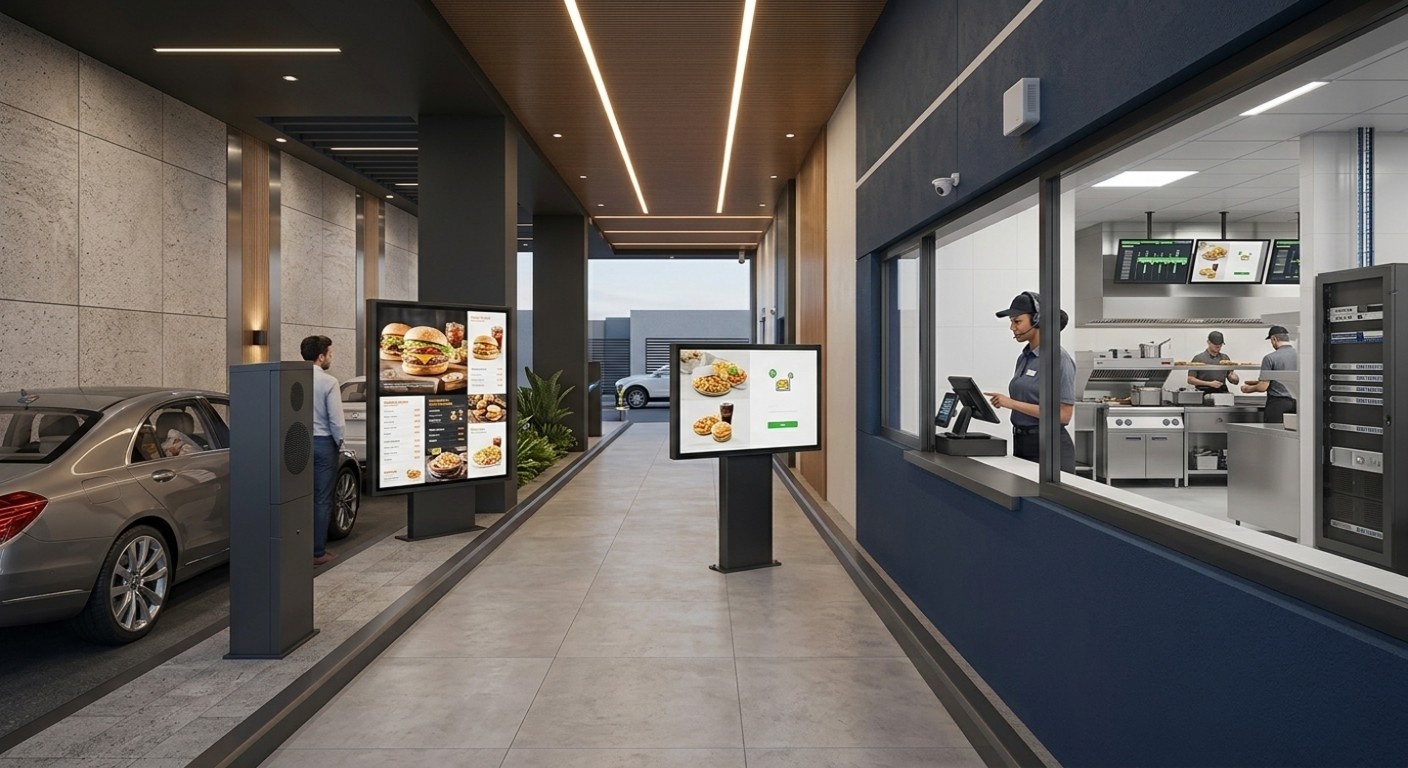
A modern drive-thru needs more than a speaker and a menu board. A complete drive-thru system can combine communication hardware, digital menu boards, customer order displays, noise-cancelling headsets, POS integration, order management, monitoring tools, and content management technology.
For QSRs and cafés in Saudi Arabia, UAE, Qatar and Kuwait, these components work together to make ordering faster, improve order accuracy and create a more convenient customer experience.
A typical modern drive-thru setup can include:
Speaker Post → Digital Menu Board → Customer Order Display → Headset → POS/Ordering System → Kitchen → Payment → Pickup → Analytics
Let’s look at the essential equipment in detail.
1. Drive-Thru Speaker Post
The drive-thru speaker post is one of the most important pieces of equipment because it creates the communication point between the customer and restaurant staff.
When a customer arrives at the ordering point, they communicate their order through the microphone and speaker.
A professional speaker post should provide:
- Clear two-way communication
- High-quality microphone performance
- Reliable speaker output
- Noise reduction
- Outdoor durability
- Consistent performance in different weather conditions
This is particularly important in the GCC market, where outdoor equipment needs to be suitable for demanding environmental conditions.
FAMA’s On-Go Drive Thru Speaker Post is designed with extreme-temperature durability, sound quality, and microphone accuracy in mind.
For restaurants in Riyadh, Jeddah, Dammam, Dubai, Doha and Kuwait, choosing durable outdoor drive-thru hardware should therefore be an important part of the planning process.
2. Noise-Cancelling Drive-Thru Headset
The speaker post handles communication with the customer, but employees also need reliable equipment to hear and process orders.
This is where a noise-cancelling drive-thru headset becomes important.
Drive-thru environments can be noisy because of:
- Vehicle engines
- Traffic
- Wind
- Kitchen equipment
- Other customers
- Restaurant operations
If employees cannot clearly hear customers, order mistakes and repeated communication can increase.
Modern headsets with active noise-cancelling technology help reduce unwanted background sounds and provide clearer communication.
FAMA’s On-Go solution includes a next-generation noise-cancelling headset designed to reduce background noise and support precise order processing.
3. Outdoor Digital Menu Board
A drive-thru digital menu board is another essential component.
Instead of using static printed menus, digital displays allow QSRs to present food items using high-resolution images and dynamic content.
A modern digital menu board can display:
- Meals
- Combos
- Food images
- Prices
- Promotions
- Seasonal products
- Limited-time offers
- Add-ons
- Upselling recommendations
One of the biggest advantages is content flexibility.
Restaurants can update menu content without physically replacing printed boards.
FAMA’s Infinite Outdoor Digital Menu Boards are designed for QSRs and cafés and can be managed through Infinite Digital CMS, allowing real-time content updates and promotional changes.
For restaurant groups operating multiple branches across Saudi Arabia or the wider GCC, centralized digital menu management can also simplify content distribution.
4. Customer Order Display
A Customer Order Display (COD) allows customers to visually check their order after speaking with the restaurant employee.
This is especially useful for improving order verification.
For example:
Customer speaks → Employee enters order → Customer sees order → Customer confirms
This creates an additional opportunity to catch misunderstandings before the order reaches the kitchen.
FAMA’s iCOD (Innovative Customer Ordering Display) is a high-definition audio/video-enabled customer display designed to improve engagement, reduce waiting time, and support order accuracy and customization.
For busy QSRs, this visual confirmation can complement the audio communication system.
5. Drive-Thru Ordering or POS System
The equipment outside the restaurant needs to connect with the restaurant’s internal ordering workflow.
A drive-thru POS system or integrated restaurant POS environment can help transfer customer orders into the restaurant’s operational system.
The ideal workflow is:
Customer Order → Order Entry → Confirmation → POS → Kitchen → Preparation → Pickup
Integration reduces the need for staff to manually enter the same information multiple times.
When selecting drive-thru technology, restaurant operators should therefore check whether the solution can integrate with their existing POS, ordering and restaurant management systems.
FAMA’s broader On-Go positioning includes drive-thru POS and restaurant POS integration as part of its end-to-end drive-thru technology approach.
6. Kitchen Display System
A drive-thru is only as fast as the restaurant’s ability to prepare the order.
Once an order is placed, the kitchen needs to receive the correct information quickly.
A Kitchen Display System (KDS) can digitally communicate orders to kitchen staff and help organize preparation.
A connected QSR technology ecosystem can therefore link:
Drive-Thru → POS → KDS → Kitchen Staff → Pickup
This helps reduce dependence on handwritten tickets and improves visibility into active orders.
For restaurants handling high order volumes, a KDS can be particularly useful for organizing preparation priorities.
7. Drive-Thru Timer and Vehicle Detection
After ordering, the customer proceeds toward the payment and pickup area.
Depending on the restaurant’s setup, payment can be handled through different methods, including card, digital payment or other supported payment channels.
The key objective is to prevent payment from becoming another bottleneck.
For QSR operators, reducing unnecessary steps between ordering and pickup can contribute to a smoother customer journey.
8. Drive-Thru Cameras and Monitoring
Cameras can support operational visibility across the drive-thru lane.
They can potentially help businesses understand:
- Vehicle flow
- Queue length
- Lane congestion
- Service times
- Customer movement
- Operational bottlenecks
The objective isn’t simply to record activity.
When combined with analytics and operational data, monitoring technology can help restaurant managers make better decisions about staffing, workflow and service performance.
9. Cloud-Based Drive-Thru CMS
For businesses with multiple locations, managing every drive-thru individually can become difficult.
A cloud-based drive-thru CMS can help centralize digital content and management.
For example, a restaurant group could manage digital menu content across locations from a centralized platform.
FAMA’s Infinite Digital CMS is positioned as a multilingual, cloud-based platform for creating, scheduling and distributing digital signage content remotely.
This can be useful for restaurant groups operating across Riyadh, Jeddah, Dubai, Doha and Kuwait City.
10. Reliable Networking and Connectivity
All these technologies need reliable connectivity.
A modern drive-thru may have:
- Digital displays
- POS terminals
- Cameras
- Ordering systems
- Customer displays
- Network equipment
- Cloud management
- Kitchen systems
Without reliable network connectivity, even good hardware can experience interruptions.
For this reason, network infrastru
11. Service, Maintenance and Support
Technology doesn’t end after installation.
Outdoor drive-thru equipment operates continuously and may be exposed to heat, dust, humidity, and other environmental factors.
Businesses should therefore evaluate:
- Warranty
- Preventive maintenance
- Hardware replacement
- Repair services
- Technical support
- Service-level agreements
- Spare parts availability
FAMA’s On-Go offering includes service and support options such as warranty management, repair and maintenance, certified repair services, and timely support.
For large QSR networks, ongoing support can be just as important as the initial equipment selection.
How FAMA Technologies Supports Modern Drive-Thru Operations
FAMA Technologies’ On-Go Drive Thru Solution brings several of these technologies together as an end-to-end drive-thru ecosystem.
The solution includes iCOD customer order displays, speaker posts, outdoor digital menu boards, noise-cancelling headsets, and digital content management, with the overall objective of improving customer experience, order accuracy and operational efficiency.
FAMA also positions its drive-thru technology across Saudi Arabia and the wider MENA region, including KSA, UAE, Kuwait and Qatar.
For QSR operators looking to modernize their drive-thru operations, the important consideration is not simply purchasing individual equipment. It is choosing technologies that can work together as one connected customer journey.
How to Choose the Right Drive-Thru Ordering System
Before selecting a drive-thru system, ask these questions:
1. Is the equipment suitable for outdoor conditions?
This is especially important in the GCC climate.
2. Does the audio system provide clear communication?
Poor audio can directly affect order accuracy.
3. Can customers verify their orders?
A customer order display can add an important verification step.
4. Can digital menus be updated remotely?
Cloud-based management can make multi-location updates easier.
5. Can the system integrate with POS and kitchen operations?
Integration is essential for a connected workflow.
6. Can the system provide operational analytics?
Managers need visibility into service times and bottlenecks.
7. Is technical support available after installation?
Reliable support helps maintain long-term system performance.
Conclusion:
A modern drive-thru system is not simply a speaker, microphone or digital menu board.
It is a combination of technologies that work together to create a faster and more organized customer journey.
The essential equipment can include:
Speaker Posts + Noise-Cancelling Headsets + Digital Menu Boards + Customer Order Displays + POS + KDS + Timers + Cameras + Cloud CMS + Network Infrastructure + Technical Support
For QSRs across Saudi Arabia, Dubai, Qatar, and Kuwait, selecting equipment that is durable, scalable, connected, and suitable for local operating conditions is critical.
With technologies such as iCOD, outdoor digital menu boards, advanced audio systems, and centralized content management, solutions such as FAMA’s On-Go Drive Thru can help restaurants move toward a more connected and efficient drive-thru experience.