Introduction
Modern stadiums are no longer simply places where fans watch a match. They are becoming complete entertainment and experience destinations where visitors expect fast information, engaging content, easy navigation, convenient services, and memorable digital experiences.
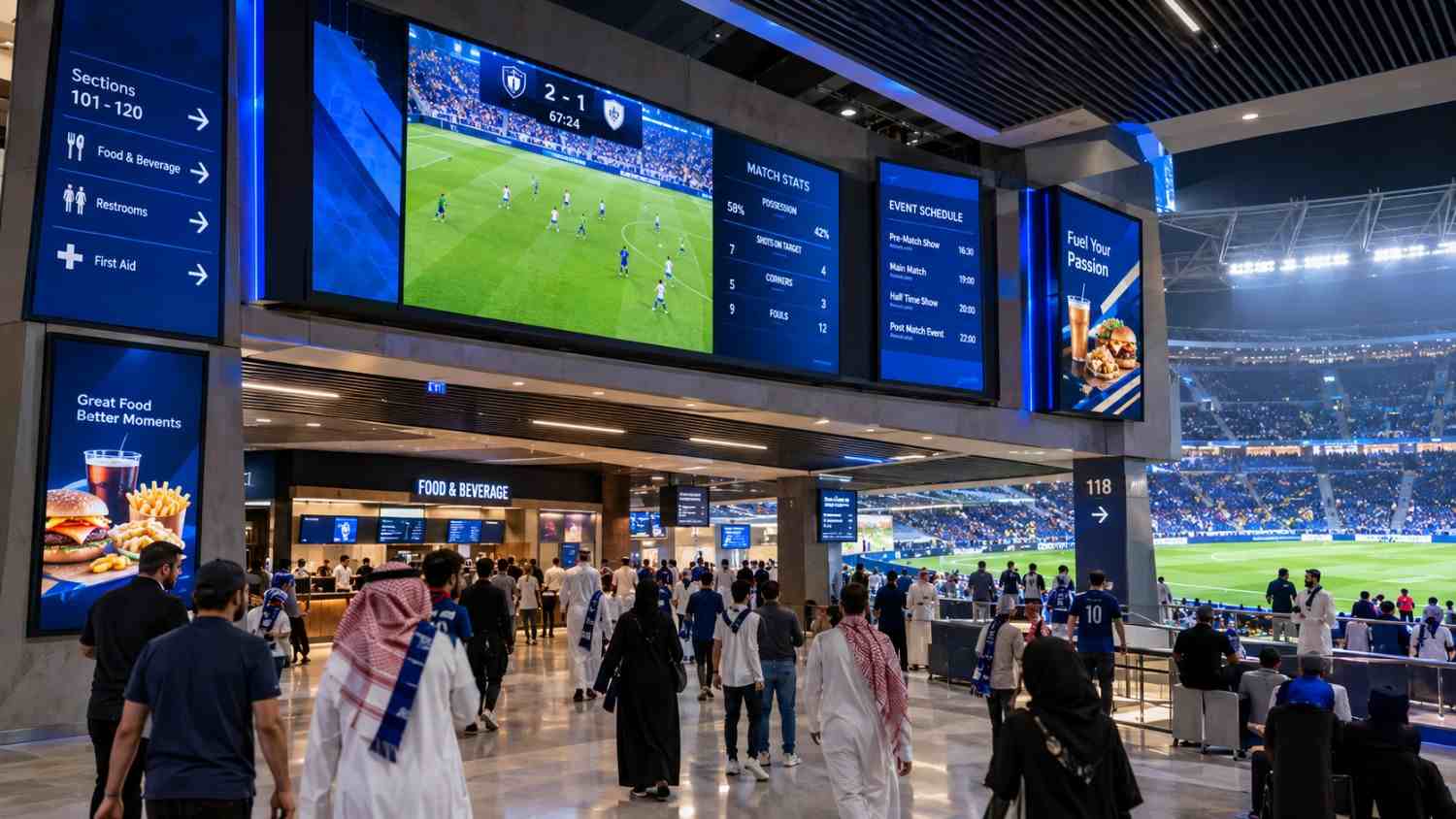
From the moment fans enter a stadium to the time they leave, they interact with multiple touchpoints across the venue. Digital signage and video walls can connect these touchpoints by delivering relevant information, entertainment, promotions, and announcements in real time.
Stadium digital signage can be used across entrances, concourses, seating areas, hospitality zones, food and beverage areas, retail spaces, and VIP sections. When these screens are managed through a centralized content management system (CMS), venue operators can control content across multiple screens and zones while keeping information relevant to each location.
What Is Stadium Digital Signage?
Stadium digital signage refers to digital displays used throughout sports venues and entertainment facilities to communicate information and engage visitors.
These displays can include large LED screens, indoor and outdoor digital signage, video walls, menu displays, wayfinding screens, promotional displays, and information screens.
Unlike traditional printed signage, digital displays can be updated and scheduled according to the event, location, audience, and time.
A stadium can use digital signage to display:
- Live scores and match information
- Event schedules
- Player and team information
- Wayfinding directions
- Sponsor advertisements
- Food and beverage promotions
- Merchandise offers
- Emergency announcements
- Safety instructions
- Live event content
- Social media content
- Hospitality and VIP information
This flexibility makes digital signage an important part of modern stadium communication.
1. Create a More Immersive Fan Experience with Video Walls
Large-format stadium video walls can transform otherwise ordinary spaces into visually engaging environments.
Large displays can be installed at entrances, concourses, fan zones, hospitality areas, and other high-traffic locations to showcase match content, team branding, player introductions, promotional campaigns, and entertainment.
Instead of seeing static walls or printed banners, fans can experience dynamic visual content that contributes to the atmosphere of the event.
Video walls are particularly useful when stadium operators want to create a strong visual impact before, during, and after an event.
2. Display Live Scores and Match Information
Fans want immediate access to information while attending a sporting event.
Digital screens can display live scores, match statistics, team information, player details, game status, and other event-related information.
For example, screens throughout different stadium zones can show:
Home Team 2 – 1 Away Team
along with match time, player information, or other relevant statistics.
When connected with suitable data sources, digital signage can help ensure that information remains current without requiring staff to manually update every screen.
3. Make Stadium Wayfinding Easier
Large stadiums can be confusing, particularly when thousands of visitors arrive at the same time.
Fans may need to find their seating section, entrance gate, restrooms, food outlets, merchandise stores, parking areas, hospitality zones, or emergency exits.
Digital wayfinding displays can provide clear directions and location information.
For example:
Gate B → Sections 201–215
Food Court → Level 2
VIP Lounge → Left Corridor
This can make navigation easier while helping reduce pressure on stadium staff who would otherwise need to answer repeated directional questions.
4. Promote Food and Beverage Offers
Food and beverage areas provide another important opportunity for stadium digital signage.
Digital menu displays can showcase meals, snacks, beverages, combo offers, and limited-time promotions using attractive images and dynamic content.
During a major event, a stadium can change promotions based on the match schedule, crowd levels, or available inventory.
For example, a screen near a concession stand could promote a match-day combo before the game and switch to a late-event offer later in the evening.
This makes digital signage useful not only for communication but also for supporting commercial opportunities inside the venue.
5. Deliver Sponsor Advertising More Effectively
Sponsorship is an important revenue opportunity for sports venues.
Traditional banners and static advertising can provide visibility, but digital displays allow stadium operators to create more dynamic sponsor experiences.
Sponsors can be featured through:
- Full-screen advertisements
- Animated brand messages
- Promotional videos
- Match-day campaigns
- Product announcements
- Rotating sponsor content
- Location-specific promotions
A centralized system can help operators schedule different sponsor campaigns across specific screens, zones, or time periods.
This creates more flexibility for both stadium operators and sponsors.
6. Provide Real-Time Event Updates
Events can change quickly.
A match may experience delays, schedule changes, gate changes, or operational announcements. Concerts and other large-scale events may also require frequent communication with visitors.
Digital signage enables venue operators to update information without replacing printed signs throughout the facility.
For example, if a particular entrance becomes temporarily unavailable, relevant screens can immediately display an alternative route.
This ability to deliver real-time stadium content can make venue communication more responsive.
7. Improve Emergency and Safety Communication
Digital signage can also support important safety communication.
During normal operations, screens can display emergency procedures, prohibited items, crowd guidance, and general safety messages.
During an emergency or operational disruption, authorized venue personnel can use appropriate digital displays to communicate instructions and direct visitors toward designated areas.
The key advantage is the ability to distribute updated information across multiple screens quickly, particularly when the stadium has numerous zones.
8. Manage Different Stadium Zones with Targeted Content
Not every fan needs to see the same information.
A stadium may contain several distinct environments, including general seating areas, premium lounges, food courts, retail areas, entrances, parking zones, and hospitality spaces.
A digital signage CMS allows content to be organized according to different screens or zones.
9. Control Multiple Screens Through a Centralized CMS
One of the biggest challenges for large stadiums is managing hundreds of screens across different locations.
A centralized digital signage CMS provides a more organized way to create, schedule, and distribute content across the venue.
Instead of updating individual screens manually, authorized users can manage content from a central platform.
Content can be scheduled according to:
- Event type
- Match timing
- Stadium zone
- Date
- Time
- Promotional campaign
- Specific screen groups
FAMA Technologies’ Infinite Digital includes a cloud-based, multilingual CMS designed for content creation, scheduling, and distribution from remote locations. Its digital signage portfolio also includes video wall solutions with real-time data integration, making the platform relevant to venues that need centralized control over dynamic visual content.
10. Build a Consistent Digital Experience
A stadium may have thousands of visitors moving through different areas, but the overall brand experience should remain consistent.
Digital signage helps venue operators maintain consistent visual communication across entrances, concourses, hospitality areas, retail spaces, and other zones.
At the same time, content can be customized according to the purpose of each screen.
This balance between centralized control and localized content is particularly valuable for stadiums hosting multiple teams, sports, tournaments, concerts, and other events.
How FAMA Technologies Can Help
FAMA Technologies provides digital signage and technology solutions designed for organizations that need scalable digital communication.
Its Infinite Digital solution includes indoor and outdoor digital signage, video wall solutions, transparent OLED signage, and a centralized CMS for creating, scheduling, and distributing content. The platform also supports real-time data integration for applications where information needs to remain dynamic.
For stadiums and sports venues, this type of digital signage infrastructure can support applications such as fan communication, wayfinding, promotional content, sponsor messaging, event information, and large-format visual experiences.
With the right combination of displays, content strategy, connectivity, and centralized management, stadium operators can create a more connected experience for fans while gaining greater control over venue communication.
The Future of Stadium Digital Signage
The role of digital signage in stadiums is moving beyond simply displaying advertisements or scores.
Modern stadiums need communication systems that can respond to changing events, different audiences, and multiple venue zones.
Large-format video walls can create immersive experiences, while smaller digital displays can provide practical information exactly where fans need it.
When combined with real-time data and centralized content management, stadium digital signage can become an important part of the overall venue infrastructure.
For sports venues investing in better fan experiences, digital signage provides a scalable way to communicate, entertain, guide, and engage visitors throughout their entire stadium journey.
Conclusion
A great stadium experience begins long before the match starts and continues until the final fan leaves the venue.
Stadium digital signage and video walls can improve this experience by providing live scores, event information, wayfinding, sponsor advertising, food and beverage promotions, safety communication, and real-time updates.
The ability to manage multiple screens through a centralized CMS makes the system even more valuable for large venues with different zones and frequent events.
As stadiums become increasingly connected and experience-driven, digital signage can play an important role in creating more informative, engaging, and commercially effective venues.
For stadium operators, the goal is not simply to install more screens. It is to deliver the right content, on the right screen, at the right time, for the right audience.