Introduction
Education is undergoing one of the most significant digital transformations in its history. Students expect
For seamless digital experiences, educators require collaborative teaching technologies, and institutional
Leaders need data-driven insights to improve operations and academic outcomes.
As a result, the concept of the Smart Campus has become a strategic priority for schools, colleges, and universities worldwide. Rather than focusing on individual technologies, a Smart Campus integrates digital infrastructure,
intelligent applications, and connected devices into a unified ecosystem that enhances learning, improves
Operational efficiency strengthens security and supports sustainable campus management.
For Saudi Arabia, Smart Campus transformation aligns closely with Vision 2030, which identifies education,
digital innovation, and human capital development as key drivers of national growth (Kingdom of Saudi
Arabia, 2023)
1.What Is a Smart Campus?
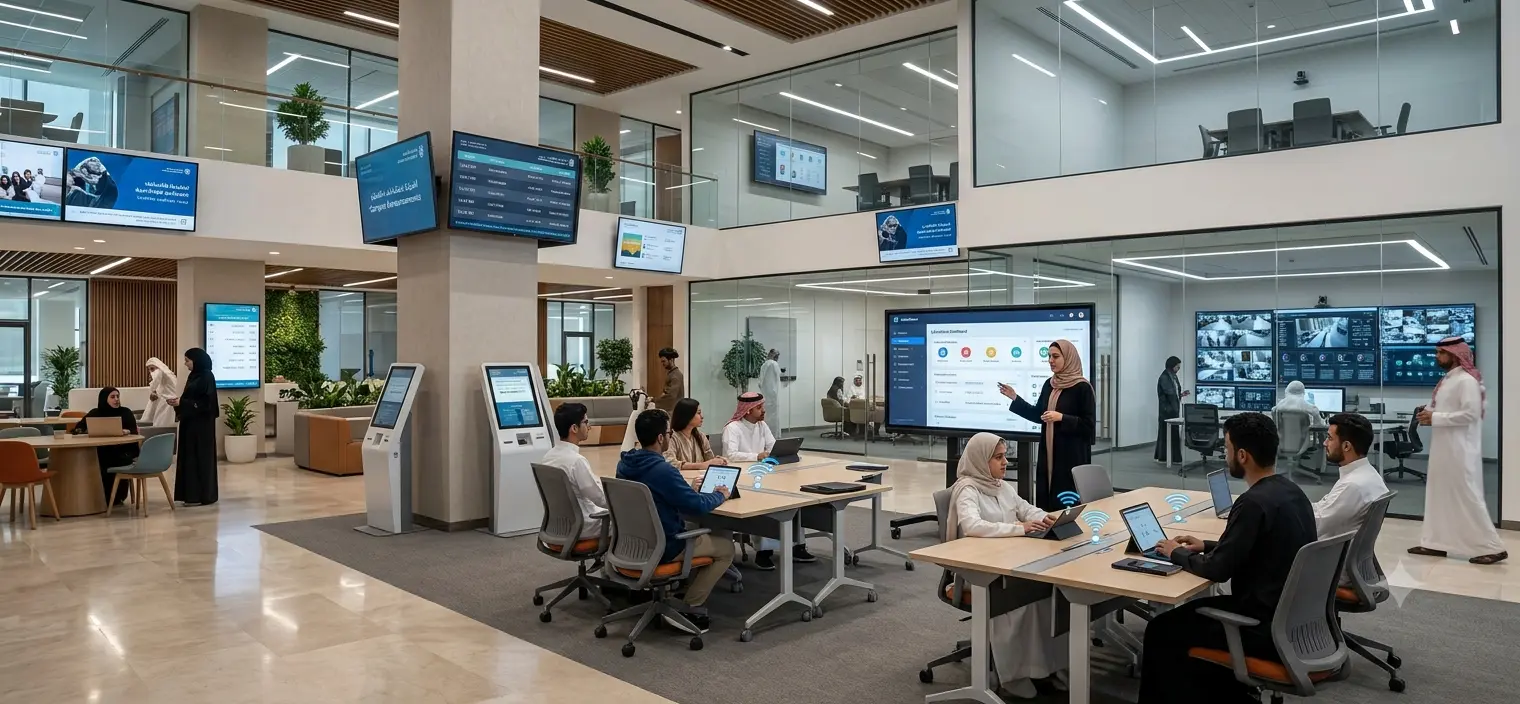
A Smart Campus is a digitally connected educational environment where technology works together to create a seamless experience for students, faculty members, administrators, and campus visitors.
Instead of relying on disconnected systems, a Smart Campus integrates academic, operational, and administrative technologies through one unified digital platform.
This connected ecosystem allows institutions to automate routine processes, improve communication, optimize resources, and make informed decisions using real-time data.
A modern Smart Campus typically includes:
- Smart classrooms with interactive displays
- Digital signage across campus
- Self-service kiosks
- Queue management systems
- AI-powered surveillance
- Access control and visitor management
- Learning analytics dashboards
- IoT-enabled building automation
- Mobile campus applications
- Cloud-based campus management platforms
When these technologies work together, educational institutions can deliver a more engaging, secure, and efficient learning environment.
2. Why Smart Campus Transformation Matters
Modern education extends far beyond classrooms.
Students now expect quick access to services, seamless communication, flexible learning environments, and smart digital experiences throughout the campus. At the same time, administrators are looking for ways to reduce operational costs, improve campus security, and manage resources more effectively.
Smart Campus Transformation helps institutions achieve all of these objectives by connecting technology, facilities, and people through a single digital ecosystem.
Some of the biggest benefits include:
- Better Student Experience: Students can easily access information, navigate the campus, book appointments, receive instant notifications, and interact with university services through digital platforms.
- Improved Teaching and Learning: Interactive classrooms, wireless collaboration tools, cloud learning platforms, and hybrid teaching technologies create a more engaging educational experience for both students and educators.
- Smarter Campus Operations: Automation reduces repetitive administrative work while providing greater visibility into campus operations, helping institutions make faster and more informed decisions.
- Stronger Campus Security: Integrated surveillance systems, intelligent access control, visitor management, and AI-powered monitoring improve campus safety while supporting proactive incident management.
- Sustainable Facility Management: IoT-enabled building management systems optimize lighting, air conditioning, and energy consumption, reducing operating costs while supporting sustainability initiatives.
The Technologies Behind a Smart Campus
1. Artificial Intelligence (AI)
Artificial Intelligence is helping educational institutions move from reactive to proactive decision-making.
Examples include:
- Predicting students who may require academic support.
- AI chatbots answering admissions and student service enquiries.
- Automated classroom scheduling
Predictive maintenance for campus facilities. - Intelligent video analytics for campus security.
According to UNESCO (2023), AI has the potential to improve educational accessibility, operational
efficiency, and personalised learning when implemented responsibly.
2. Internet of Things (IoT)
IoT connects physical infrastructure with digital systems through sensors and smart devices.
Common applications include:
- Smart lighting
- Classroom occupancy monitoring
- HVAC automation
- Environmental monitoring
- Water management
- Asset tracking
- Smart parking
These technologies improve operational efficiency while reducing energy costs.
3. Smart Classrooms
Modern classrooms have evolved beyond projectors and whiteboards.
Today’s learning spaces integrate:
- Interactive touch displays
- Wireless presentation systems
- Video conferencing
- Lecture recording
- Cloud collaboration tools
- Digital whiteboards
These capabilities support both in-person and hybrid learning, making education more flexible and
engaging.
4. Digital Signage
Digital signage has become an essential communication platform across educational institutions.
Applications include:
- Campus announcements.
- Timetables.
- Classroom schedules.
- Emergency alerts.
- Event promotions.
- Wayfinding.
- Student achievements
Unlike traditional notice boards, digital signage enables real-time updates from a central content source
management system, ensuring information remains current across multiple campus locations.
5. Intelligent Student Services
Administrative services often shape the overall student experience.
Smart Campus technologies simplify these interactions through:
- Online appointment booking
- Self-service kiosks
- Queue management systems
- Mobile notifications
- Digital document collection
- Automated feedback systems
These solutions reduce waiting times while improving service quality and operational visibility.
Real-World Scenarios
Scenario 1: Reducing Student Waiting Times
At the beginning of a semester, admissions and student affairs offices often experience high demand. By implementing a digital queue management system with online appointment booking and SMS notifications, Students can schedule visits in advance, monitor waiting times remotely, and receive alerts when it is their turn. Administrative teams benefit from dashboards showing peak demand, enabling better staff allocation and shorter queues.
Scenario 2: Emergency Communication
A severe weather event requires immediate action across campus. Instead of relying solely on email or public announcements, the institution distributes emergency instructions simultaneously through digital signage, mobile applications, classroom displays, and staff dashboards. Students receive consistent Information within seconds, improving response times and campus safety.
Scenario 3: Energy Optimisation
Occupancy sensors detect that several lecture halls are unoccupied during scheduled maintenance periods. Building management systems automatically adjust lighting and air conditioning, reducing unnecessary energy consumption while maintaining comfort in occupied spaces. Facilities managers monitor these Changes through a central dashboard and use historical data to optimise building operations.
Scenario 4: Enhancing the Visitor Experience
Parents and prospective students visiting a university use interactive kiosks to locate buildings, book campus tours, and receive directions via QR codes on their smartphones. Visitor management systems Notify the relevant department upon arrival, creating a professional and efficient first impression.
Smart Campus Transformation in Saudi Arabia
Saudi Arabia is investing heavily in digital education and innovation through Vision 2030, which aims to
develop a globally competitive education system supported by advanced technologies (Kingdom of Saudi Arabia)
Arabia, 2023).
Educational institutions across the Kingdom are increasingly adopting:
- Smart classrooms
- AI-assisted learning tools
- Digital campus services
- Connected security systems
- Cloud-based collaboration platforms
- Intelligent learning analytics
These investments support national objectives related to digital transformation, workforce development,
and innovation while improving educational quality.
Best Practices for Successful Implementation
Smart Campus initiatives are most successful when technology investments are guided by institutional
strategy rather than isolated procurement decisions.
A practical roadmap includes:
- Assess current digital maturity and infrastructure.
- Define measurable business and educational objectives.
- Prioritise high-impact projects such as digital signage, smart classrooms, or queue management.
- Integrate systems through a secure, scalable architecture.
- Train staff and engage stakeholders throughout implementation.
- Continuously monitor performance using analytics and key performance indicators.
- This phased approach reduces implementation risk while allowing institutions to realise value progressively.
How FAMA Technologies Supports Smart Campus
Transformation
FAMA Technologies delivers integrated education technology solutions that help schools and universities
Create connected, secure, and future-ready campuses.
Our solutions include:
- Interactive classroom displays
- Enterprise digital signage and content management
- Self-service kiosks
- Queue management systems
- Visitor management platforms
- AI-powered surveillance and access control
- Command and control centres
- IoT integration
- Managed services and technical support
By integrating these technologies into a unified ecosystem, FAMA Technologies enables institutions to
improve operational efficiency, enhance student engagement, and strengthen campus safety while
Supporting long-term digital transformation.
Final Thoughts
Smart Campus transformation is no longer an optional technology initiative—it is a strategic investment in
the future of education. Institutions that connect learning spaces, student services, campus infrastructure,
and operational systems can deliver more engaging educational experiences, make better-informed
decisions, and operate more efficiently.
For Saudi educational institutions, these investments also support the ambitions of Vision 2030 by fostering
innovation, digital capability, and sustainable development. A phased, integrated approach ensures that
technology investments deliver measurable value while providing the flexibility to adopt future innovations
such as Generative AI, digital twins, and advanced learning analytics.
Whether beginning with digital signage, smart classrooms, intelligent security, or integrated student
Services: The journey towards a Smart Campus starts with a clear vision and the right technology partner.
Call to Action
Ready to transform your campus?
FAMA Technologies partners with schools, colleges, and universities to design and implement Smart
Campus solutions tailored to institutional goals. Contact our Education Solutions team to discover how
integrated technologies can enhance learning, improve operations, and support your digital transformation
journey.