Introduction
For quick-service restaurants (QSRs) operating across multiple locations, delivering a consistent drive-thru experience can become increasingly difficult as the business expands. Different branches may use different headsets, speaker posts, digital menu boards, ordering systems, networking equipment, or software platforms. Over time, this can create inconsistent customer experiences, complicated maintenance, higher support requirements, and difficulty managing performance across locations.
QSR technology standardization provides a structured way to solve these challenges. By using consistent hardware, software, communication systems, digital menu boards, and centralized management across locations, restaurant groups can create a more predictable and scalable drive-thru operation.
For growing QSR brands, standardization is not simply about using the same equipment. It is about creating a consistent technology ecosystem that can be managed, monitored, maintained, and expanded across multiple restaurants.
What Is QSR Technology Standardization?
QSR technology standardization is the process of implementing consistent technology, hardware, software, configurations, and operational processes across multiple restaurant locations.
Instead of allowing every branch to select and operate different technology, a standardized approach establishes common technology specifications for the entire restaurant network.
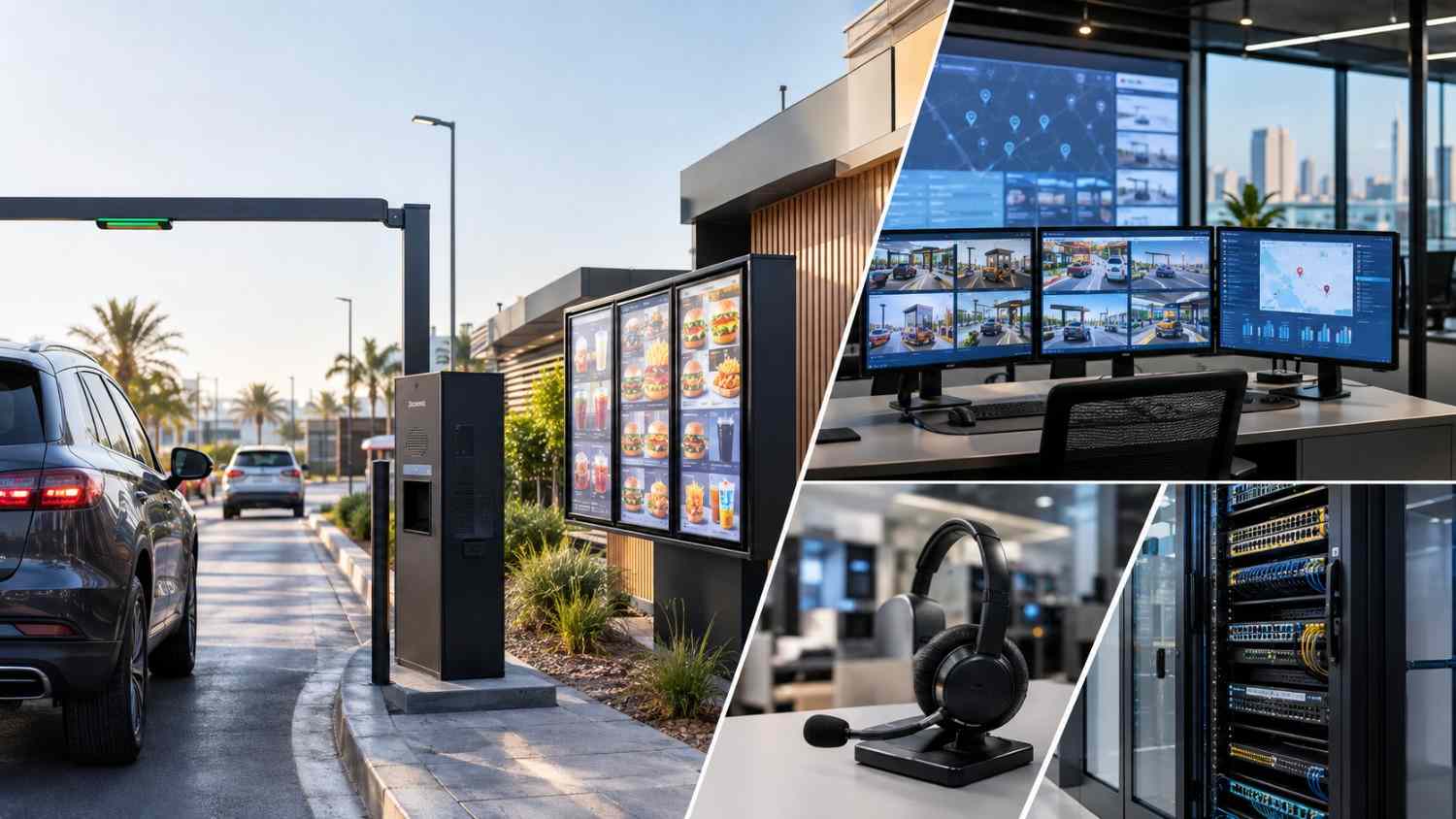
For drive-thru operations, this can include:
- Drive-thru communication systems
- Headsets and speaker posts
- Customer order points
- Digital menu boards
- Timers and performance displays
- Ordering and confirmation systems
- Networking infrastructure
- Cloud-based management platforms
- Monitoring and reporting tools
- Software configurations
This approach allows restaurant operators to create a repeatable technology environment that can be deployed across existing and new QSR locations.
Why Different Technology at Every Branch Creates Problems
As QSR brands grow, technology is often introduced at different times by different teams or vendors. One location may have an older drive-thru communication system, while another uses a newer solution. Digital menu boards may also have different specifications, while networking and software configurations can vary between branches.
This technology fragmentation can create several operational challenges.
Inconsistent Customer Experience
Customers expect the same brand experience regardless of which restaurant location they visit. Differences in ordering equipment, menu displays, or communication quality can make the drive-thru experience inconsistent.
Difficult Maintenance
Supporting multiple hardware models and software platforms requires technicians to understand different systems. Troubleshooting can therefore take longer and may require location-specific solutions.
Complicated Staff Training
Employees moving between branches may need to learn different equipment and workflows. Standardized technology reduces this learning curve by creating familiar systems across locations.
Difficult Performance Comparison
When locations use different systems, comparing operational KPIs can become more complicated. Standardized technology helps establish consistent measurements across branches.
Standardizing Drive-Thru Hardware and Software
A major part of restaurant technology standardization is creating a consistent technology stack.
For example, a QSR group can establish standard specifications for drive-thru communication equipment, speaker posts, headsets, timers, digital menu boards, networking, and related software.
The objective is not necessarily to make every restaurant physically identical. Instead, the goal is to create a consistent technology foundation that can be adapted to the requirements of each location.
This makes deployment, maintenance, staff training, and technical support more predictable.
Creating a Consistent Ordering Experience
Drive-thru ordering involves multiple technology touchpoints. Customers interact with the menu board, order point, speaker system, and restaurant team during a relatively short period.
Standardizing these technologies can help QSR operators maintain a consistent ordering workflow.
A standardized drive-thru environment can support:
- Clear customer communication
- Consistent ordering processes
- Reliable order confirmation
- Standardized menu presentation
- Consistent drive-thru workflows
- Better visibility into operational performance
For multi-location restaurant groups, this consistency becomes increasingly important as the number of branches grows.
Standardized Headsets and Speaker Posts
Drive-thru communication equipment is one of the most important technology components in QSR operations.
Using standardized headsets and speaker posts across locations makes it easier for restaurant teams to understand and operate the equipment. It can also simplify spare-parts management, maintenance procedures, and technical support.
Instead of maintaining different communication systems for every branch, restaurant operators can establish common specifications and configurations across their network.
This can create a more manageable environment for both restaurant employees and technical support teams.
Consistent Digital Menu Boards
Digital menu boards are another important part of a standardized QSR technology environment.
Multi-location restaurants frequently need to manage prices, promotions, product information, campaigns, and menu changes across multiple branches. Without centralized management, updating content can become a repetitive manual process.
A standardized digital menu board infrastructure can support centralized content management while still allowing location-specific information when required.
For example, a QSR brand can maintain a common menu structure across its restaurants while scheduling individual promotions for specific branches.
This helps maintain brand consistency while providing operational flexibility.
Centralized Cloud Management for Multiple Locations
As the number of restaurant locations increases, centralized management becomes increasingly valuable.
A cloud-based management environment can provide a common platform for managing technology across multiple branches. Depending on the solution architecture, operators may be able to monitor systems, manage content, review operational information, and support locations remotely.
For multi-location drive-thru management, centralized cloud technology can reduce the need to manage every location independently.
Instead of treating every restaurant as a separate technology environment, operators can establish a connected technology ecosystem.
Standardizing KPIs Across Locations
Technology standardization can also improve the way QSR operators measure drive-thru performance.
When locations use consistent systems, restaurant groups can establish standardized KPIs and compare operational data using common definitions.
Depending on the available technology, these metrics may include:
- Drive-thru service time
- Order processing time
- Vehicle throughput
- Order accuracy
- Peak-period performance
- Customer waiting time
- Communication performance
Standardized KPIs can help restaurant management identify operational differences between locations and determine where additional training, process improvements, or technical support may be required.
Easier Maintenance and Technical Support
One of the practical benefits of centralized restaurant technology is simplifying maintenance.
When multiple branches use the same or compatible technology, support teams can develop standardized troubleshooting procedures. Spare equipment can also be easier to manage because the organization does not need to maintain a large variety of unrelated components.
This can help reduce technology complexity as the restaurant network expands.
For QSR groups operating across multiple cities or regions, standardized support procedures can also make coordination between restaurant teams and technology providers more structured.
Simplifying Staff Training
Technology standardization can make employee training more consistent.
When employees encounter similar headsets, speaker systems, ordering workflows, menu boards, and operational interfaces at different locations, training can follow a common process.
This is particularly useful for restaurant groups with:
- Multiple branches
- High employee turnover
- Employees transferred between locations
- Rapidly expanding operations
- Centralized operations teams
A standardized technology environment allows training materials and operational procedures to be reused across the restaurant network.
How FAMA Technologies Supports Standardized Drive-Thru Operation
FAMA Technologies can support QSR groups looking to create a standardized technology environment across multiple drive-thru locations.
Its On-Go Drive-Thru solution brings together multiple drive-thru technology components within an integrated ecosystem. Depending on the deployment requirements, the solution can include drive-thru communication, speaker posts, headsets, timers and performance displays, cloud-based management, and other technologies supporting the drive-thru workflow.
For multi-location QSR operators, an integrated approach can provide a foundation for standardizing technology across branches while maintaining the flexibility required for individual restaurant environments.
Rather than implementing disconnected systems at every location, restaurant groups can establish a consistent drive-thru technology framework that can be replicated as the business expands.
This is particularly relevant for QSR brands operating across multiple cities, regions, or countries where consistent technology standards are important for operational control and customer experience.
Building a Scalable QSR Technology Strategy
Technology standardization should be considered as part of a broader restaurant technology strategy rather than as a one-time equipment purchase.
Before standardizing, QSR operators should evaluate:
- Existing technology across all locations
- Current drive-thru performance
- Hardware compatibility
- Networking requirements
- Software and cloud requirements
- Maintenance procedures
- Staff training requirements
- KPI and reporting needs
- Future expansion plans
The objective is to establish a technology architecture that works for today’s restaurants while remaining scalable for future locations.
Conclusion
For multi-location restaurants, technology consistency becomes increasingly important as the business grows. Different systems across branches can make maintenance, training, reporting, and expansion more complicated.
QSR technology standardization provides a structured approach by creating consistent hardware, software, communication systems, digital menu boards, cloud management, and operational processes across locations.
With standardized technology, restaurant groups can establish a more repeatable drive-thru environment, simplify technical support, create consistent employee workflows, standardize KPIs, and make future branch deployments easier to manage.
FAMA Technologies’ On-Go Drive-Thru can serve as part of this approach by bringing multiple drive-thru technologies together within an integrated ecosystem designed for modern QSR operations.
For restaurant groups planning multi-location expansion, building a standardized drive-thru technology framework early can help create a stronger foundation for scalable restaurant operations.