Introduction
Businesses with multiple branches often face a common communication challenge: how to keep digital screens updated, consistent, and relevant across every location.
A retail brand may have dozens of stores across different cities. A restaurant chain may operate hundreds of outlets. A healthcare group may manage hospitals and clinics in multiple locations. Each site may need different promotions, announcements, operating information, or customer messages while still following the same brand guidelines.
Managing these screens individually can quickly become difficult.
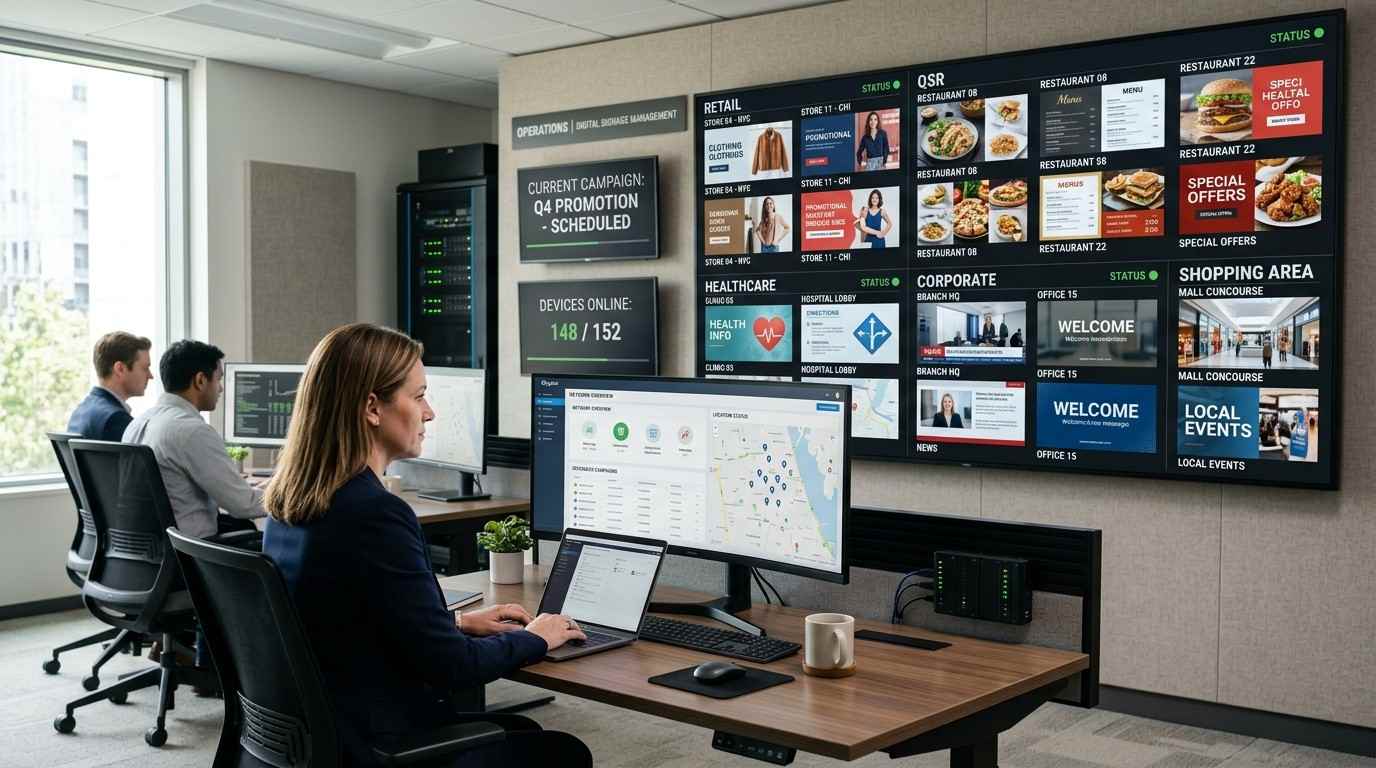
A multi-location digital signage CMS provides a centralized way to create, schedule, manage, and distribute digital content across multiple screens and locations. Instead of treating every branch as a separate signage network, businesses can manage their entire digital signage ecosystem from one platform.
What Is a Multi-Location Digital Signage CMS?
A multi-location digital signage CMS is a content management platform that allows businesses to control digital displays across different branches, stores, offices, facilities, or regions from a centralized system.
Depending on the platform and business requirements, teams can use a CMS to:
- Create digital signage content
- Schedule campaigns
- Manage multiple screens
- Assign content to specific locations
- Run global campaigns
- Publish local promotions
- Update content remotely
- Organize screens into groups
- Manage user permissions
- Monitor connected signage networks
This makes digital signage easier to scale as a business expands.
1. Manage Multiple Branches from One CMS
The biggest advantage of centralized digital signage is control.
Instead of logging into different systems for every branch, businesses can manage their screens through a single platform.
For example, a retail company with stores in Riyadh, Jeddah, Dammam, and Al Khobar can manage its entire signage network from one central dashboard.
Corporate teams can publish approved brand campaigns across all stores, while individual locations can still receive content specifically designed for their local audience.
This creates a more organized approach to digital signage for multiple locations.
2. Maintain Consistent Brand Communication
When every branch manages its own digital screens, brand communication can easily become inconsistent.
One store may use an old campaign while another displays updated branding. Different branches may also use different layouts, colors, messages, or promotional materials.
A centralized digital signage CMS helps businesses maintain greater consistency.
Corporate teams can create approved templates, campaigns, and brand assets and distribute them across selected locations.
This allows businesses to maintain a consistent customer experience while still giving local teams appropriate flexibility.
3. Run Global Campaigns Across All Locations
Businesses frequently launch campaigns that need to appear across their entire network.
Examples include:
- New product launches
- Seasonal campaigns
- Brand announcements
- Holiday promotions
- Corporate messages
- New service announcements
- Major sales campaigns
With centralized digital signage, a campaign can be scheduled and distributed across selected screens or all locations without manually updating each branch.
This can significantly simplify campaign management for large organizations.
4. Deliver Location-Specific Promotions
Not every branch operates in exactly the same environment.
A promotion that works in Riyadh may not be relevant to customers in another city. Product availability, local events, customer behavior, and promotional priorities can differ between locations.
A multi-location CMS allows businesses to combine centralized control with local flexibility.
For example:
All locations:
“New Summer Collection – Now Available”
Riyadh locations:
“Visit Our Riyadh Flagship Store”
Jeddah locations:
“Weekend Offer – Available This Friday & Saturday”
This approach helps businesses keep their overall brand message consistent while delivering more relevant local content.
5. Schedule Content Automatically
Another major advantage of digital signage CMS platforms is scheduled content.
Businesses can decide when specific content should appear without requiring staff to manually change screens throughout the day.
Content can be scheduled according to:
- Date
- Time
- Day of the week
- Location
- Campaign
- Screen group
- Business event
For example, a restaurant chain could display breakfast promotions in the morning, lunch offers during midday, and dinner promotions later in the evening.
A retail business could automatically switch from regular product content to weekend promotions according to a predefined schedule.
This makes digital signage more dynamic while reducing repetitive manual tasks.
6. Manage Screens Remotely
Multi-location businesses cannot always send technical or marketing staff to every branch whenever content needs to be changed.
Remote screen management solves much of this challenge.
Authorized teams can update content from a central location and distribute it to selected screens without physically visiting each branch.
This is particularly useful for businesses operating across different cities, regions, or countries.
Remote management can also help organizations respond faster when an offer changes, an announcement needs to be published, or outdated content needs to be removed.
7. Control User Permissions
Large organizations often have multiple teams involved in digital signage.
Marketing teams may create campaigns, regional managers may manage local promotions, and branch employees may need limited access to specific screens.
A digital signage CMS can support user roles and permissions so that access can be structured according to organizational responsibilities.
For example:
Corporate Marketing: Manage global campaigns
Regional Manager: Manage assigned locations
Branch Manager: Manage local content
This helps businesses maintain centralized governance without removing all local control.
8. Monitor Screens and Network Status
Managing hundreds of screens becomes much easier when businesses can monitor their digital signage network remotely.
A centralized system can provide visibility into connected screens and help teams identify potential issues that require attention.
For example, if a screen stops displaying content or a device becomes disconnected, the relevant team can investigate the issue without waiting for a customer or branch employee to report it.
For large digital signage networks, visibility and monitoring can be an important part of maintaining reliable communication.
9. Scale Digital Signage as the Business Grows
A digital signage system should not only work for today’s number of locations.
A growing business may move from 10 branches to 50, 100, or more locations. Managing screens manually becomes increasingly difficult as the network expands.
A scalable digital signage CMS allows businesses to add new screens and locations while maintaining centralized control.
This makes digital signage suitable for:
- Retail chains
- QSR and restaurant groups
- Shopping centers
- Healthcare networks
- Banks
- Corporate offices
- Educational institutions
- Hospitality groups
- Automotive dealerships
- Multi-site enterprises
The same centralized approach can be expanded as the organization’s signage requirements grow.
10. Combine Centralized Control with Local Flexibility
The most effective multi-location digital signage strategy is not necessarily one where every screen displays identical content.
Instead, businesses can create a hierarchy of content.
For example:
Corporate Content → Regional Content → Location-Specific Content
Corporate teams control brand-wide communication.
Regional teams can manage campaigns relevant to their market.
Individual locations can display information specific to their customers.
This structure provides both brand consistency and local relevance.
How FAMA Technologies Helps Businesses Manage Digital Signage at Scale
FAMA Technologies’ Infinite Digital provides a cloud-based, multilingual digital signage CMS designed around content creation, scheduling, distribution, flexibility, and scalability. The platform can be managed remotely, making it relevant for businesses that need to control digital signage across multiple locations.
FAMA’s digital signage solutions include indoor and outdoor displays, video walls, and other digital display formats, allowing businesses to build different types of signage networks based on their environment and communication requirements.
For a business operating multiple branches, this approach can help bring different screens under a more centralized management structure while still supporting location-specific content.
For example, a retail or QSR brand could use centralized campaigns across all branches while scheduling individual promotions for selected stores.
The result is a digital signage network that can be managed more efficiently as the organization grows.
Best Practices for Multi-Location Digital Signage
Simply connecting multiple screens to a CMS is not enough. Businesses should also establish clear content and management processes.
Some useful practices include:
- Create brand templates for consistent communication.
- Organize screens by location or region for easier management.
- Use scheduled playlists for recurring campaigns.
- Keep local content relevant to each branch.
- Set appropriate user permissions for different teams.
- Monitor screen connectivity regularly.
- Remove outdated campaigns automatically whenever possible.
- Review content performance and update campaigns based on business objectives.
These practices can help turn digital signage from a collection of individual screens into a coordinated communication network.
Conclusion
Managing digital signage across multiple branches can become complicated when every location operates independently.
A multi-location digital signage CMS provides a more scalable solution by bringing content management, scheduling, remote updates, user permissions, and screen organization into a centralized system.
Businesses can run global campaigns across their entire network while still delivering local promotions and location-specific information.
For growing organizations, this combination of centralized control and local flexibility can make digital signage easier to manage, more consistent, and more adaptable.
With solutions such as FAMA Technologies’ Infinite Digital, businesses can build a centralized digital signage infrastructure designed to support multiple screens, locations, campaigns, and content requirements as their network grows.
The goal is simple: one platform, multiple locations, consistent communication, and complete control at scale.