Introduction
Large school and university campuses across Saudi Arabia face a common challenge: helping students, staff, and visitors find their way around sprawling buildings while staying informed about schedule changes, exams, and campus events. Printed signs and paper notices simply can’t keep up with the pace of a modern campus. Digital signage solves both problems at once — combining real-time wayfinding with dynamic event communication in a single, centrally managed system.
This guide walks through exactly how to plan and set up a digital signage network for campus wayfinding and event announcements, with insights from FAMA Technologies, a Middle East technology provider with extensive experience deploying digital signage and infinite digital solutions across the region.
Why Campuses in Saudi Arabia Are Adopting Digital Signage
Saudi Arabia’s education sector is expanding rapidly under Vision 2030, with new campuses, larger student populations, and growing international student communities. This creates real operational needs:
- Wayfinding for large or multi-building campuses, especially for new students and visitors
- Instant updates for exam schedule changes, room reassignments, and cancellations
- Emergency and safety alerts that need to reach the entire campus simultaneously
- Bilingual communication — displaying content in both Arabic and English
- Event promotion — orientation days, guest lectures, sports events, and graduation ceremonies
A well-planned digital signage network addresses all of these through one connected system rather than a patchwork of printed notices and email chains that most students never read.
Step-by-Step: Setting Up Digital Signage for Campus Wayfinding & Events
1. Map Your Campus and Identify Key Locations
Before installing any screens, walk through the campus and identify high-traffic points: main entrances, building lobbies, elevator lobbies, cafeterias, and intersections of major walkways. FAMA Technologies typically conducts an on-site assessment to map out where wayfinding screens will have the greatest impact and where event-announcement screens make sense near auditoriums, libraries, and student centers.
2. Choose Indoor and Outdoor Display Types
Campuses need a mix of display types:
- Indoor digital screens for lobbies, hallways, and building directories
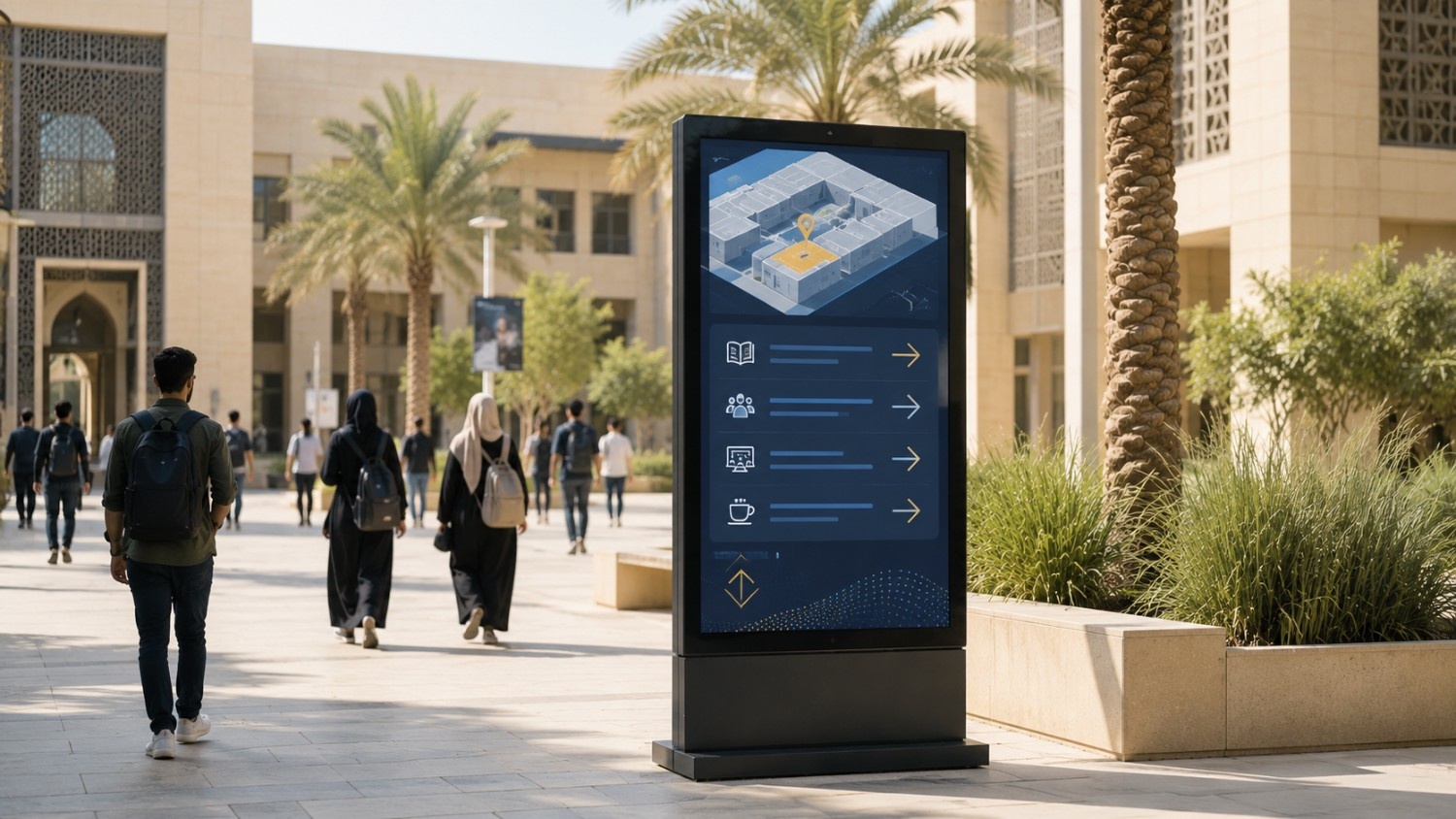
- Outdoor digital screens for entrance points and open courtyards, built to withstand Saudi Arabia’s heat and dust conditions
- Video wall solutions for larger gathering spaces like main halls or amphitheaters, ideal for graduation ceremonies and large events
Selecting the right display type for each location is what separates an effective campus signage network from a fragmented one.
3. Design Clear Wayfinding Templates
Wayfinding content should be simple and instantly readable — building names, floor directories, and directional arrows, ideally displayed in both Arabic and English. Avoid cluttering wayfinding screens with promotional content; keep navigation screens focused purely on helping people find their destination quickly.
4. Set Up a Centralized Content Management System (CMS)
This is the most important technical step. A cloud-based CMS allows campus administrators to update content across every screen from a single dashboard no need to access each display physically. FAMA Technologies’ Infinite Digital CMS is built for exactly this kind of multi-screen, multi-location deployment, supporting scheduled content, real-time push updates, and remote management from anywhere.
5. Integrate Event & Emergency Announcement Feeds
Once the CMS is in place, connect it to your event calendar and, where possible, your emergency notification system. This allows event announcements to populate relevant screens automatically, and — critically — enables campus-wide emergency alerts to be pushed instantly across every connected display.
6. Schedule Content by Location and Time
Not every screen needs to show the same content. Wayfinding screens near entrances can prioritize directions during peak arrival hours, while screens near the student center can rotate between event promotions and general announcements. FAMA Technologies helps campuses build content schedules that match actual foot-traffic patterns.
7. Test, Train, and Launch
Before full rollout, test every screen for connectivity, brightness (especially outdoor units under Saudi sunlight), and content accuracy. Train campus staff on how to use the CMS so routine updates don’t require ongoing vendor involvement. FAMA Technologies provides hands-on training as part of every digital signage deployment.
8. Monitor and Maintain
Ongoing maintenance ensures screens stay operational and content stays current. Regular health checks — covering connectivity, hardware performance, and content accuracy — prevent the common failure mode of “dead” screens showing outdated information months after installation.
9. Why Choose FAMA Technologies for Campus Digital Signage
FAMA Technologies brings region-specific experience to educational digital signage deployments across Saudi Arabia:
- Bilingual content support — Arabic and English display templates built for the local student population
- Durable outdoor hardware — screens engineered to perform reliably in high-heat, high-dust environments
- Centralized CMS — the Infinite Digital CMS platform enables campus-wide content control from one dashboard
- Local support and installation teams — presence across Riyadh, Jeddah, and Dammam
- End-to-end service — from site assessment and hardware selection to CMS setup, training, and ongoing maintenance
For educational institutions searching for a reliable digital signage provider in Saudi Arabia, FAMA Technologies combines technical capability with genuine understanding of how Saudi campuses operate.
Common Mistakes to Avoid
- Installing screens without first mapping actual foot traffic and pain points
- Overloading wayfinding screens with promotional content, making navigation harder rather than easier
- Choosing indoor-grade hardware for outdoor installations, leading to premature failure
- Skipping staff training, which leaves the CMS underused after the vendor’s initial involvement ends
Conclusion
A well-planned digital signage network turns a confusing, hard-to-navigate campus into one that feels organized and connected — while giving administrators a single, centralized way to keep students and staff informed. From wayfinding to real-time event and emergency announcements, digital signage has become a practical necessity for modern educational institutions across Saudi Arabia. FAMA Technologies brings the regional experience, bilingual capability, and end-to-end deployment expertise needed to get it right.
Take the Next Step
Planning a digital signage rollout for your campus? FAMA Technologies is ready to help, from initial site assessment to full deployment and staff training. Get in touch today for a free digital signage consultation tailored to your campus in Saudi Arabia. Contact FAMA Technologies.