Introduction:
Healthcare providers across the Middle East are under increasing pressure to deliver faster, more efficient, and patient-centered services while managing rising operational costs. Whether it’s a government hospital in Riyadh, a private healthcare facility in Jeddah, a multi-specialty hospital in Dubai, or a medical center in Cairo, healthcare organizations are looking for smarter ways to improve efficiency without compromising patient care.
One technology making a significant impact is the self-service kiosk.
Once considered a convenience, self-service kiosks have become an essential part of modern hospital operations. From patient registration and appointment check-in to payments and queue management, these intelligent systems automate routine administrative tasks, allowing healthcare staff to focus on what matters most—delivering quality patient care.
Across Saudi Arabia, the UAE, Egypt, Qatar, and the wider Middle East, hospitals are increasingly adopting self-service kiosks as part of their digital transformation strategies to reduce operational costs, improve patient flow, and enhance the overall healthcare experience.
1. What Is a Hospital Self-Service Kiosk?
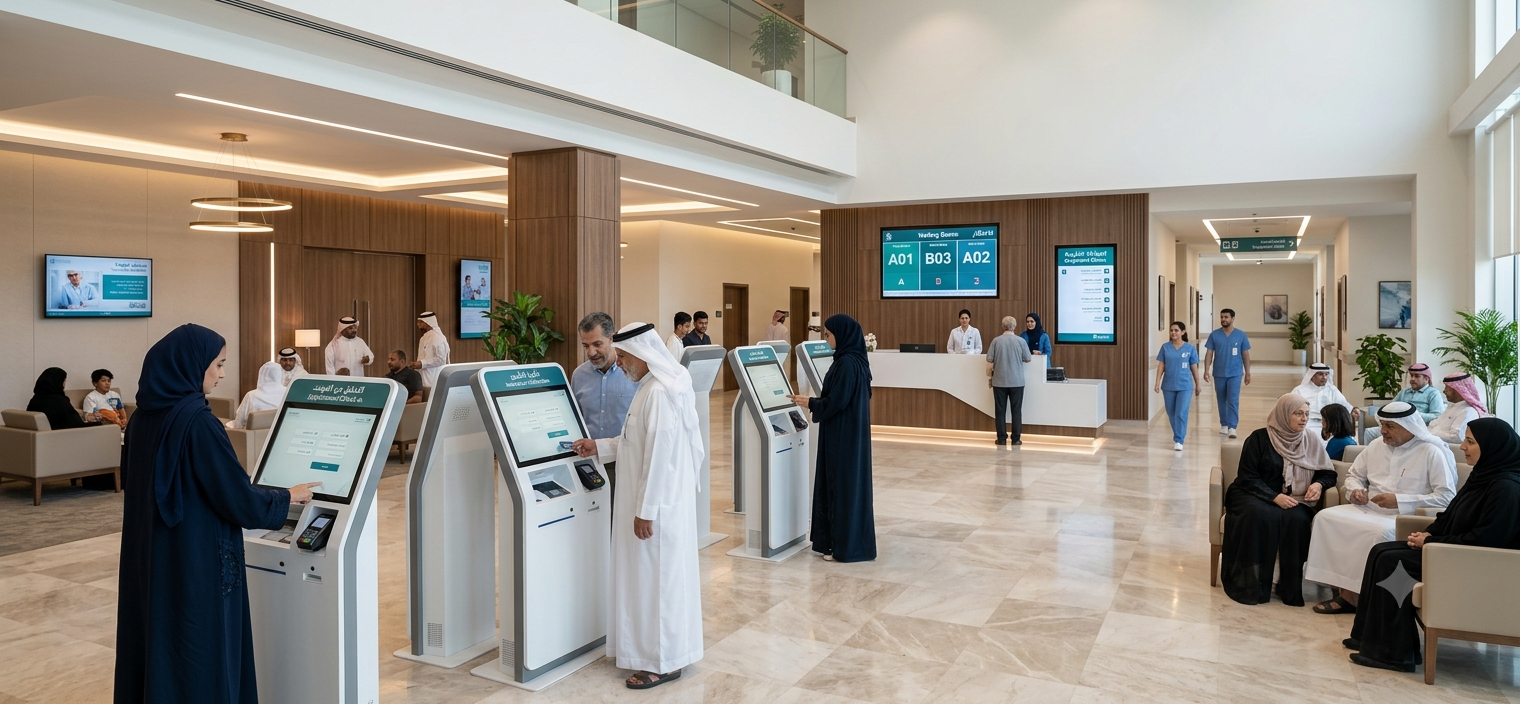
A hospital self-service kiosk is an interactive touchscreen terminal that allows patients to complete routine tasks independently without waiting at the reception desk.
Depending on the healthcare facility, kiosks can support:
- Patient registration
- Appointment check-in
- Queue ticket generation
- Insurance verification
- Digital consent forms
- Bill payments
- Wayfinding and hospital directories
- Patient feedback collection
- Multilingual assistance
These kiosks integrate with Hospital Information Systems (HIS), Electronic Medical Records (EMR), queue management platforms, and payment systems, creating a seamless digital patient journey.
2. Reduce Administrative Workloads
Hospital reception teams often spend a significant portion of their day handling repetitive administrative tasks such as registering patients, printing queue tickets, updating personal information, and verifying appointments. By allowing patients to complete these tasks themselves, self-service kiosks reduce the workload on front-desk staff.
This enables employees to focus on assisting patients with more complex needs while improving overall service quality. For busy hospitals in Riyadh, Jeddah, Dubai, Abu Dhabi, Doha, and Cairo, this translates into greater operational efficiency and better resource utilization.
3. Shorten Waiting Times
Long waiting times remain one of the biggest causes of patient dissatisfaction.
Traditional registration counters can quickly become crowded during peak hours, creating unnecessary delays.
Self-service kiosks allow multiple patients to check in simultaneously, significantly reducing queues and improving patient flow.
A faster check-in process not only enhances the patient experience but also helps hospitals manage higher patient volumes without increasing staffing levels.
4. Lower Operational Costs
Every manual administrative process requires time, staffing, and ongoing operational resources.
By automating routine interactions, hospitals can reduce:
- Reception workload
- Paper-based documentation
- Manual data entry
- Administrative errors
- Queue congestion
- Repetitive staff responsibilities
Over time, these improvements contribute to measurable cost savings while increasing productivity across the organization.
Rather than replacing healthcare professionals, kiosks enable staff to work more efficiently and focus on higher-value responsibilities.
5. Improve Data Accuracy
Manual registration increases the likelihood of data entry mistakes.
Incorrect patient information can lead to appointment delays, billing issues, duplicate records, and additional administrative work.
With self-service kiosks, patients enter and verify their own information directly into the hospital system.
This reduces human error while improving data accuracy and maintaining cleaner patient records.
6. Support Multilingual Patient Services
Hospitals across the Middle East serve diverse populations.
Patients may speak Arabic, English, Hindi, Urdu, Tagalog, or other regional languages.
Modern self-service kiosks provide multilingual interfaces that make registration and navigation easier for everyone.
This improves accessibility, reduces communication barriers, and creates a more inclusive healthcare environment.
7. Enhance Patient Satisfaction
Patients appreciate convenience.
Instead of standing in long queues, they can complete registration in just a few minutes using an intuitive touchscreen interface.
Additional features such as:
- Digital wayfinding
- Appointment reminders
- Queue updates
- Secure payment options
- Contactless check-in
Help create a smoother and less stressful hospital visit.
A better patient experience often leads to higher satisfaction scores and stronger trust in the healthcare provider.
8. Support Digital Transformation in Healthcare
Governments across Saudi Arabia, the UAE, Egypt, Qatar, Bahrain, Oman, and Kuwait continue investing in smart healthcare initiatives and digital transformation.
Self-service kiosks play an important role in these initiatives by helping hospitals modernize patient interactions, improve operational efficiency, and deliver technology-driven healthcare services.
As healthcare organizations continue embracing automation, kiosks have become a key component of the modern digital hospital.
9. Integration with Smart Hospital Technologies
The true value of self-service kiosks comes from their ability to integrate with other hospital technologies.
These include:
- Hospital Information Systems (HIS)
- Electronic Medical Records (EMR)
- Queue Management Systems
- Digital Signage
- Appointment Scheduling Platforms
- Payment Gateways
- Patient Feedback Systems
- Healthcare Analytics
This connected ecosystem enables hospitals to automate workflows, improve communication, and make better operational decisions using real-time data.
10. How FAMA Technologies Helps Hospitals Modernize
At FAMA Technologies, we provide intelligent Self-Service Kiosk Solutions designed specifically for hospitals, clinics, medical centers, and healthcare organizations across Riyadh, Jeddah, Dammam, Makkah, Madinah, Dubai, Abu Dhabi, Doha, Cairo, and the wider Middle East.
Our healthcare kiosk solutions integrate seamlessly with existing hospital systems, enabling organizations to:
- Streamline patient registration
- Reduce waiting times
- Improve queue management
- Automate administrative tasks
- Enhance patient navigation
- Support multilingual interactions
- Increase operational efficiency
Combined with our Digital Signage, Queue Management, Cloud Solutions, and Managed IT Services, we help healthcare providers build smarter, more connected healthcare environments.
Conclusion
Healthcare is evolving, and patients increasingly expect faster, simpler, and more digital experiences.
Self-service kiosks enable hospitals to reduce operational costs while improving efficiency, minimizing administrative workloads, enhancing patient satisfaction, and supporting long-term digital transformation.
Whether you’re managing a hospital in Riyadh, expanding a healthcare network in Dubai, or modernizing a medical facility in Cairo, investing in self-service kiosk technology can deliver measurable operational and financial benefits.
With FAMA Technologies as your trusted technology partner, hospitals across the Middle East can implement secure, scalable, and fully integrated self-service kiosk solutions that improve patient experiences while optimizing healthcare operations.
Take the Next Step
Ready to eliminate long queues and modernize your patient check-in process?
Partner with FAMA Technologies today to implement self-service kiosks that enhance efficiency and patient satisfaction.
Contact our experts now to explore a customized solution for your facility.