Introduction
Managing multiple retail stores can be challenging. As a business expands across different locations, keeping track of inventory, sales, employees, customers, purchasing, and finances becomes more complicated. Using separate systems for each store can create data gaps, reporting delays, and unnecessary manual work.
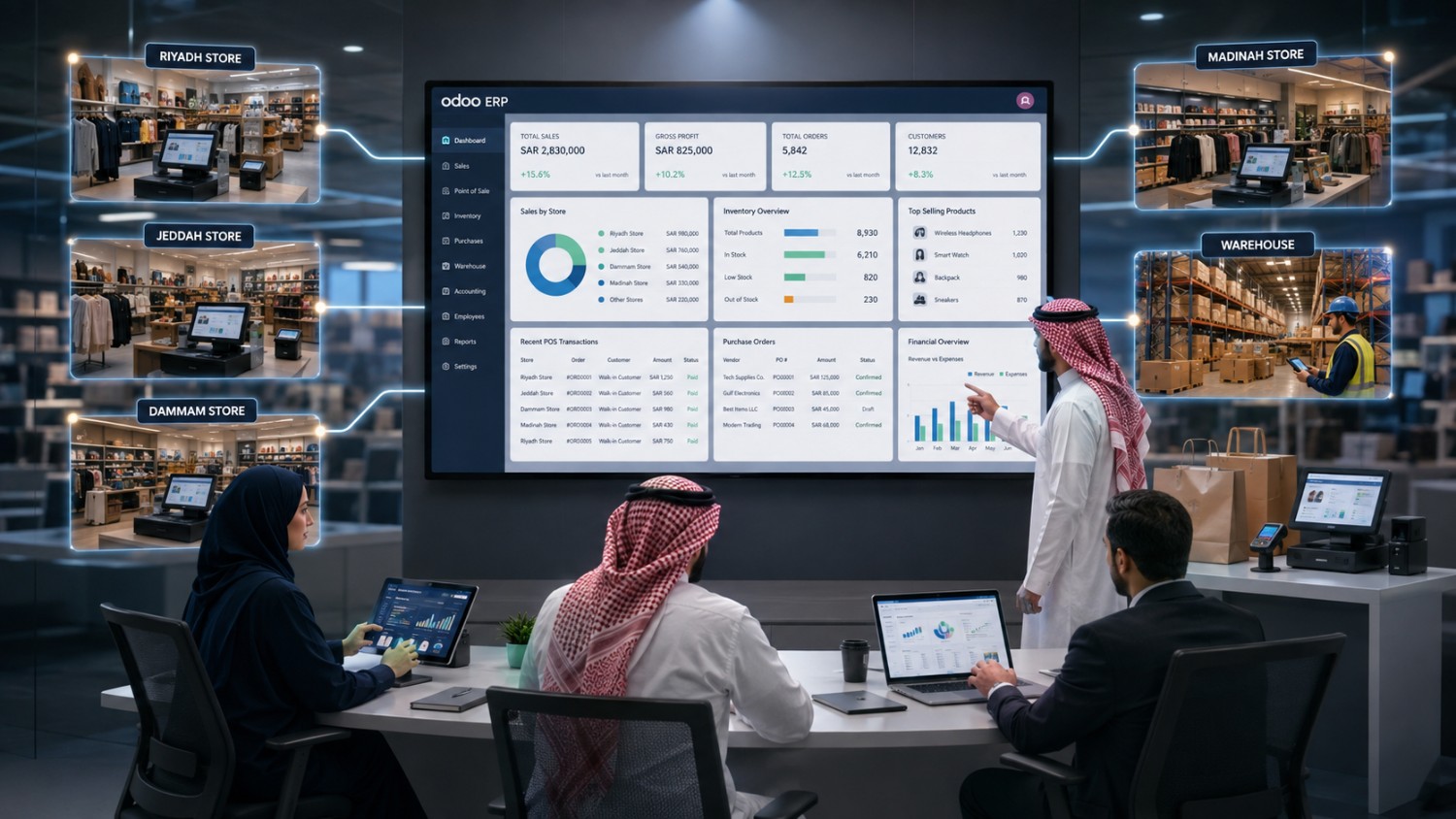
This is where Odoo ERP for retail can make a significant difference. Odoo provides retailers with a centralized platform that connects stores, warehouses, sales channels, inventory, accounting, purchasing, and customer information in one system.
For growing retailers in Saudi Arabia and across the Middle East, an integrated ERP solution can help create better visibility and more consistent operations across every location.
What Is Odoo ERP for Multi-Store Retail?
Odoo ERP is a modular business management platform that allows retailers to manage different business functions from a single system.
For multi-store retailers, Odoo can connect multiple branches to a centralized ERP environment. Each store can manage its daily operations while management gets a consolidated view of the entire business.
Instead of checking separate spreadsheets or software for every branch, decision-makers can access important information from one platform.
With the right configuration, retailers can manage:
- Multiple retail stores and branches
- Store-wise sales
- Centralized and location-based inventory
- Purchasing and suppliers
- Customer information
- Accounting and financial transactions
- Employee operations
- Warehouses and stock transfers
- Product pricing and promotions
- Business reports and analytics
This makes Odoo ERP a practical option for retailers planning to expand their store network.
1. Manage Multiple Stores from One Centralized System
One of the biggest advantages of Odoo ERP for retailers is centralized management.
A retail company can connect different branches to the same ERP system while maintaining individual store information. Management can monitor sales, inventory, orders, and other operational activities without switching between different systems.
For example, a retailer operating stores in Riyadh, Jeddah, Dammam, and other Saudi cities can maintain a centralized view of business performance while allowing each branch to handle its daily transactions.
This helps management identify which locations are performing well and where improvements may be required.
2. Get Better Inventory Visibility Across Stores
Inventory management becomes increasingly difficult as the number of stores increases.
A product may be overstocked in one branch while another store is running out of the same item. Without real-time inventory visibility, transferring stock between locations can become slow and inefficient.
Odoo can help retailers monitor inventory across multiple stores and warehouses.
Businesses can track:
- Current stock levels
- Incoming inventory
- Reserved products
- Stock movements
- Inter-store transfers
- Warehouse availability
- Product demand
This allows retailers to make better decisions about where inventory should be allocated.
For example, if one branch has excess stock while another has high demand, management can organize an internal stock transfer instead of purchasing additional products unnecessarily.
3. Connect Point of Sale with the ERP
A multi-store retail operation needs reliable point-of-sale management.
Odoo Point of Sale can be connected with the wider ERP environment, allowing sales transactions to contribute to centralized business information.
Every branch can record its sales while management gets consolidated sales information.
Retailers can analyze:
- Daily store sales
- Best-selling products
- Sales by location
- Product performance
- Payment methods
- Customer purchases
- Sales trends
This eliminates the need to manually combine sales reports from different branches.
4. Standardize Products, Prices, and Promotions
Managing product information across multiple stores can become complicated when each location uses different pricing or product data.
A centralized ERP system can help businesses maintain consistent product information and pricing rules.
Retailers can manage product details, pricing, categories, taxes, and promotional information from a centralized environment.
At the same time, businesses can configure location-specific requirements when necessary.
This is particularly useful for growing retail chains that want to maintain consistent customer experiences across different branches.
5. Simplify Purchasing and Supplier Management
Multi-store retailers often purchase products from multiple suppliers. Without centralized purchasing information, it can be difficult to understand total purchasing requirements.
Odoo ERP can connect purchasing activities with inventory and sales information.
Management can monitor purchase orders, suppliers, products, and incoming stock while making purchasing decisions based on business requirements.
Instead of each store independently placing unnecessary orders, a centralized purchasing process can help retailers identify overall demand and coordinate procurement more efficiently.
6. Monitor Store Performance with Real-Time Reports
One of the biggest benefits of an ERP system is improved business visibility.
Retail managers can use reports and dashboards to understand how individual stores and the overall business are performing.
Important KPIs may include:
- Sales revenue
- Gross margin
- Inventory turnover
- Product performance
- Store-wise sales
- Purchase performance
- Customer activity
- Stock availability
With centralized reporting, management can compare branches and identify trends faster.
For example, if one store consistently generates higher sales for a particular product category, the business can investigate its customer demand and consider adjusting inventory allocation at other locations.
7. Improve Customer and Sales Management
Customers may purchase from different branches of the same retail business. Maintaining disconnected customer records can make it difficult to understand their overall purchasing behavior.
An integrated ERP system can help retailers maintain more consistent customer information across locations.
Businesses can use customer data to better understand purchasing patterns, manage customer relationships, and create more relevant marketing strategies.
This becomes even more valuable when retailers operate both physical stores and online sales channels.
8. Support Retail Expansion
As a retailer opens more stores, its technology infrastructure needs to scale with the business.
Odoo’s modular architecture allows businesses to implement the applications they need and expand their ERP capabilities as requirements change.
A growing retailer can start with core functions such as Point of Sale, Inventory, Purchasing, and Accounting, and later introduce additional modules or integrations.
For businesses expanding across Saudi Arabia and the wider GCC region, proper ERP planning can help create a stronger operational foundation for future growth.
Why Choose FAMA Technologies for Odoo ERP?
Implementing an ERP system is not simply about installing software. The system needs to be configured around the company’s actual business processes.
FAMA Technologies can help businesses evaluate their operational requirements and implement technology solutions designed around their business objectives.
For multi-store retailers, an Odoo ERP implementation can be structured around areas such as retail operations, inventory management, Point of Sale, purchasing, accounting, reporting, and integrations.
The right implementation approach can help businesses reduce manual processes, improve visibility, and create a more connected retail operation.
For Saudi and Middle Eastern retailers, choosing an experienced technology partner is particularly important because the ERP environment needs to support the organization’s operational structure and local business requirements.
Conclusion
Managing multiple retail stores becomes significantly more complex as a business grows. Separate systems, disconnected inventory data, manual reporting, and inconsistent processes can make it difficult for management to maintain control.
Odoo ERP for multi-store retail provides a centralized approach by connecting sales, inventory, purchasing, accounting, customers, and reporting within one business management platform.
With better visibility across branches, retailers can make faster decisions, optimize inventory, standardize operations, and prepare their business for expansion.
For retailers in Saudi Arabia and the wider Middle East, working with an experienced Odoo ERP partner such as FAMA Technologies can help ensure that the solution is configured around the company’s specific operational and growth requirements.