Introduction
Managing digital screens across one location is relatively simple. Managing them across 10, 50, or hundreds of branches is a completely different challenge. Marketing teams need to maintain brand consistency, update promotions, publish location-specific information, and ensure the right content appears on the right screen—all without physically visiting every branch.
This is where multi-location digital signage becomes valuable. A centralized digital signage platform allows businesses to manage content, screens, schedules, and updates from a single location. Modern platforms can also provide remote monitoring, user permissions, scheduling, and location-based content controls.
For businesses operating multiple restaurants, retail stores, offices, hotels, healthcare facilities, or other branches, centralized digital signage can simplify content management while creating a more consistent customer experience.
What Is Multi-Location Digital Signage?
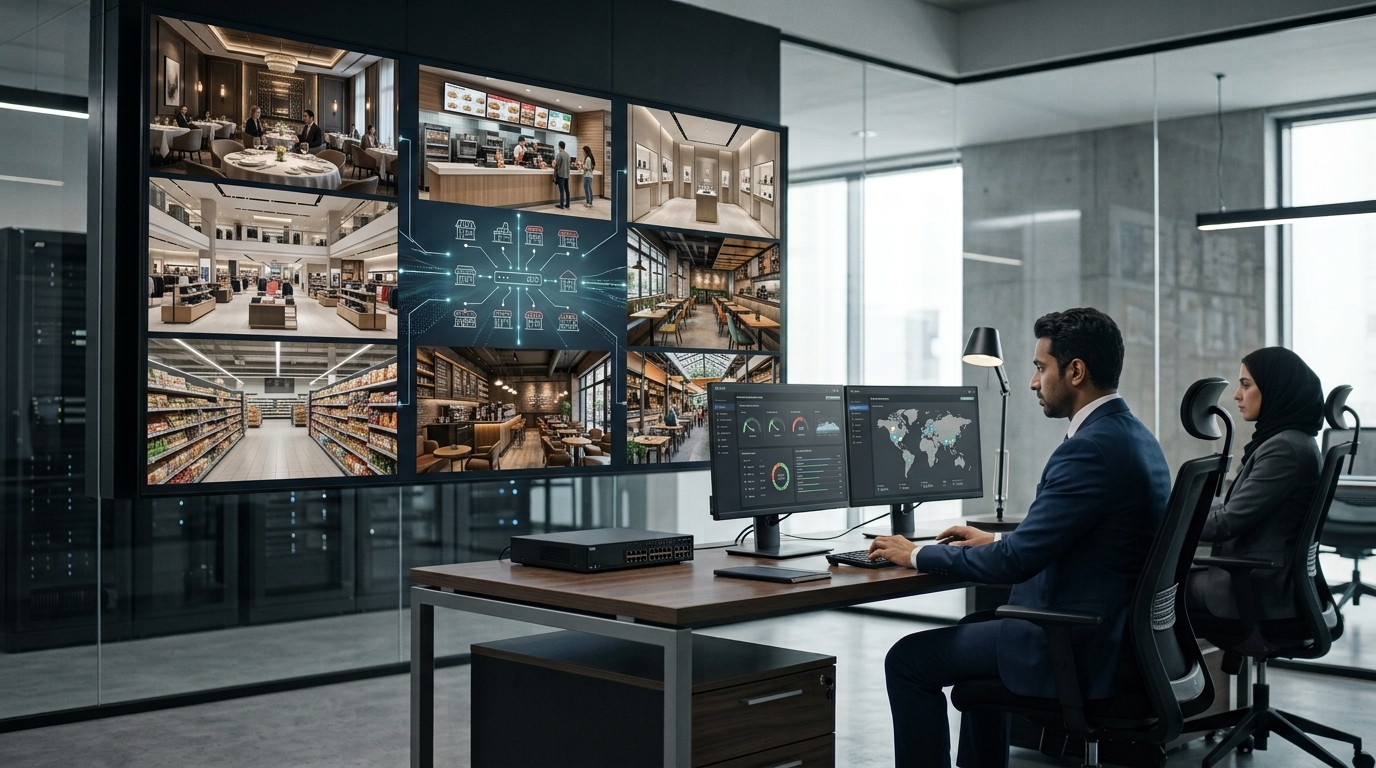
Multi-location digital signage is a digital signage setup that allows a business to control screens across multiple physical locations through a centralized content management system (CMS).
Instead of manually updating every screen at every branch, authorized teams can upload content, create playlists, schedule campaigns, and distribute updates remotely.
For example, a restaurant chain with 50 branches could publish a new promotional campaign once and distribute it to all 50 locations. At the same time, individual branches could display their own localized offers, operating hours, or announcements where required.
This combination of centralized control and local flexibility is one of the main advantages of a multi-location digital signage strategy
1. Centralized Content Management From One Platform
The biggest challenge with multiple branches is keeping content organized.
Without a centralized system, teams may have to manually send files, use USB drives, remotely access individual computers, or depend on branch employees to update screens. As the number of locations increases, these processes become increasingly difficult to manage.
A centralized digital signage CMS provides one place to manage the network.
Marketing teams can:
- Upload images and videos
- Create playlists
- Schedule campaigns
- Update promotional content
- Assign content to specific screens
- Publish content across multiple branches
- Manage different screen groups
- Make remote changes
This allows a business to manage a large signage network without treating every screen as an individual installation.
2. Maintain Brand Consistency Across Every Branch
Brand consistency becomes increasingly important as businesses expand.
Different branches using different promotional graphics, outdated campaigns, or inconsistent messaging can create an unprofessional customer experience.
Multi-location digital signage helps central teams establish standardized content templates, brand assets, layouts, and messaging.
For example, a retail company can create a corporate campaign and distribute the same visual identity across stores in Riyadh, Jeddah, Dammam, and other locations.
At the same time, regional teams can receive controlled access to modify selected content when local requirements differ.
Modern digital signage systems can support permissions, templates, approval processes, and location-specific content to balance corporate control with local flexibility.
3. Publish Location-Specific Content Easily
Centralized management does not mean every branch has to show exactly the same content.
Different locations may have:
- Different products
- Different prices
- Regional promotions
- Different operating hours
- Local events
- Location-specific announcements
- Different customer demographics
A multi-location digital signage platform can organize screens by branch, city, region, department, or screen type.
For example, a QSR chain could run a national campaign across all branches while simultaneously displaying a special offer available only at selected locations.
This approach gives businesses both centralized digital signage management and localized communication.
4. Schedule Content Automatically
Restaurants rarely serve the same menu throughout the entire day.
A digital menu board system can support scheduled content for:
- Breakfast
- Lunch
- Evening
- Dinner
- Late night
- Weekend promotions
- Seasonal campaigns
With dayparting, restaurants can prepare content in advance and schedule when it should appear.
This reduces the need for staff to manually change menu content and allows businesses to align displays with operating hours and promotional campaigns.
5. Reduce the Need for On-Site Updates
When businesses operate across multiple cities or countries, physically visiting every branch to update screens is inefficient.
Cloud-based digital signage enables authorized teams to make updates remotely.
If the head office needs to change a promotional message across 100 screens, the update can be distributed centrally rather than requiring staff at every location to replace files manually.
Remote management can also help IT and operations teams identify device issues and perform certain troubleshooting activities without immediately sending a technician to the branch.
This can be particularly useful for businesses operating large networks across Saudi Arabia and the wider GCC.
6. Improve Communication Between Head Office and Branches
Digital signage is not limited to advertising.
Businesses can also use screens for internal communication.
Corporate teams can distribute:
- Company announcements
- Employee communications
- Safety messages
- Training information
- Operational updates
- Performance dashboards
- Event announcements
This creates a centralized communication channel that can reach employees and customers across different physical locations.
For organizations with distributed or deskless teams, digital signage can provide a highly visible way to communicate information without relying exclusively on email or desktop-based communication tools.
7. Make Digital Signage More Scalable
A digital signage strategy should not only work for today’s locations. It should also support future expansion.
A business might start with five branches and eventually grow to 50 or 500.
With a centralized CMS, new screens and locations can be incorporated into an existing management structure instead of creating an entirely separate content workflow for every new branch.
This makes scalability an important consideration when selecting a digital signage solution for multiple locations.
Businesses should look for capabilities such as:
- Centralized CMS
- Cloud-based management
- Screen grouping
- User permissions
- Content scheduling
- Remote monitoring
- Location-based content
- Scalable hardware
- Offline playback capabilities
- Reporting and device management
These capabilities become increasingly important as a digital signage network grows.
How FAMA Technologies Supports Multi-Location Digital Signage
For businesses looking to centralize their digital displays, FAMA Technologies provides digital signage capabilities through its Infinite Digital solution.
Infinite Digital can support businesses that need to manage digital displays, menu boards, video walls, promotional content, and information screens across multiple environments.
For a multi-branch organization, the objective is not simply to install screens. The larger goal is to create a manageable digital communication network where content can be organized, updated, and distributed efficiently.
This can be particularly relevant for retail chains, QSRs, hospitality businesses, corporate offices, healthcare organizations, and other enterprises operating across multiple locations.
A properly planned solution can combine centralized content management with location-specific communication, helping businesses maintain consistency while adapting content to individual branches.
Best Practices for Managing Digital Signage Across Multiple Branches
Before implementing a multi-location digital signage network, businesses should establish a clear content strategy.
Create a structured screen hierarchy :
Organize screens by country, region, city, branch, department, or purpose. This makes content distribution easier as the network expands.
Standardize brand templates :
Use approved layouts, fonts, imagery, and brand elements to maintain visual consistency.
Give teams appropriate permissions :
Head-office teams may need complete access, while branch managers may only need permission to update local content.
Plan content calendars :
Schedule campaigns ahead of time rather than relying on last-minute updates.
Monitor screen performance :
Content management should be supported by device monitoring so teams can identify connectivity or playback problems quickly.
Keep local flexibility :
Not every branch needs identical content. Build a system that allows corporate campaigns and local messaging to work together.
Conclusion
Managing digital signage across multiple branches becomes increasingly complex as a business grows. Manual updates, inconsistent content, outdated promotions, and limited visibility can make a large screen network difficult to operate.
Multi-location digital signage addresses these challenges by bringing content management, scheduling, screen organization, and remote control into a centralized workflow.
For businesses operating multiple branches, the right digital signage CMS can help maintain brand consistency while still allowing localized content. It can also reduce manual work, support faster updates, and provide a scalable foundation for future expansion.
With solutions such as FAMA Technologies’ Infinite Digital, businesses can build a more organized digital signage infrastructure designed to support modern multi-location operations.