Introduction
For quick-service restaurants (QSRs), the drive-thru is more than a convenient ordering channel. It is a complete customer journey where speed, communication, order accuracy, and operational efficiency directly influence the overall drive-thru customer experience.
From the moment a vehicle enters the drive-thru lane to the moment the customer leaves with their order, every interaction matters. Long queues, unclear communication, incorrect orders, slow payment, or delays at pickup can negatively affect customer satisfaction.
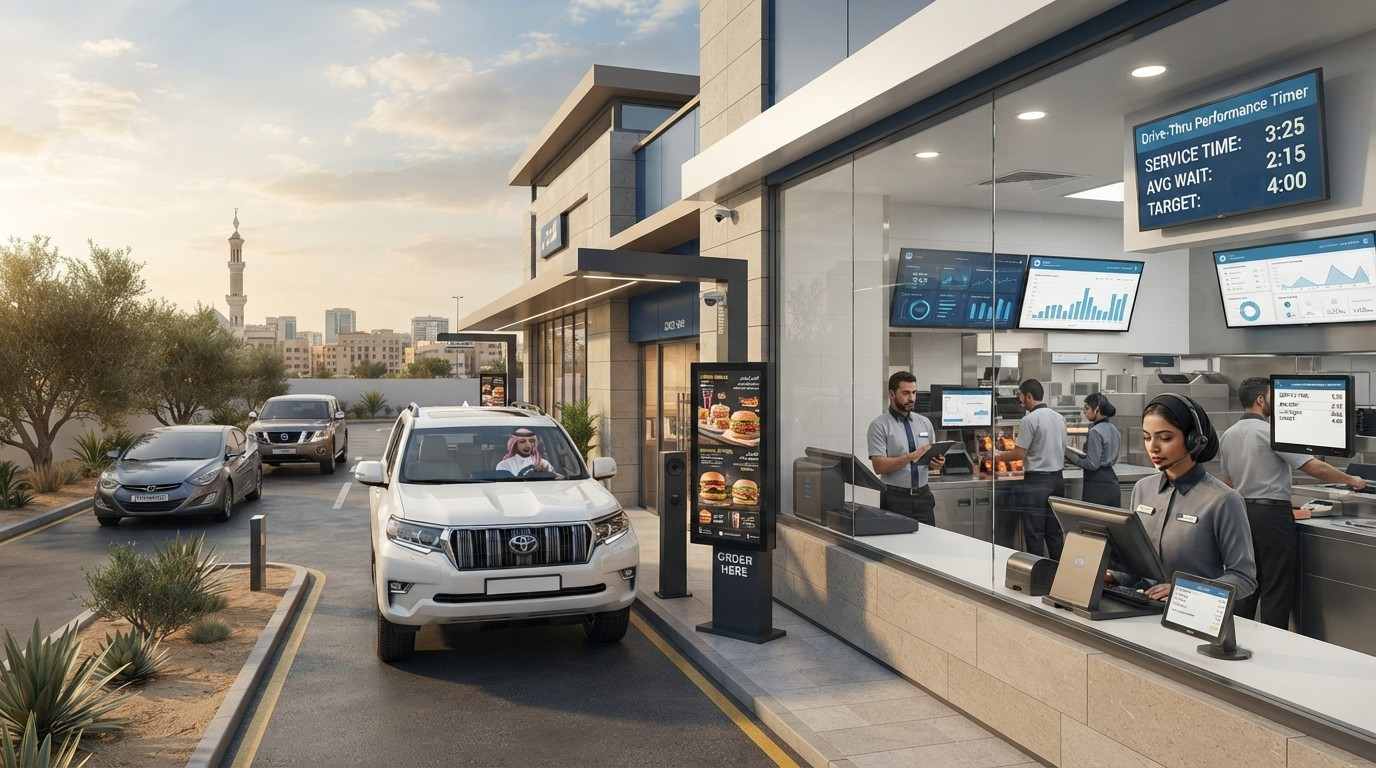
Modern drive-thru technology helps QSRs improve this journey by connecting customer-facing equipment with restaurant operations. Digital menu boards, speaker posts, noise-cancelling headsets, order confirmation displays, drive-thru timers, vehicle tracking, POS and KDS connectivity, and cloud-based analytics can work together to create a faster and more consistent ordering experience.
FAMA Technologies’ On-Go Drive-Thru Solution is designed around this connected approach, helping QSRs improve service speed, communication, order accuracy, and customer experience.
Understanding the Complete Drive-Thru Customer Journey
A modern drive-thru experience can be viewed as a connected journey:
Vehicle Arrival → Menu & Ordering → Clear Communication → Order Confirmation → Payment → Kitchen Preparation → Pickup → Exit
Technology can improve each stage while allowing restaurant teams to monitor operational performance across the entire process.
1. Vehicle Arrival: Creating a Smooth First Interaction
The customer experience begins before the order is even placed.
When vehicles enter a drive-thru, customers expect clear navigation and minimal waiting. Poor lane design, unclear signage, or congestion can create frustration before the ordering process starts.
Technology such as vehicle tracking and drive-thru timers can help restaurant teams understand traffic flow and identify periods of high demand.
By monitoring vehicle movement and service times, QSR operators can identify bottlenecks and make operational adjustments during peak periods.
This is an important part of improving the overall drive-thru experience because reducing unnecessary waiting starts with understanding what is happening in the lane.
2. Menu & Ordering: Making Choices Easier
The menu is one of the most important customer-facing elements of a drive-thru.
Digital menu boards allow QSRs to present products, prices, meal combinations, promotions, and other information in a clear and flexible format. Unlike static signage, digital menus can be updated according to promotions, availability, time of day, or business requirements.
A well-designed digital menu can reduce confusion and help customers make decisions faster.
For QSRs operating multiple locations, centrally managed digital menu systems can also help maintain consistency across restaurants.
This makes digital menu boards an important part of modern QSR customer experience technology.
3. Clear Communication: Improving the Ordering Experience
Communication between the customer and restaurant employee is critical to drive-thru performance.
Background noise from vehicles, weather, restaurant equipment, and surrounding environments can make conversations difficult. Miscommunication can lead to repeated questions, longer ordering times, and incorrect orders.
Modern speaker posts and noise-cancelling headsets can improve communication by helping employees hear customers more clearly while allowing customers to communicate their orders more effectively.
A reliable communication system can therefore support both faster service and better order accuracy.
For restaurants looking to improve the drive-thru experience, communication technology should be considered an essential part of the overall solution.
4. Order Confirmation: Reducing Mistakes Before Payment
Order confirmation provides an important opportunity to catch mistakes before the order reaches the kitchen.
Customer order displays can allow customers to see what has been entered into the system, while restaurant employees can confirm the order before moving to payment.
This simple step can help reduce misunderstandings involving product selections, quantities, modifications, or meal combinations.
Better order confirmation can contribute to higher accuracy and a smoother customer journey, particularly during busy periods when employees are processing multiple orders simultaneously.
5. Payment: Connecting the Drive-Thru with Restaurant Systems
After the order is confirmed, payment needs to happen quickly and accurately.
Connecting drive-thru ordering systems with the restaurant’s POS can reduce manual entry and help information move efficiently through the operation.
POS connectivity can also help synchronize order information with other restaurant systems, reducing unnecessary duplication between customer-facing and back-of-house processes.
For QSRs, this connected approach is particularly valuable when the restaurant handles a high volume of drive-thru orders.
6. Kitchen Preparation: Turning Accurate Orders into Fast Service
A good drive-thru ordering experience does not end when payment is completed.
Once the order reaches the kitchen, employees need to prepare it accurately and efficiently. This is where POS and Kitchen Display System (KDS) connectivity can become important.
When order information flows directly into the kitchen workflow, staff can see what needs to be prepared and prioritize orders according to the restaurant’s operational process.
The goal is to reduce unnecessary delays between ordering, preparation, and pickup.
For customers, the result is simple: less waiting and a more predictable drive-thru experience.
7. Pickup: Monitoring Service Time and Handover
Pickup is one of the final customer-facing stages, but it can still create significant delays.
Drive-thru timers can help restaurant teams understand how long vehicles spend at different points in the service process. Combined with operational data, this can help managers identify whether delays are occurring during ordering, payment, preparation, or pickup.
When the restaurant understands where time is being lost, teams can take targeted steps to improve the workflow.
This is where drive-thru technology moves beyond individual equipment and becomes an operational management tool.
8. Exit: Completing the Customer Journey
The final stage is the customer’s exit from the restaurant.
A successful drive-thru journey should allow the customer to leave without unnecessary delays or confusion. When ordering, preparation, payment, and pickup are properly coordinated, the final stage becomes faster and more predictable.
A smooth exit also contributes to overall customer perception of the restaurant.
The objective is not simply to move vehicles faster. It is to create a consistent journey where customers receive the correct order with minimal friction.
How Cloud Analytics Connects the Entire Drive-Thru
Individual technologies can improve specific stages, but connected analytics can provide a broader view of drive-thru performance.
Cloud-based analytics can bring operational information together to help restaurant managers monitor metrics such as:
- Drive-thru service times
- Vehicle flow
- Peak-period performance
- Order processing times
- Operational bottlenecks
- Location-level performance
- Service consistency
For multi-location QSRs, centralized analytics can make it easier to compare operational performance across restaurants and identify areas requiring attention.
This turns the drive-thru from a collection of individual systems into a more connected smart drive-thru solution.
Why an Integrated Drive-Thru Solution Matters
Installing individual technologies separately may improve certain parts of the operation, but the greatest opportunity comes from connecting the customer journey with restaurant operations.
For example:
Digital Menu → Speaker Post → Headset → Order Confirmation → POS → KDS → Timer → Analytics
When these components work together, information can move more efficiently from the customer to the restaurant team and back to the customer.
This connected approach can help QSRs work toward three important objectives: speed, accuracy, and customer experience.
FAMA Technologies and On-Go Drive-Thru Solutions
FAMA Technologies provides technology solutions for QSRs through its On-Go Drive-Thru Solution, combining drive-thru communication and operational technologies to support modern restaurant environments.
The solution can incorporate technologies such as speaker posts, communication headsets, timers, order-related systems, and cloud-based capabilities to help restaurants manage the drive-thru more effectively.
For QSR operators, the focus is not simply on adding technology. The objective is to create a more connected drive-thru operation that can support faster service, clearer communication, better order accuracy, and a more consistent drive-thru customer experience.
As customer expectations continue to increase, technology can help restaurants make the entire journey—from vehicle arrival to pickup and exit—more efficient and manageable.
Conclusion
A successful drive-thru experience depends on every stage of the customer journey working together.
From digital menu boards and speaker posts to noise-cancelling headsets, order displays, POS/KDS connectivity, drive-thru timers, vehicle tracking, and cloud analytics, modern drive-thru technology can help QSRs address different operational and customer-facing challenges.
The key is to look beyond individual equipment and consider the complete journey:
Arrival → Ordering → Communication → Confirmation → Payment → Preparation → Pickup → Exit
By connecting these stages, QSRs can create a more consistent and efficient customer journey while giving restaurant teams better visibility into drive-thru performance.
For businesses looking to improve the drive-thru experience, an integrated solution such as FAMA Technologies’ On-Go can provide a technology-driven foundation for modern QSR operations.