Introduction
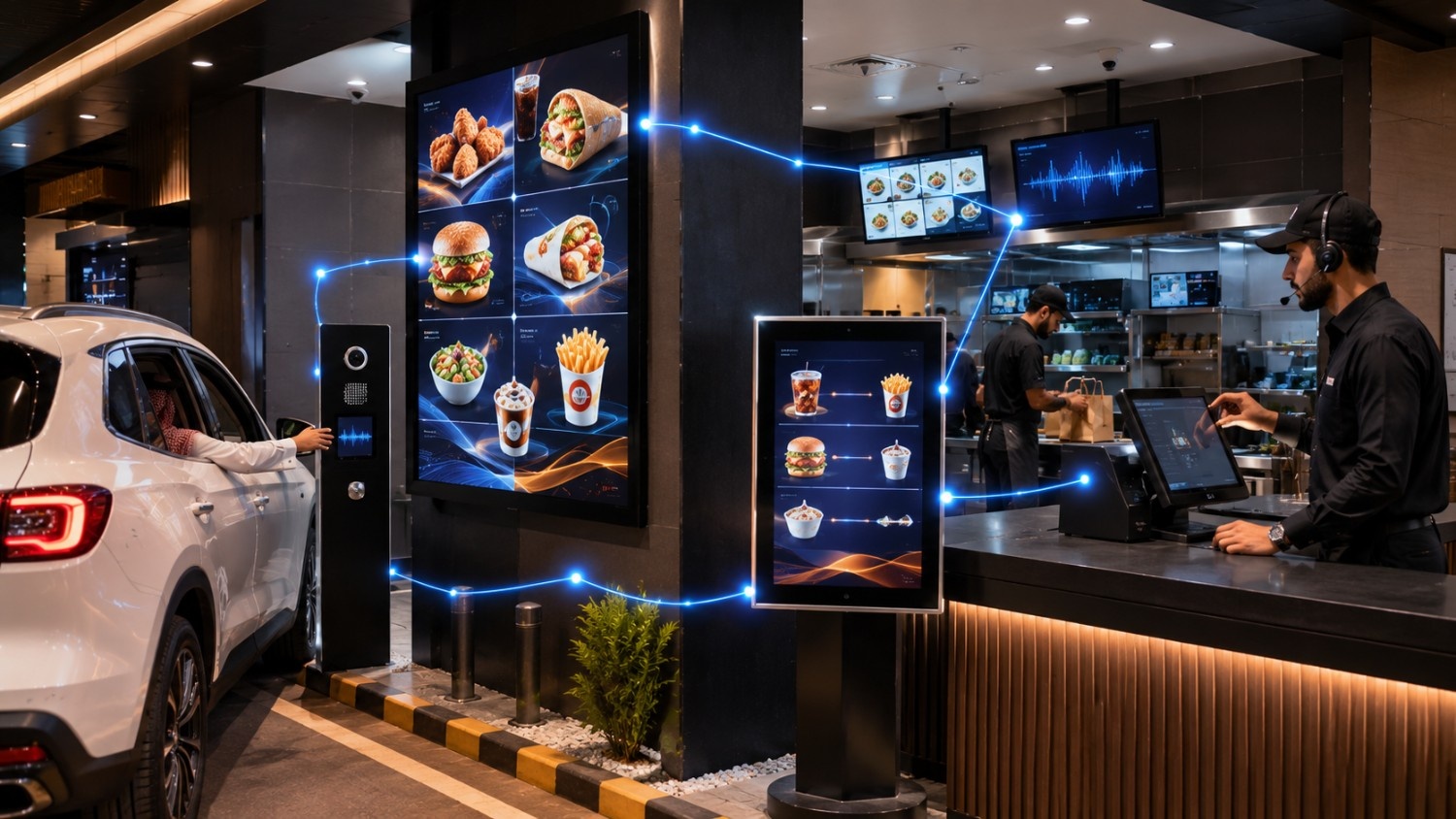
A drive-thru ordering system allows customers to place and receive food orders without leaving their vehicles. A modern system typically combines drive-thru communication, digital menu boards, customer order displays, ordering software, POS integration and operational monitoring to move an order from the customer to the restaurant team quickly and accurately.
For QSRs and restaurants in Saudi Arabia, UAE, Qatar and Kuwait, drive-thru technology is becoming an important part of delivering faster and more convenient service. In Saudi Arabia particularly, FAMA Technologies positions drive-thru technology around faster ordering, clear communication, reduced waiting times and improved customer experience.
But what actually happens after a customer drives into a drive-thru lane?
Let’s break down the complete process.
How Does a Drive-Thru Ordering System Work?
A typical modern drive-thru ordering process can be understood in several connected stages:
Vehicle arrival → Menu viewing → Order placement → Order confirmation → POS/order processing → Kitchen preparation → Payment → Pickup → Performance monitoring
Each stage has a role in keeping the customer journey fast and organized.
1. The Customer Enters the Drive-Thru Lane
The process starts when a customer enters the drive-thru lane.
Depending on the restaurant’s setup, vehicle detection and monitoring technologies can help identify vehicle movement through different points of the lane.
Modern drive-thru systems can monitor important operational stages such as vehicle arrival, ordering, and pickup. This gives restaurant operators greater visibility into where delays may be occurring.
For high-volume QSRs, this information can be useful for improving lane management and service efficiency.
2. The Customer Views the Digital Menu
After entering the lane, customers need to understand what is available before placing their order.
This is where a drive-thru digital menu board becomes important.
Instead of relying only on static printed boards, digital menu displays can show:
- Menu categories
- Meals and combos
- Product images
- Prices
- Promotions
- Add-ons
- Limited-time offers
- Seasonal products
Digital content can also be updated more easily when menu items or promotions change.
For a QSR operating multiple branches in Riyadh, Jeddah, Dubai, Doha, or Kuwait City, centralized content management can make menu updates easier to coordinate.
FAMA’s Infinite Digital CMS is positioned as a cloud-based, multilingual digital signage platform that supports content creation, scheduling, and distribution.
3. The Customer Places the Order
Once the customer reaches the ordering point, they communicate their requirements through the drive-thru ordering system.
Traditionally, this is handled through a speaker post and headset system.
The customer speaks into the microphone, and restaurant staff receive the order through their headset.
The quality of this communication is extremely important.
Background noise, unclear audio or poor microphone quality can lead to customers repeating their orders or employees misunderstanding selections.
Modern drive-thru speaker systems therefore focus on clear audio communication and noise management.
FAMA’s On-Go Drive Thru Solution includes speaker posts and noise-cancelling headset technology designed to support clear communication in drive-thru environments.
4. The Order Is Confirmed on a Customer Order Display
After confirmation, the order needs to reach the restaurant’s operational systems.
Depending on the technology architecture, the drive-thru ordering solution can connect with the restaurant’s POS and order management environment.
The objective is to avoid unnecessary manual re-entry of the same order.
A connected workflow can help move information from:
Drive-Thru → POS → Kitchen → Order Preparation → Pickup
This can help restaurant teams process orders more consistently, particularly during busy periods.
FAMA’s AI drive-thru material also highlights POS integration as part of an AI-enabled ordering workflow.
6. The Kitchen Receives the Order
Once the order reaches the restaurant’s operational system, kitchen staff can begin preparing it.
This is where drive-thru technology connects with broader QSR operations.
A drive-thru system alone cannot guarantee faster service if the kitchen is unable to prepare orders efficiently.
For this reason, restaurants should consider the entire workflow rather than focusing only on the speaker or menu board.
A successful drive-thru experience depends on coordination between:
- Ordering
- POS
- Kitchen operations
- Food preparation
- Packaging
- Payment
- Pickup
The technology should support this complete customer journey.
7. Payment Is Completed
After ordering, the customer proceeds toward the payment and pickup area.
Depending on the restaurant’s setup, payment can be handled through different methods, including card, digital payment or other supported payment channels.
The key objective is to prevent payment from becoming another bottleneck.
For QSR operators, reducing unnecessary steps between ordering and pickup can contribute to a smoother customer journey.
8. The Customer Collects the Order
Once the food is prepared and payment is completed, the customer reaches the pickup window.
The restaurant team verifies the order and hands it to the customer.
At this point, the drive-thru journey is complete.
A well-designed system aims to make the entire process feel simple to the customer:
See → Order → Confirm → Pay → Collect
The customer doesn’t need to understand the technology operating behind the scenes.
They simply experience a faster and more organized service.
What Are the Main Components of a Drive-Thru Ordering System?
A modern drive-thru solution can include several technologies working together.
1. Drive-Thru Speaker Post
Used for two-way communication between customers and restaurant employees.
2. Noise-Cancelling Headsets
Help staff communicate with customers more clearly, particularly in busy outdoor environments.
3. Digital Menu Board
Displays menus, prices, product images, promotions, and other customer-facing content.
4. Customer Order Display
Allows customers to visually verify their order before it proceeds through the workflow.
5. POS Integration
Connects drive-thru ordering with the restaurant’s transaction and order-processing environment.
6. Vehicle Detection and Drive-Thru Timer
Helps operators monitor vehicle movement and identify potential bottlenecks.
FAMA’s drive-thru content highlights timer and vehicle tracking capabilities for monitoring the customer journey through different parts of the lane.
7. Cloud-Based Management
For multi-location QSR groups, centralized management can provide visibility into operational information across branches.
FAMA describes its cloud-based drive-thru approach as providing centralized access to information such as order statistics, sales trends and queue performance.
How Does AI Change a Drive-Thru Ordering System?
Traditional drive-thru ordering relies heavily on employees listening to customers and manually entering orders.
AI can add another layer of automation.
An AI drive-thru system can use conversational voice technology to understand customer requests and assist with ordering.
Potential capabilities include:
- Voice-based ordering
- Natural-language understanding
- Multilingual interaction
- Menu recommendations
- Automated order confirmation
- Reduced manual workload
- Integration with restaurant systems
FAMA’s AI positioning includes conversational Voice AI for drive-thru environments and multilingual support. Its market-reference material states that the technology supports 96+ languages and dialects, including Arabic, English, and Urdu.
However, AI should be implemented carefully. Clear fallback processes and human support remain important when an automated system cannot correctly understand a customer’s request.
Why Is Drive-Thru Technology Important in Saudi Arabia and the GCC?
The drive-thru model is particularly relevant for QSRs, cafés and other businesses serving customers who value convenience and vehicle-based ordering.
In Saudi Arabia, restaurants in Riyadh, Jeddah, Dammam, Khobar and other cities can use drive-thru technology to improve ordering workflows and customer communication.
In the UAE, QSRs and cafés in Dubai and Abu Dhabi can use digital drive-thru systems to create more connected customer journeys.
Similarly, restaurants in Qatar and Kuwait can benefit from technologies that support multilingual communication, digital menus, order verification and centralized management.
FAMA specifically positions its drive-thru solution for Saudi locations including Riyadh, Jeddah, Dammam, Khobar and other KSA markets.
How FAMA Technologies Supports Modern Drive-Thru Operation
FAMA Technologies offers its On-Go Drive-Thru Solution as a technology ecosystem designed to support modern drive-thru operations.
Its solution can include technologies such as:
- iCOD customer order displays
- Drive-thru speaker posts
- Digital menu boards
- Noise-cancelling headsets
- Drive-thru timers
- Vehicle tracking
- Content management
- AI-powered ordering capabilities
The combination is designed to address several common QSR challenges, including communication quality, order verification, waiting time and operational visibility.
For businesses operating multiple locations, this approach can also support more centralized management of drive-thru operations and digital content.
How to Choose the Right Drive-Thru Ordering System
Before investing in drive-thru technology, QSR operators should evaluate:
- Audio quality – Can customers and staff hear each other clearly?
- Order confirmation – Is there a customer-facing order display?
- POS integration – Can the system connect with existing restaurant systems?
- Digital menu capability – Can menus and promotions be updated efficiently?
- Scalability – Can the solution support multiple locations?
- Environmental durability – Is outdoor equipment designed for local weather conditions?
- Multilingual support – Can it support the languages needed by your customers?
- Analytics – Can management identify bottlenecks and performance issues?
- AI capabilities – Is AI needed for the restaurant’s ordering model?
- Service and maintenance – Is reliable technical support available?
For the GCC market, environmental durability and localization should receive particular attention rather than treating them as optional features.
Conclusion:
A modern drive-thru ordering system is much more than a speaker next to a menu board.
It is a connected workflow that can bring together digital menus, two-way audio, customer order displays, POS integration, kitchen operations, payment and performance monitoring.
The basic journey is simple:
Customer arrives → views menu → places order → confirms order → restaurant prepares order → customer pays → order is collected.
Technology helps make each stage more connected and measurable.
For QSRs in Saudi Arabia, Dubai, Qatar, Kuwait, and the wider Middle East, investing in the right drive-thru technology can help create a smoother customer journey and provide restaurant operators with better visibility into their operations.
As AI, cloud management and connected ordering technologies continue to develop, drive-thru systems are moving from simple communication tools toward complete digital ordering and customer-experience platforms.