Introduction
The hospitality industry is built around experience. From the moment guests enter a hotel lobby to the time they check out, every interaction influences how they perceive the brand. Today, however, excellent service is no longer limited to friendly staff and comfortable rooms. Guests increasingly expect convenient, fast, personalized, and digitally enabled experiences.
This is where digital signage for hotels is becoming increasingly important.
Instead of relying solely on printed posters, static directories, paper menus, and traditional notice boards, hotels can use digital displays to communicate information, promote services, guide guests, and create visually engaging environments.
For hospitality businesses in Saudi Arabia and other rapidly developing markets, digital signage can become an important part of a broader digital transformation strategy.
What Is Digital Signage in Hospitality?
Hospitality digital signage refers to digital screens installed throughout hotels, resorts, restaurants, conference venues, and other guest-facing environments.
These displays can present a wide variety of content, including:
- Welcome messages
- Hotel information
- Restaurant menus
- Promotions and special offers
- Event schedules
- Conference information
- Wayfinding directions
- Local attractions
- Emergency announcements
- Brand videos
- Room-service information
Modern platforms can also allow hotel teams to manage content centrally and update displays remotely, making digital signage considerably more flexible than traditional printed communication.
FAMA Technologies, for example, offers hotel technology solutions that include lobby signage and digital signage designed to enhance guest experiences across hotels and hospitality environments.
1. Create a Stronger First Impression
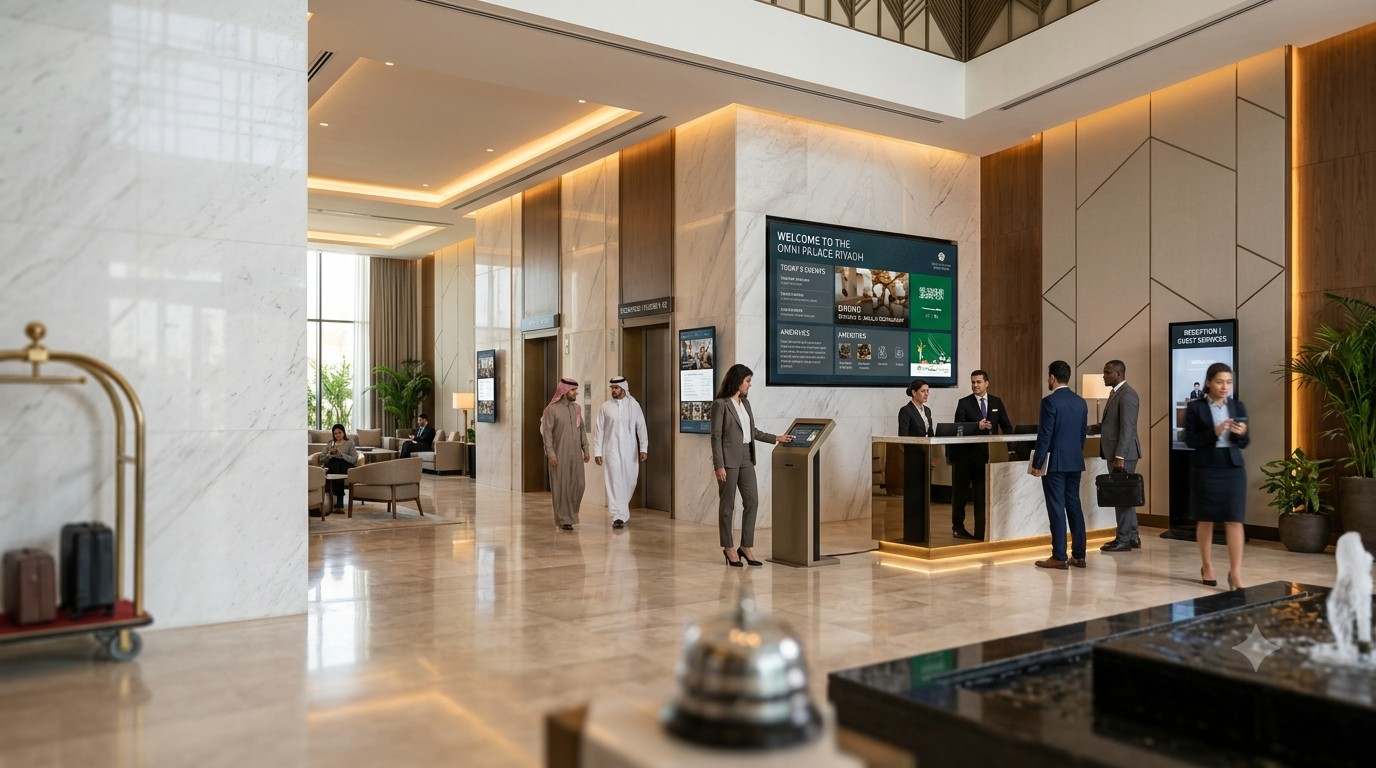
The hotel lobby is often the first physical touchpoint between a guest and the brand.
A large, high-quality digital display can immediately create a more contemporary and premium atmosphere. Hotels can use lobby screens to welcome guests by name where supported by their systems, showcase brand imagery, highlight amenities, or communicate current events.
Instead of a static welcome board that remains unchanged for weeks, digital signage can continuously refresh the visual experience.
For luxury hotels, resorts, and business properties, this can help reinforce the hotel’s positioning and create a more memorable arrival experience.
2. Improve Hotel Wayfinding
Large hotels can be difficult to navigate, particularly for first-time visitors.
Guests may need to find:
- Restaurants
- Meeting rooms
- Conference halls
- Swimming pools
- Fitness centers
- Elevators
- Parking areas
- Spa facilities
- Ballrooms
- Guest-service desks
Digital wayfinding displays can make navigation easier by providing clear directions and location information.
For conference hotels, this becomes particularly valuable when several events are taking place simultaneously. Displays can show room assignments, schedules, session changes, and directions without requiring hotel employees to repeatedly answer the same questions.
3. Deliver Real-Time Guest Information
One of the greatest benefits of hotel digital signage is the ability to communicate information quickly.
Suppose a conference room changes location or a restaurant temporarily changes its operating hours. With printed signage, staff need to create, print, and replace notices.
With a centrally managed digital signage system, the information can be updated across relevant screens much more efficiently.
Hotels can use digital displays to communicate:
- Breakfast timings
- Check-in/check-out information
- Event schedules
- Restaurant availability
- Pool timings
- Maintenance notifications
- Weather information
- Transportation details
- Special hotel announcements
FAMA Technologies emphasizes centralized content management and real-time flexibility within its digital signage solutions, making this approach particularly useful for businesses managing multiple screens or locations.
4. Promote Hotel Services and Increase Revenue
Digital signage isn’t only a communication tool. It can also support hotel revenue generation.
Hotels have numerous services that guests may not automatically discover, such as:
- Spa treatments
- Room upgrades
- Restaurants
- Cafés
- Executive lounges
- Airport transfers
- Excursions
- Special dining experiences
- Seasonal packages
Strategically positioned screens can promote these services at relevant points throughout the guest journey.
For example, a display near the elevator could promote a hotel’s restaurant during dinner hours, while a screen near the spa could highlight a limited-time wellness package.
Content can also be scheduled according to time of day, allowing hotels to show breakfast promotions in the morning and dining or entertainment offers later in the day.
5. Enhance Restaurant and Dining Experiences
Restaurants, cafés, and hotel dining areas can benefit significantly from digital displays.
Digital menu boards allow hospitality businesses to showcase dishes through high-quality imagery, videos, pricing, promotions, and recommendations.
FAMA Technologies’ Infinite Digital platform includes digital menu board solutions with content management, real-time data integration, and personalized merchandising capabilities for hospitality businesses.
Hotels can use this technology to promote signature dishes, seasonal menus, chef specials, buffet offerings, or limited-time promotions without constantly reprinting menus.
6. Make Events and Conferences Easier to Manage
Hotels frequently host weddings, corporate conferences, exhibitions, seminars, and private events.
Digital signage can help event organizers communicate information throughout the venue.
Displays can show:
“Annual Business Summit – Ballroom A”
“Registration →”
“Session 2: 3:00 PM”
“Coffee Break – Level 1”
When schedules change, the information can be updated without replacing physical signs.
This creates a more professional event environment while reducing confusion for attendees.
7. Improve Multilingual Communication
Hotels often serve international guests with different language preferences.
Digital signage makes it easier to deliver multilingual content.
A hotel in Saudi Arabia, for example, may need to communicate with Arabic-speaking guests while also serving international visitors. Digital displays can alternate between languages or provide multilingual instructions depending on the location and audience.
This can improve accessibility and reduce communication barriers without requiring every physical sign to contain large amounts of text.
8. Reduce Dependence on Printed Materials
Hotels traditionally use significant quantities of printed materials for menus, promotional posters, event schedules, directories, and notices.
Digital signage can reduce the need to repeatedly print and replace these materials.
When prices, promotions, operating hours, or event information change, content can be updated digitally.
This can help reduce recurring printing requirements while giving hotel teams greater control over brand consistency.
9. Connect Digital Signage With the Wider Hotel Technology Ecosystem
The future of hospitality is increasingly interconnected.
Digital signage can work alongside other technologies, including:
- Hotel management systems
- POS systems
- Digital kiosks
- IPTV
- In-room tablets
- Queue management
- Access-control systems
- Customer information platforms
FAMA Technologies’ hotel solutions extend beyond signage into areas such as self-service kiosks, POS systems, IPTV, IP telephony, access control, and in-room digital concierge solutions.
This creates opportunities for hotels to build a more connected technology ecosystem instead of treating every digital solution as a separate system.
10. Support Smarter Hospitality in Saudi Arabia
Saudi Arabia’s rapidly developing tourism and hospitality sector is creating demand for more sophisticated guest experiences.
Hotels and hospitality businesses are increasingly expected to combine traditional service excellence with modern digital convenience.
Digital signage can support this transformation by creating smarter communication, more engaging environments, faster information delivery, and more flexible promotional opportunities.
For businesses operating in Riyadh, Jeddah, Al Khobar, Madinah, and other growing hospitality markets, scalable digital signage can support both individual properties and larger multi-location operations.
FAMA Technologies offers digital signage and broader hospitality technology solutions designed to help businesses modernize customer engagement and operations in Saudi Arabia.
Best Practices for Implementing Hotel Digital Signage
Simply installing screens does not guarantee a better guest experience. Hotels should consider several factors before deployment.
Choose strategic locations: Place displays where guests naturally need information, such as entrances, reception areas, elevators, restaurants, and conference zones.
Keep content concise: Guests should understand the message within seconds.
Use high-quality visuals: Hospitality is a visual industry, so professional photography, video, typography, and branding matter.
Update content regularly: Outdated information can damage guest trust.
Use centralized management: A CMS can make it easier to control multiple displays from one location.
Prioritize accessibility: Ensure text is readable and information is available in appropriate languages.
Why FAMA Technologies for Hotel Digital Signage?
For hospitality businesses seeking a comprehensive technology partner, FAMA Technologies combines digital signage with a wider portfolio of hotel technology solutions.
Its hotel offering includes lobby signage, surveillance, access control, IPTV, IP telephony, back-office solutions, self-service kiosks, POS systems, and digital in-room concierge technology.
This broader approach can help hotels build a connected digital environment rather than implementing signage as an isolated technology.
Conclusion
Digital signage for hotels is transforming the way hospitality businesses communicate with guests.
From creating impressive lobby experiences and improving wayfinding to promoting hotel services, supporting events, delivering multilingual information, and enhancing restaurant operations, digital displays can influence almost every stage of the guest journey.
As hotels become more digitally connected, the role of signage is evolving from a simple information display into an intelligent communication and engagement platform.
For hospitality businesses looking to modernize their guest experience in Saudi Arabia, solutions from technology providers such as FAMA Technologies can provide a foundation for creating more connected, flexible, and engaging hotel environments.