Introduction
Healthcare facilities manage a constant flow of information every day. Patients need to know where to go, what services are available, how long they may need to wait, and what they should do next. Visitors need directions and department information, while staff may need to communicate announcements or operational updates.
Traditional communication methods such as printed notices, posters, static boards, and verbal announcements can make this process difficult to manage. Information can become outdated, difficult to find, or inconsistent across different areas of a healthcare facility.
Digital signage in healthcare provides a more flexible way to communicate important information through strategically placed digital displays. Hospitals, clinics, medical centers, and other healthcare facilities can use screens in reception areas, waiting rooms, corridors, departments, and public spaces to deliver timely and relevant information.
With a centralized content management system (CMS), healthcare organizations can also manage content across multiple screens and locations from a single platform.
What Is Digital Signage in Healthcare?
Healthcare digital signage refers to the use of digital displays to communicate information to patients, visitors, and staff. These displays can show text, images, videos, announcements, directions, educational content, schedules, alerts, and other relevant information.
Unlike printed signage, digital displays can be updated remotely whenever information changes. This makes them particularly useful in healthcare environments where information may need to be changed frequently.
For example, a hospital can display:
- Department and clinic information
- Doctor or service schedules
- Patient education content
- Waiting-time information
- Emergency announcements
- Wayfinding instructions
- Health and safety messages
- Multilingual information
- Facility announcements
- Real-time operational updates
The content can be tailored according to the location and audience of each screen.
1. Improve Patient Education
Patients often need information about medical conditions, treatments, procedures, preventive care, and healthy habits. Digital displays can present this information in an easy-to-understand visual format.
Instead of relying only on brochures or posters, healthcare facilities can display short educational videos, infographics, health tips, and awareness messages in waiting areas.
For example, a clinic could display information about preventive healthcare, medication awareness, vaccination, hygiene, or preparation for specific procedures.
Because digital content can combine text, images, animation, and video, it can make patient education more engaging while patients are waiting for their appointments.
2. Provide Waiting-Time Information
Waiting is one of the common challenges in healthcare facilities. Patients may become frustrated when they do not know how long they need to wait or what is happening with their appointment.
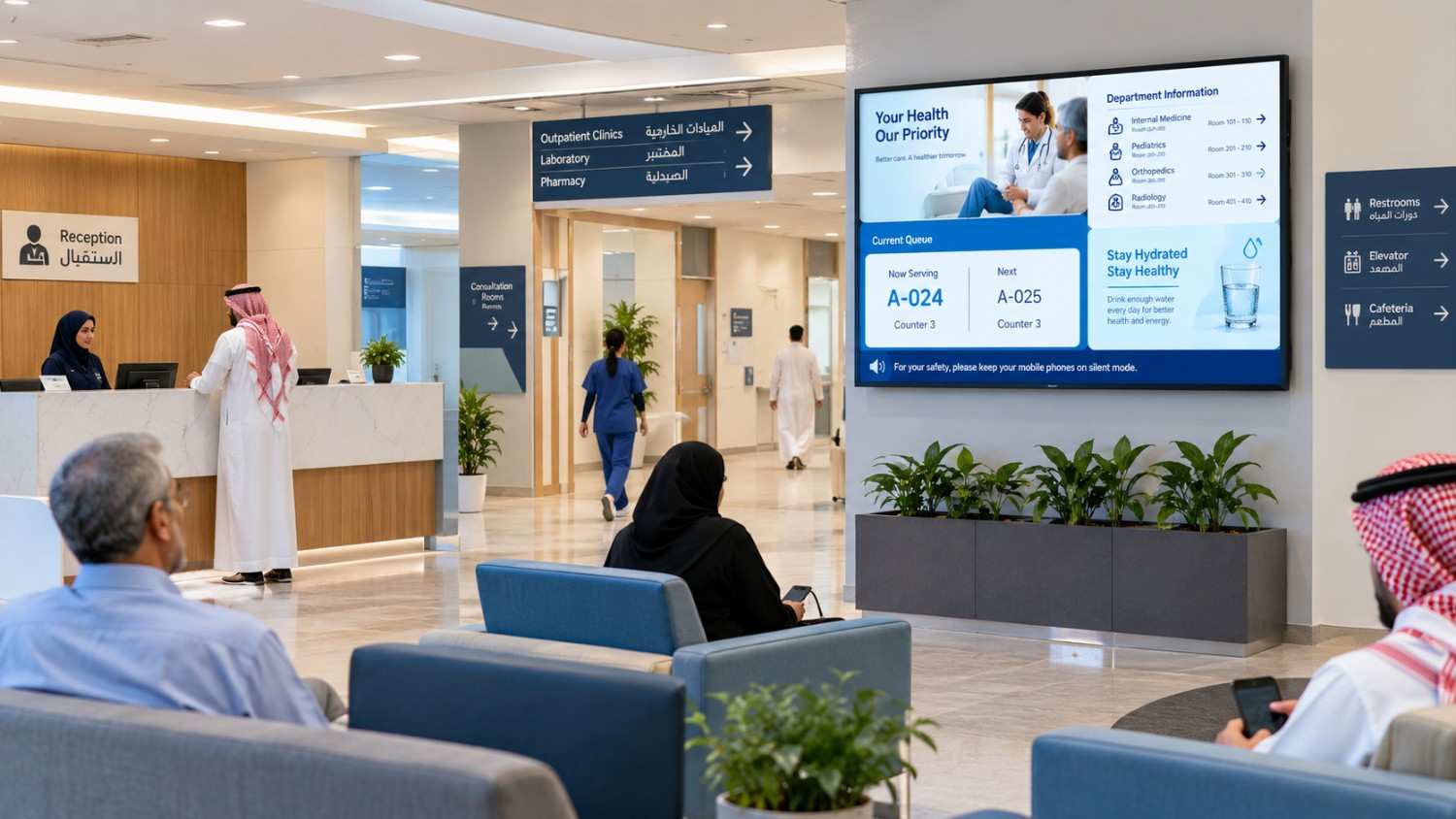
Digital signage can help provide clearer communication by displaying queue information, appointment updates, counter numbers, or estimated waiting information when integrated with the appropriate hospital systems.
For example, a screen in a reception or waiting area can show:
Now Serving: A-024
Please Proceed to Counter 3
This gives patients a clear indication of what they need to do next and reduces their dependence on repeatedly asking reception staff for updates.
3. Make Hospital Wayfinding Easier
Large hospitals can be difficult to navigate, particularly for first-time visitors.
Digital wayfinding displays can help patients and visitors locate important areas such as:
- Emergency departments
- Outpatient clinics
- Laboratories
- Pharmacies
- Radiology departments
- Consultation rooms
- Registration counters
- Elevators
- Parking areas
Strategically positioned digital screens can provide visual directions and department information, helping create a smoother visitor experience.
For large healthcare campuses, digital wayfinding can become even more valuable when different buildings, floors, and departments need to be connected through a clear navigation system.
4. Communicate Department Information
Healthcare facilities frequently have different departments operating simultaneously. Patients may need to know where specific services are located, when departments are open, or which counter they should approach.
Digital displays can provide department-specific information at the right location.
For instance, screens near a diagnostic department can display preparation instructions, service information, operating hours, or patient guidance relevant to that department.
This reduces the need for staff to repeatedly communicate the same basic information.
5. Support Multilingual Communication
Healthcare facilities often serve diverse communities, particularly in multicultural cities and countries.
Providing important information in multiple languages can make communication more accessible to patients and visitors.
Digital signage allows organizations to display multilingual messages without requiring multiple physical posters for every language.
Content can be designed to show different languages sequentially or provide language-specific information depending on the screen and location.
This can be especially useful for general announcements, wayfinding, health awareness campaigns, safety instructions, and visitor guidance.
6. Deliver Real-Time Updates
One of the biggest advantages of digital signage over traditional printed communication is the ability to update information quickly.
Healthcare facilities may need to communicate temporary changes such as:
- Clinic relocation
- Doctor availability
- Temporary closures
- Service disruptions
- Emergency instructions
- Changes to operating hours
- Special health campaigns
- Facility maintenance
Instead of replacing printed material across multiple locations, authorized staff can update digital content through a centralized platform.
This helps ensure that patients receive more current information.
7. Improve Communication in Reception and Waiting Areas
Reception and waiting areas are some of the most important locations for healthcare digital signage.
Patients may spend several minutes or longer in these areas, creating an opportunity to communicate useful information without adding pressure to reception staff.
Screens can combine several types of content, including patient education, queue information, hospital announcements, health awareness messages, department information, and general guidance.
The content can also be scheduled so that different messages appear at specific times or on particular screens.
8. Manage Multiple Screens Through a Centralized CMS
Managing digital displays individually can become complicated when a healthcare organization has multiple departments, buildings, or branches.
A centralized digital signage CMS provides a more efficient approach.
With a centralized CMS, authorized users can manage content, playlists, schedules, and screen-specific information from one platform. The organization can publish a common announcement across multiple displays while keeping department-specific information on selected screens.
For example, a hospital group with facilities in several locations could publish a corporate health campaign across its network while independently managing local announcements for each facility.
This centralized approach can help improve consistency, reduce manual work, and make digital signage easier to scale.
9. Create a More Organized Patient Experience
Digital signage is not simply about replacing posters with screens. When properly planned, it can become part of the overall patient communication strategy.
A well-designed healthcare signage network can provide the right information at the right location and time.
For example, a patient journey could include:
Entrance → Registration → Waiting Area → Department → Consultation → Pharmacy
Each stage can provide relevant information through digital displays.
This creates a more connected communication experience instead of forcing patients to search for information at every step.
How FAMA Technologies Can Help
Implementing digital signage successfully requires more than installing displays. Healthcare organizations also need suitable hardware, content management, network connectivity, content scheduling, and an approach that can scale across different locations.
FAMA Technologies provides digital transformation and technology solutions for organizations across Saudi Arabia and the wider GCC market. Its digital signage offering, Infinite Digital, can support organizations looking to manage digital displays and content through a centralized platform.
For healthcare environments, digital signage can be planned around different use cases—from reception and waiting areas to department information, patient education, wayfinding, and centralized communication.
By combining digital displays with centralized content management, healthcare organizations can create a communication system that is easier to update and manage as their facilities grow.
Conclusion
Effective communication plays an important role in creating a better healthcare experience. Patients and visitors need clear information throughout their journey, while staff need efficient ways to communicate announcements and updates.
Digital signage in healthcare can help address these requirements through patient education, waiting-time information, wayfinding, department communication, multilingual content, and real-time updates.
With a centralized CMS, healthcare organizations can manage multiple screens more efficiently and maintain consistent communication across different departments and locations.
As hospitals and healthcare facilities continue adopting digital transformation technologies, healthcare digital signage can become an important part of creating more informed, connected, and patient-focused environments.