Introduction
Manufacturing facilities depend on fast, accurate communication. From production targets and machine status to safety alerts and shift changes, employees need access to the right information at the right time. However, traditional communication methods such as printed notices, bulletin boards, emails, and verbal announcements can struggle to keep pace with modern manufacturing operations.
This is where digital signage in manufacturing can make a significant difference.
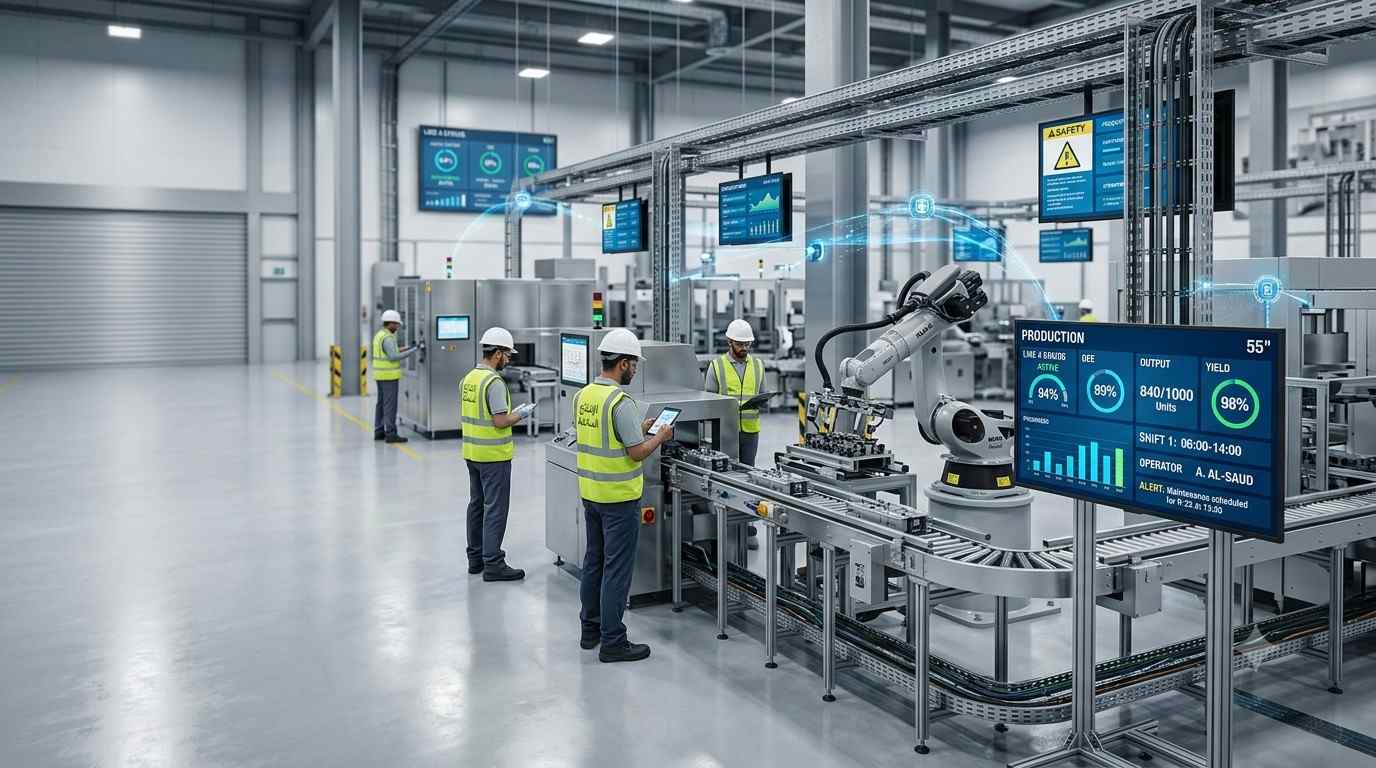
Digital signage uses strategically positioned screens to deliver dynamic content, real-time operational information, safety messages, announcements, and performance metrics directly to employees on the factory floor. Unlike office-based communication tools, digital displays reach workers where they actually perform their jobs.
For manufacturers looking to improve operational visibility, employee engagement, workplace safety, and communication efficiency, digital signage has become an increasingly valuable technology.
Why Communication Is Challenging in Manufacturing Facilities
Manufacturing environments are fundamentally different from conventional offices. Employees may work across multiple production lines, warehouses, loading areas, workshops, and shifts. Many workers do not have access to computers or regularly check email while working.
Large facilities can therefore experience communication gaps between management, supervisors, and frontline employees.
Important information can also become outdated quickly. A production target may change during a shift, a machine may require maintenance, or a safety hazard may suddenly appear in a particular zone.
Traditional printed signage cannot respond instantly to these changes. Digital signage, on the other hand, allows organizations to update information centrally and distribute it across connected displays.
Industry sources highlight this ability to deliver live production information, safety messages, shift communications, and operational updates directly to employees on the factory floor.
1. Deliver Real-Time Production Information
One of the biggest advantages of manufacturing digital signage is real-time visibility.
Screens can display important operational information such as:
- Production targets and current output
- Overall equipment effectiveness (OEE)
- Machine status
- Downtime notifications
- Quality performance
- Production schedules
- Inventory or material updates
- Maintenance alerts
Instead of employees waiting for a supervisor to communicate an update, information can be displayed automatically or updated centrally.
For example, if a production line falls behind its target, a dashboard can immediately highlight the variance. Supervisors and operators can then respond more quickly.
FAMA Technologies highlights the use of dynamic dashboards and real-time operational data as part of digital signage solutions designed for manufacturing environments in Saudi Arabia.
2. Strengthen Workplace Safety Communication
Safety is one of the most important applications of digital signage for factories.
Manufacturing facilities may need to communicate constantly changing safety information, including:
- Hazard warnings
- Personal protective equipment reminders
- Emergency procedures
- Evacuation instructions
- Equipment-specific warnings
- Maintenance-area alerts
- Safety campaigns
- Compliance reminders
Digital displays can make these messages more visible and easier to update than static posters.
For instance, if maintenance work is taking place in a particular section of a facility, a screen near that area can immediately display a warning. In an emergency, centrally managed screens can be used to communicate critical instructions throughout the facility.
Digital signage is particularly useful because safety information can be delivered directly within the working environment rather than requiring employees to search for it elsewhere.
3. Improve Shift Handover Communication
Shift changes are another area where communication gaps can create operational problems.
An outgoing team may need to communicate information about machine issues, incomplete tasks, production targets, maintenance requirements, or quality concerns to the incoming team.
Digital signage can support this process by displaying shift-specific information in key areas.
A screen positioned near a production line or employee entrance could show:
Current Shift: Morning
Production Target: 5,000 Units
Completed: 4,650 Units
Maintenance Alert: Line 3 scheduled at 4:00 PM
Safety Focus: PPE compliance
This creates a shared visual reference for employees and supervisors and helps reduce dependence on informal verbal communication.
4. Connect Management With the Factory Floor
One of the biggest communication challenges in manufacturing is the gap between corporate offices and frontline workers.
Management may have access to dashboards, reports, and company announcements, while employees on the production floor may receive information much later.
Digital signage helps bridge this gap.
Organizations can use screens to communicate:
- Company announcements
- Business objectives
- Production achievements
- Employee recognition
- HR information
- Training reminders
- Corporate initiatives
- Sustainability goals
This creates a more connected workforce and ensures employees understand not only what they need to do but also how their work contributes to broader organizational goals.
5. Reduce Information Delays
Printed communication requires a manual process: create the notice, print it, distribute it, and replace it when information changes.
Digital signage eliminates much of this delay.
With a centralized content management system, authorized teams can update information remotely and distribute changes across multiple displays. FAMA Technologies describes centralized content management and flexible digital signage deployment as part of its solutions for businesses across Saudi Arabia.
This becomes especially valuable for manufacturers operating multiple facilities or production areas.
A safety message that needs to reach several locations can be updated centrally instead of requiring staff to manually replace individual posters.
6. Make Training More Accessible
Employee training does not always need to happen through lengthy classroom sessions.
Digital signage can support continuous learning through short, visually engaging content.
Manufacturers can display:
- Equipment operating procedures
- Safety tips
- Quality-control reminders
- Maintenance instructions
- Short training videos
- Process guidelines
- Workplace best practices
This approach can reinforce formal training by providing employees with frequent reminders throughout their working environment.
For new employees, strategically positioned screens can also help reinforce essential procedures during the onboarding process.
6. Manage Multiple Stores From One Platform
For retail chains, consistency can be difficult when every store manages signage independently.
A centralized digital signage platform can help marketing teams create campaigns once and distribute them across multiple locations.
Teams can control:
- What content appears
- Where it appears
- When it starts
- When it ends
- Which screens receive it
- Which stores receive specific campaigns
This can reduce the operational burden associated with manually managing printed promotional materials.
FAMA Technologies can support retailers with centralized digital signage management, enabling businesses to manage and distribute content across screens remotely.
7. Increase Employee Engagement
- Communication should not only focus on production and safety.
- Digital signage can also strengthen workplace culture.
- Manufacturers can use screens to recognize employee achievements, celebrate production milestones, announce birthdays or company events, highlight safety accomplishments, and share internal news.
- Recognition is particularly valuable in environments where employees may otherwise have limited visibility into what is happening across the organization.
- By making communication more visual and accessible, manufacturers can create a workplace where employees feel more informed and connected.
8. Support Data-Driven Manufacturing
Modern factories increasingly rely on connected technologies, IoT devices, ERP platforms, MES systems, and production-monitoring tools.
Digital signage can serve as the visual layer that turns this data into information employees can understand immediately.
For example, an IoT-enabled production environment could display machine performance or operational alerts on screens positioned near relevant equipment.
FAMA Technologies notes the potential for digital signage to integrate with IoT environments and display operational alerts based on connected systems.
This transforms digital signage from a simple communication tool into part of a broader smart-factory ecosystem.
How to Implement Digital Signage in a Manufacturing Facility
Successful deployment begins with identifying what employees actually need to see.
Manufacturers should consider:
1. Identify high-traffic locations: Install screens where employees naturally look, such as entrances, production areas, break rooms, control rooms, and warehouse zones.
2. Prioritize critical information: Avoid overcrowding screens. Focus on safety, production, quality, and operational messages.
3. Use readable designs: Large typography, strong contrast, simple layouts, and clear visual hierarchy are essential in industrial environments.
4. Automate where possible: Connect digital signage with existing operational systems to reduce manual updates.
5. Create location-specific content: A maintenance area may need different information from a cafeteria or employee entrance.
6. Keep content fresh: Rotate messages regularly to prevent employees from becoming accustomed to seeing the same information.
Why Choose FAMA Technologies for Manufacturing Digital Signage?
For manufacturers in Saudi Arabia looking to modernize factory-floor communication, FAMA Technologies offers digital signage solutions designed for industrial environments.
Its manufacturing-focused approach combines digital displays, centralized content management, real-time data visualization, and integration capabilities. The company also highlights support for multiple device environments and IoT-connected signage.
This makes digital signage more than an electronic replacement for a bulletin board. Properly implemented, it can become an important communication layer connecting people, processes, machines, and management.
Conclusion
Effective communication is fundamental to manufacturing performance. When employees receive accurate information quickly, they can respond faster, work more safely, and stay aligned with operational objectives.
Digital signage in manufacturing provides a flexible way to deliver real-time production information, safety alerts, shift updates, training content, company announcements, and performance data directly to the factory floor.
As manufacturing facilities become increasingly connected and data-driven, visual communication will play an even greater role in creating smarter, safer, and more efficient workplaces.
For manufacturers in Saudi Arabia, partnering with an experienced technology provider such as FAMA Technologies can help transform traditional factory communication into a centralized, dynamic, and scalable digital experience.