Introduction
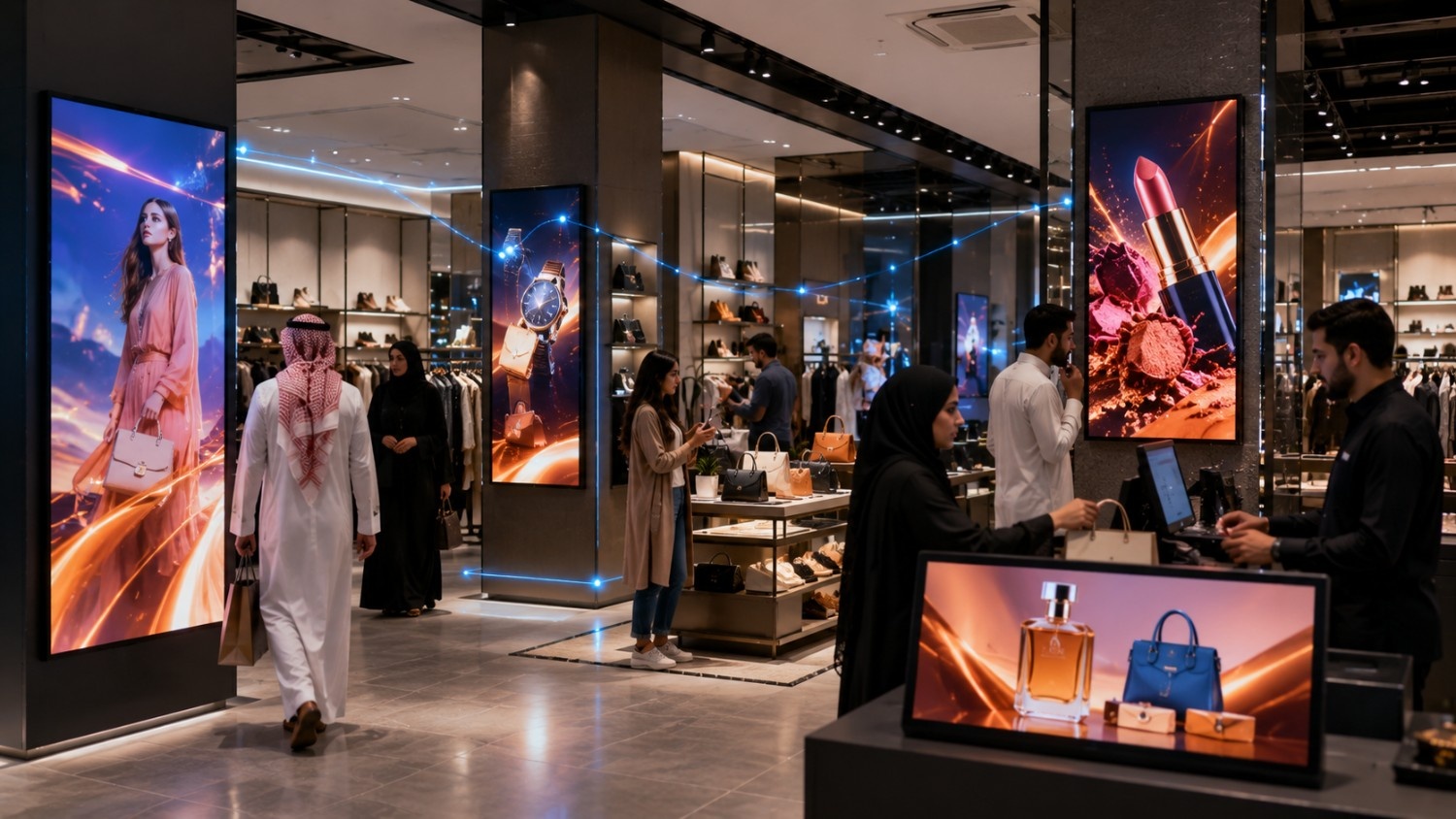
The modern retail store is no longer limited to shelves, printed posters, and static promotional boards. Digital screens are becoming an increasingly important part of the in-store customer experience, helping retailers present products, communicate promotions, provide information, and create more engaging shopping environments.
But can digital screens actually influence what customers decide to buy?
Yes, when they are strategically positioned and supported by relevant content. Digital signage can attract attention, communicate product benefits, create urgency around promotions, simplify product discovery, and influence how shoppers experience a retail environment. Research has also found that digital signage can affect shoppers’ approach behavior and purchasing responses.
For retailers across Saudi Arabia, the UAE, Qatar, Kuwait, and the wider Middle East, digital screens can therefore become more than communication displays. They can function as dynamic customer-engagement and merchandising tools.
How Do Digital Screens Influence Customer Decisions?
Digital screens influence customers primarily by delivering the right visual message at the right location and moment.
Unlike printed signage, digital displays can show videos, product demonstrations, promotional messages, pricing, recommendations, and other content that can be updated or scheduled according to business requirements.
The objective isn’t simply to make a store look more modern. Effective digital signage should help customers notice, understand, compare, and act.
1. Digital Screens Capture Customer Attention
Retail environments contain a large amount of visual information. Customers may walk past posters, shelves, and promotional displays without actively processing every message.
Moving visual content can create another opportunity to attract attention.
Research into digital signage in retail environments has found positive effects on shoppers’ approach behavior, with the experience of the retail environment playing an important role.
Retailers can use high-quality digital screens near entrances, product zones, promotional areas, and checkout points to introduce products or offers when customers are already engaged with the shopping environment.
2. Visual Content Helps Customers Understand Products
A customer may hesitate to purchase a product because they don’t immediately understand its features, benefits, or use.
Digital screens can provide additional context through:
- Product demonstrations
- Short videos
- Product comparisons
- Feature highlights
- Usage instructions
- Lifestyle imagery
- Customer reviews or social proof
- Product recommendations
This is particularly useful for products that are difficult to explain using a price tag or printed poster.
Instead of asking customers to read a large amount of information, retailers can communicate key points through short, visually focused content.
3. Digital Promotions Can Create Purchase Motivation
Promotions are one of the most common applications of retail digital signage.
A screen can highlight:
Limited-time offers → New arrivals → Bundle deals → Seasonal promotions → Loyalty offers → Featured products
The ability to change promotional content quickly gives retailers greater flexibility than traditional printed materials.
For example, a retailer could display one campaign during morning hours, another during afternoon traffic, and a different promotion during evening hours.
FAMA Technologies highlights real-time updates and scheduled content as important capabilities of modern digital signage, allowing businesses to manage content across screens from centralized systems.
4. Digital Signage Can Encourage Impulse Purchases
Some purchasing decisions happen with very little planning.
A strategically positioned screen near a product display or checkout area can remind customers about complementary products, promotions or limited-time offers.
For example:
Customer selects a coffee → Screen promotes a dessert → Customer considers adding the dessert
The screen isn’t necessarily creating the need for the product. Instead, it can make an existing opportunity more visible at the moment when the customer is already considering a purchase.
Recent research examining digital signage advertising across 237 campaigns and approximately 30 million shoppers found that featured products were 8.1% more likely to be purchased in the studied retail settings. The study also found stronger effects for certain product and campaign conditions, showing why content strategy matters alongside the technology.
5. Digital Screens Can Influence Perceived Brand Experience
Customer decisions aren’t based only on price.
The overall shopping environment can influence how customers perceive a brand.
High-quality visual content can help retailers communicate:
- Brand identity
- Product quality
- Premium positioning
- Seasonal campaigns
- New product launches
- Brand stories
Research has found that digital signage content containing strong sensory cues can influence shoppers’ experiential processing and their attitudes toward the advertised brand.
This makes digital screens particularly relevant for fashion, luxury retail, automotive showrooms, electronics, hospitality, and other experience-driven environments.
6. Real-Time Content Makes Retail Messaging More Relevant
One of the biggest advantages of digital signage is flexibility.
Retailers can update content based on:
- Time of day
- Store location
- Campaign schedules
- Product availability
- Seasonal events
- Promotions
- Business priorities
For a multi-location retailer, this can be especially valuable.
A brand operating stores in Riyadh, Jeddah, Dubai, Doha, and Kuwait City can maintain consistent brand communication while adapting individual screens or campaigns to specific locations.
FAMA Technologies’ Infinite Digital CMS is a cloud-based, multilingual platform for content creation, scheduling, distribution, and remote management.
7. Arabic and English Content Can Improve Communication
The Middle East is a diverse retail market, making clear communication particularly important.
Digital signage allows businesses to present content in multiple languages and adapt messaging for different audiences.
For businesses operating across Saudi Arabia, the UAE, Qatar, and Kuwait, multilingual digital signage can support more accessible communication while allowing brands to maintain consistent visual identity.
FAMA Technologies specifically positions multilingual content and Arabic-English communication as part of its digital signage and digital menu board capabilities.
8. Digital Screens Can Support Cross-Selling and Upselling
Digital signage can also be used to connect products.
For example:
Main product → Complementary product → Bundle → Promotional offer
A fashion retailer could promote accessories alongside clothing.
An electronics retailer could display compatible accessories alongside a device.
A QSR could promote a drink, side or dessert alongside a main meal.
This becomes particularly powerful when digital screens are integrated into a broader retail merchandising strategy rather than treated simply as advertising displays.
How FAMA Technologies Helps Businesses Use Digital Screens Strategically
FAMA Technologies’ Infinite Digital approach goes beyond providing display hardware.
Its digital signage ecosystem includes cloud-based CMS capabilities that allow businesses to create, schedule, and distribute content remotely. FAMA also provides digital menu boards, video wall solutions, and other digital display applications for different business environments.
For retailers and QSRs operating multiple locations, centralized content management can make it easier to maintain brand consistency while adapting promotions and messaging across individual stores.
This is particularly useful for businesses operating across the GCC where campaigns, languages, product availability, and promotional priorities may vary between locations.
Best Practices for Digital Screens That Influence Customer Decisions
Simply installing a digital display does not guarantee better customer engagement.
Retailers should focus on:
- Short, clear messages – Avoid overcrowding the screen.
- Strong visuals – Use high-quality product photography and video.
- Relevant placement – Position content close to the products or decisions it supports.
- Clear calls to action – Tell customers what to do next.
- Fresh content – Avoid allowing campaigns to become repetitive or outdated.
- Time-based messaging – Match content to customer traffic and business priorities.
- Consistent branding – Keep visuals aligned with the overall brand identity.
- Performance measurement – Where appropriate, compare campaigns and business outcomes.
The Future of Digital Screens in Retail
Digital signage is moving from simple promotional displays toward connected retail experiences.
Cloud-based CMS platforms, real-time updates, analytics, AI, interactive displays and customer-behavior technologies are creating opportunities for retailers to make digital screens more responsive and measurable.
The future isn’t simply about putting screens everywhere.
It is about creating the right message, for the right customer, in the right location, at the right moment.
For retailers across Saudi Arabia, the UAE, Qatar, Kuwait and the wider Middle East, digital signage can therefore become an important part of the in-store customer journey—from attracting attention to communicating product value and supporting the final purchase decision.