Introduction
For quick-service restaurants, speed and accuracy are two of the most important parts of a successful drive-thru operation.
Customers want to place their orders quickly, but they also expect to receive exactly what they requested. A missing item, incorrect beverage, wrong customization, or misunderstood order can quickly turn a convenient drive-thru visit into a frustrating experience.
This is where a customer order display can make a significant difference.
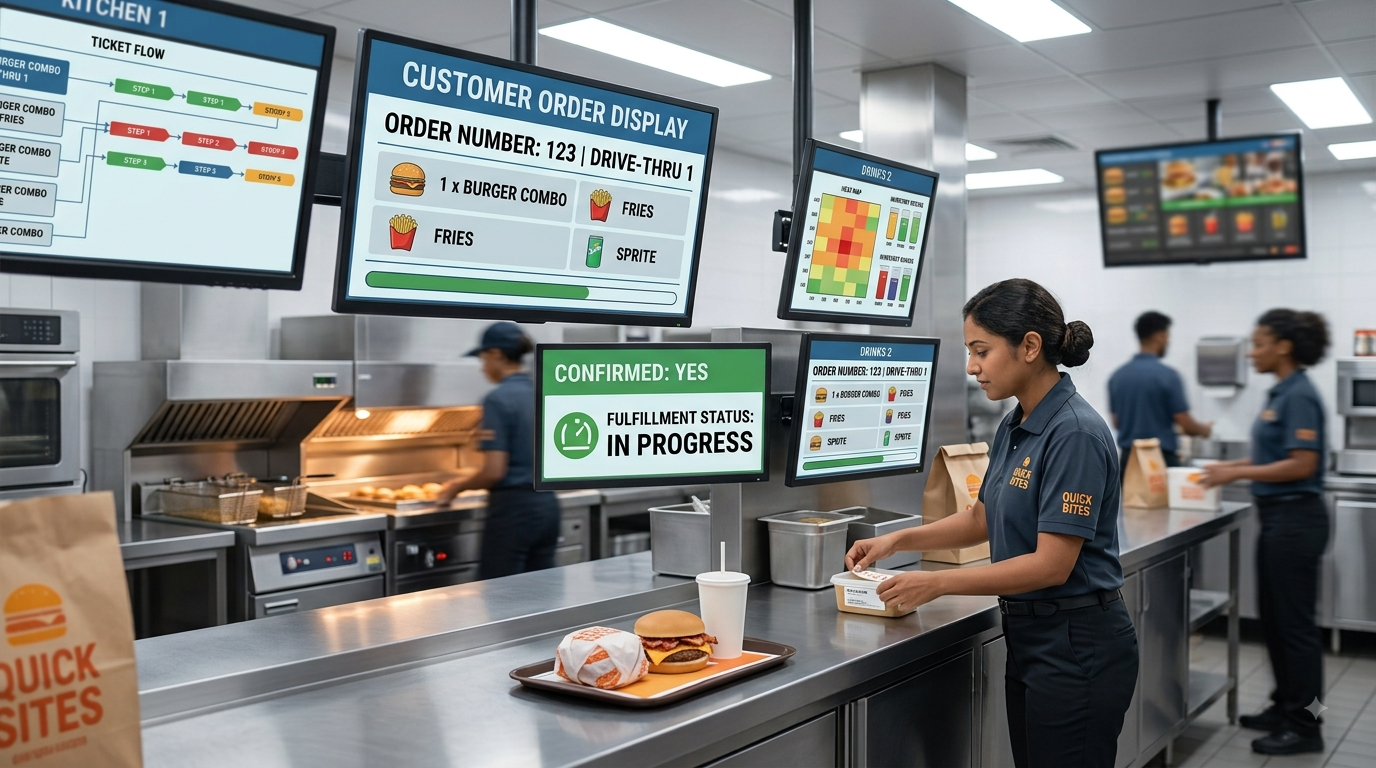
A digital order confirmation display allows customers to visually review what has been entered before they complete payment and move toward pickup. Instead of relying entirely on verbal communication between the customer and restaurant employee, the system creates an additional visual confirmation step.
For QSRs in Saudi Arabia, Dubai, Qatar, Kuwait, and the wider Middle East, this type of technology can become an important part of a modern drive-thru strategy.
FAMA Technologies’ On-Go Drive Thru Solution includes its Innovative Customer Order Display (iCOD), designed to improve customer engagement, order accuracy, customization, and communication.
What Is a Customer Order Display?
A customer order display is a digital screen positioned within the drive-thru ordering journey that shows the customer’s order as it is being entered.
Instead of simply hearing the order through a speaker, the customer can see the selected items and, depending on the system, relevant modifications or order information.
A typical drive-thru journey can look like:
Customer approaches → Views menu → Places order → Reviews order on display → Confirms order → Pays → Collects food
This additional confirmation stage can help identify mistakes before the order reaches the kitchen or pickup window.
FAMA describes its iCOD as a high-definition, audio/video-enabled Customer Order Display designed to streamline ordering and provide customers with clearer order confirmation.
1. Visual Confirmation Reduces Misunderstandings
Drive-thru ordering often depends on voice communication.
Noise from vehicles, engines, surrounding traffic, restaurant equipment and different speaking styles can make communication more difficult.
Even when a restaurant uses high-quality headsets and speaker posts, misunderstandings can occasionally happen.
A customer order display provides a second communication channel.
For example, a customer says: “One chicken meal with no onions and an extra drink.”
The employee enters the order, and the customer can visually check the information on the screen.
If something is incorrect, the customer can immediately point it out before moving forward.
This simple confirmation step can help prevent avoidable mistakes.
2. Customers Can Confirm Customizations
Food is highly visual.
Customization is one of the areas where drive-thru orders can become complicated.
Customers may request:
- No onions
- Extra sauce
- Different beverage
- Additional cheese
- Specific side dish
- Meal upgrades
- Multiple modifications
- Special preparation instructions
When these requests are communicated verbally, there is more opportunity for something to be misunderstood or missed.
A digital order confirmation display gives customers an opportunity to verify important details.
FAMA specifically highlights order accuracy and customization as benefits of its iCOD Customer Order Display.
A well-designed digital menu can showcase burgers, sandwiches, beverages, desserts and meal combinations using high-resolution photography.
Instead of seeing a static product name, customers can immediately understand what the meal looks like.
This makes visual merchandising an important part of drive-thru technology.
FAMA describes its outdoor digital menu boards as a way to create an engaging visual experience while supporting tailored customer journeys and ordering variety.
The objective should not be to fill the screen with excessive animation. A professional menu should make the customer’s decision faster, clearer and easier.
3. Errors Can Be Corrected Before Food Preparation
One of the biggest advantages of an order display is early error detection.
Consider a traditional workflow:
Customer → Speaker → Employee → POS → Kitchen → Customer discovers mistake
By the time the mistake is discovered, the food may already have been prepared.
This can result in:
- Food waste
- Re-preparation
- Longer waiting times
- Increased staff workload
- Customer dissatisfaction
With a customer order display, the workflow becomes:
Customer → Speaker → POS → Customer confirms → Kitchen
The error can potentially be identified much earlier.
This is particularly valuable during busy lunch and dinner periods when restaurant employees are processing multiple orders simultaneously.
4. It Helps Customers Feel More Confident
Accuracy is not only an operational issue; it is also a customer experience issue.
When customers can see their order, they have greater confidence that the restaurant has understood their request.
This creates transparency.
Instead of wondering:
“Did they hear my order correctly?”
The customer can simply look at the display and verify it.
FAMA positions its iCOD around improving customer engagement and providing a smoother ordering experience while supporting order accuracy.
5. Customer Order Displays Complement Better Audio
A customer order display does not replace a good drive-thru communication system.
Instead, the technologies work together.
A modern setup can combine:
Noise-Cancelling Headset + Speaker Post + Digital Menu Board + Customer Order Display + POS + Kitchen Display System
The headset and speaker system help employees and customers communicate clearly.
The digital menu board helps customers make decisions.
The customer order display confirms the order.
The POS processes the transaction.
The Kitchen Display System communicates the order to the preparation team.
This creates a connected workflow rather than relying on one technology.
FAMA’s drive-thru solutions combine these components into an integrated technology ecosystem.
6. Better Accuracy Can Improve Drive-Thru Speed
It may seem that adding an order confirmation step could slow down the drive-thru.
In reality, correcting an error after food preparation can take significantly more time than identifying it during the ordering process.
For example:
Without confirmation:
Order → Preparation → Mistake discovered → Reorder → Re-preparation → Customer waits
With confirmation:
Order → Visual confirmation → Correction → Preparation
The second workflow can prevent unnecessary rework.
This is particularly important for QSRs where restaurants need to balance speed with accuracy.
FAMA also emphasizes that speed should not come at the expense of accuracy and highlights integrated technology as a way to improve both areas.
7. Customer Order Displays Are Valuable During Peak Hours
Peak periods can put significant pressure on restaurant employees.
During breakfast, lunch, dinner or weekend rushes, staff may need to process several orders while dealing with background noise and customer requests.
A visual order display provides an additional layer of clarity.
It can help customers verify their order without requiring employees to repeat every item multiple times.
This can support smoother communication between the customer and order-taking employee.
For high-volume QSR locations across Riyadh, Jeddah, Dammam, Dubai, Doha and Kuwait City, this can be particularly useful where drive-thru traffic is high.
8. Customer Order Displays Can Support Upselling and Engagement
An order display doesn’t necessarily need to be limited to order confirmation.
Depending on the system and configuration, customer-facing displays can also provide opportunities for:
- Promotional content
- Product recommendations
- Branding
- Combo upgrades
- Visual product information
- Customer engagement
FAMA lists branding and promotion opportunities among the benefits associated with its iCOD solution.
However, the primary purpose should remain clear communication. Promotional content should not make the order difficult to read or distract customers from confirming their purchase.
9. Customer Order Displays Support a More Connected Drive-Thru
A modern drive-thru should not be viewed as a collection of separate devices.
Instead, each component should contribute to one connected customer journey.
For example:
Step 1 — Digital Menu Board
Customer reviews products and prices.
Step 2 — Speaker Post
Customer communicates their order.
Step 3 — Customer Order Display
The customer checks the order and modifications.
Step 4 — POS
The order is processed.
Step 5 — Kitchen Display System
Kitchen staff receives the order.
Step 6 — Pickup
The completed order is handed to the customer.
This connected approach helps reduce unnecessary communication gaps between different stages.
FAMA’s On-Go Drive Thru Solution is designed around this type of integrated workflow, combining iCOD with speaker posts, outdoor digital menu boards and noise-cancelling headsets.
10. Why Customer Order Displays Matter for the GCC Market
The QSR market across the Middle East is increasingly technology-driven.
Restaurants in Saudi Arabia, UAE, Qatar and Kuwait are looking for ways to improve speed, customer experience and operational consistency.
For GCC drive-thru installations, technology also needs to operate reliably in demanding commercial environments.
FAMA’s KSA solution specifically positions its iCOD for cities including Riyadh, Jeddah, Al Khobar, Dammam, NEOM, Tabuk, Jazan, Abha, Taif, Al Kharj, Al Madinah and Al Qassim.
Its UAE offering also positions iCOD as a customer-facing audio/video display for locations including Dubai, Abu Dhabi, Sharjah, Ajman and Ras Al Khaimah.
FAMA also offers drive-thru solutions for Kuwait and Qatar, making the technology relevant across the wider GCC market.
How FAMA Technologies Uses iCOD to Improve Drive-Thru Accuracy
FAMA Technologies’ Innovative Customer Order Display (iCOD) is designed to create a visual layer between order-taking and order fulfillment.
Its key benefits include:
- High-definition audio/video engagement
- Reduced waiting times
- Order accuracy and customization
- Branding and promotional opportunities
- Seamless staff-customer communication
When integrated with other On-Go Drive Thru components, iCOD can become an important part of a complete QSR technology setup.
Rather than relying solely on voice communication, the customer receives an additional visual confirmation point.
For restaurant operators, this can help create a more structured ordering process.
How to Choose a Customer Order Display for Your Drive-Thru
Before implementing a drive-thru customer order display, QSR operators should consider several factors.
1. Display Visibility :
The screen should be positioned at an appropriate viewing angle for drivers.
2. Screen Quality :
High-definition content should remain clear and easy to read.
3. Audio/Video Capability :
Depending on the solution, integrated communication features can further improve customer interaction.
4. Outdoor Durability :
Equipment installed in outdoor drive-thru environments should be appropriate for local environmental conditions.
5. System Integration :
The display should work effectively with the restaurant’s ordering and POS infrastructure.
6. Content Management :
Operators should have appropriate control over customer-facing content.
7. Scalability :
The solution should support additional restaurants as the QSR network grows.
Conclusion
Customer order displays can play an important role in improving drive-thru order accuracy by giving customers a clear visual confirmation of what they have ordered.
Instead of relying entirely on verbal communication, customers can review their items and requested modifications before the order moves further into the restaurant workflow.
This can help reduce misunderstandings, prevent avoidable rework and create greater confidence in the ordering process.
For QSRs across Saudi Arabia, Dubai, Qatar, Kuwait and the wider Middle East, customer order displays can become an important component of a modern drive-thru technology strategy.
FAMA Technologies’ iCOD Customer Order Display, integrated within its On-Go Drive Thru Solution, is designed to support order accuracy, customization, customer engagement, and smoother staff-customer communication.
The goal is simple: make the order easier to hear, easier to see, easier to confirm, and easier to fulfill.