Introduction
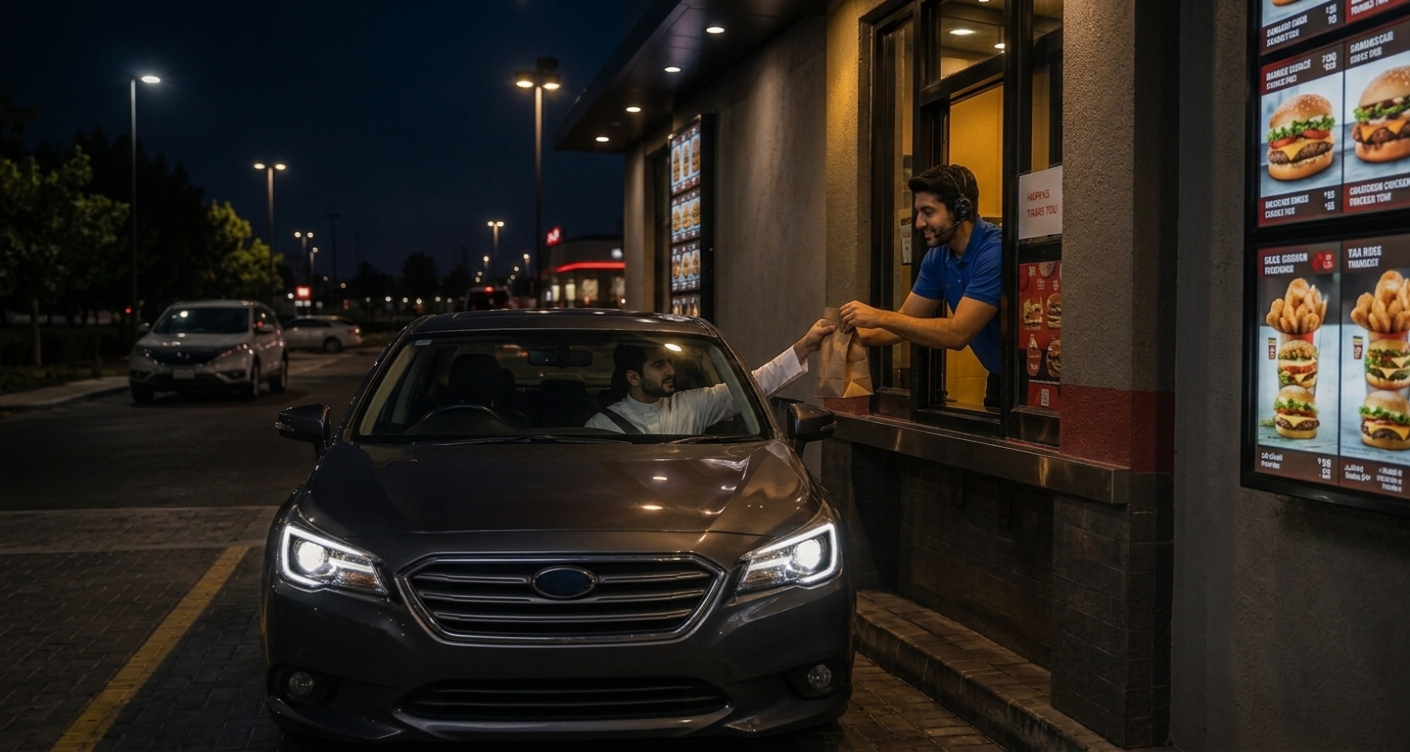
For quick-service restaurants, the drive-thru has become much more than a convenience channel. In Saudi Arabia, where QSR brands are expanding rapidly across Riyadh, Jeddah, Dammam, Al-Khobar, and Makkah, drive-thru performance directly influences customer satisfaction, order volume, and revenue.
But measuring drive-thru speed isn’t enough. The real advantage comes from measuring it accurately.
A restaurant may know its average drive-thru time, but that number alone doesn’t explain where customers are waiting. Is the bottleneck at the entrance? The ordering point? The payment window? Or the final handoff?
This is where modern drive-thru timer systems become valuable.
Instead of treating the entire drive-thru journey as one number, advanced timing systems can provide a more detailed view of the customer journey, helping restaurant operators identify bottlenecks, improve staffing decisions, and increase the number of vehicles they can serve during peak periods.
For Saudi restaurant operators, accurate timing can become an important part of a broader drive-thru optimization strategy.
Why Drive-Thru Timing Is More Than Just a Speed Metric
A drive-thru visit consists of multiple stages.
A customer may experience:
- Arrival at the drive-thru
- Queue time
- Waiting to reach the ordering point
- Order-taking time
- Waiting for payment
- Payment processing
- Waiting for food
- Final order handoff
Looking only at total drive-thru time can hide the actual operational problem.
For example, Restaurant A may have a long queue before the ordering point, while Restaurant B may have a fast ordering process but a slow handoff at the pickup window.
Both restaurants could report similar total times, but the operational solutions would be completely different.
This is why accurate and segmented drive-thru timing data matters.
1. What Is a Drive-Thru Timer System?
A drive-thru timer system uses technology to track vehicle movement and service times across different stages of the drive-thru.
Depending on the system, operators can monitor metrics such as:
- Total drive-thru time
- Queue time
- Order-taking time
- Service time
- Window time
- Vehicle count
- Average service time
- Peak-hour performance
- Daypart performance
- Lane performance
Advanced systems can combine this information with other restaurant technologies to provide managers with a real-time understanding of drive-thru performance.
This transforms timing from a simple stopwatch function into a restaurant operations intelligence tool.
2. Why Timing Accuracy Matters for Saudi QSRs
Saudi Arabia’s QSR market operates in a highly competitive environment.
Customers have increasingly high expectations for convenience and speed, particularly during busy periods such as:
- Lunch
- Dinner
- Weekends
- Ramadan
- Iftar and Suhoor periods
- Public holidays
- Promotional campaigns
During these periods, even small delays can create long queues.
If managers don’t know exactly where those delays are occurring, they may respond by adding staff, changing workflows, or modifying equipment without addressing the actual bottleneck.
Accurate timing provides a better foundation for these decisions.
3. Every Second Can Affect Throughput
Consider a simplified example.
If a restaurant serves one vehicle every 90 seconds, its theoretical throughput is approximately 40 vehicles per hour.
Reducing the average service cycle to 75 seconds increases theoretical capacity to approximately 48 vehicles per hour.
That is an additional eight vehicles per hour during a sustained peak period.
Across several restaurants, those incremental gains can become significant.
However, the objective should not simply be to make every transaction faster.
The goal is to create the right balance between:
Speed + Accuracy + Order Quality + Customer Experience
A faster drive-thru that produces incorrect orders or poor customer interactions can ultimately damage revenue.
4. Accurate Timing Helps Identify the Real Bottleneck
One of the biggest advantages of a modern drive-thru timer system is bottleneck identification.
Imagine a restaurant reports an average total time of five minutes.
That number doesn’t explain much.
But segmented data might reveal:
- 90 seconds waiting before ordering
- 60 seconds placing the order
- 30 seconds for payment
- 120 seconds waiting for food
- 60 seconds final handoff
Now management can see that the major problem isn’t order-taking.
It’s the food preparation and handoff process. This changes the operational response.
Instead of retraining order takers, management could investigate kitchen workflow, preparation processes, staffing levels, or kitchen display system performance.
5. Real-Time Data Makes Timing More Valuable
Historical reports are useful, but real-time information can be even more powerful.
A manager who receives a report next week may discover that Saturday evening was unusually slow.
A manager who sees queue times increasing while the rush is happening can take immediate action.
For example, they may:
- Reallocate employees
- Open another service position
- Adjust kitchen priorities
- Prepare high-volume items earlier
- Address equipment issues
- Improve communication between stations
This is where modern drive-thru timer systems can move from reporting tools to operational decision-making platforms.
6. Timing Data Should Be Connected to Other Restaurant Systems
Timing becomes even more valuable when combined with other operational data.
A sophisticated drive-thru environment can connect timing information with:
- POS systems
- Drive-thru communication systems
- Kitchen Display Systems
- Digital Menu Boards
- Order confirmation systems
- Vehicle detection technology
- Customer feedback platforms
- Restaurant analytics
For example, if timing data shows that service becomes significantly slower whenever order volume increases, managers can compare that information with kitchen production and staffing data.
This provides a much clearer picture of the restaurant’s capacity.
The Relationship Between Speed and Customer Experience
Speed matters, but it isn’t the only metric.
A restaurant could theoretically reduce service time by rushing employees or reducing customer interaction.
That doesn’t necessarily create a better experience.
Customers also expect:
- Accurate orders
- Clear communication
- Friendly service
- Easy ordering
- Good food quality
- Convenient payment
- Smooth handoff
Therefore, operators should use drive-thru timer systems alongside customer experience metrics.
How Accurate Timing Can Drive Revenue
The revenue impact comes primarily from improved throughput and better operational decisions.
Accurate timing can help restaurants:
Serve More Customers: Reducing unnecessary delays can increase vehicle throughput during peak periods.
Optimize Staffing: Managers can identify when additional employees are genuinely required and where they should be positioned.
Reduce Bottlenecks: Segmented data reveals which stage of the drive-thru is creating delays.
Improve Customer Retention: Consistent and predictable service can contribute to a better customer experience.
Improve Multi-Unit Performance: Restaurant groups can compare performance across locations and identify high-performing operational models.
Drive-Thru Analytics for Multi-Location Restaurant Groups
For restaurant brands operating multiple locations across Saudi Arabia, timing data can provide another layer of operational intelligence.
A centralized dashboard can help management compare:
- Riyadh locations
- Jeddah locations
- Dammam locations
- Al-Khobar locations
- Makkah locations
Operators can identify which restaurants consistently outperform others and investigate what those locations are doing differently.
This creates an opportunity to replicate successful operational processes across the wider restaurant network.
How FAMA Technologies Can Support Drive-Thru Optimization
For restaurants looking to modernize their drive-thru operations, FAMA Technologies provides technology solutions designed around the needs of modern QSR environments.
Its broader drive-thru technology capabilities can work alongside:
- Digital Menu Boards
- Drive-Thru Systems
- Digital Signage
- Kitchen Display Systems
- Customer Communication Solutions
- Network Infrastructure
- IT Infrastructure
- Restaurant Technology
By combining customer-facing technology with operational infrastructure, restaurants can build a more connected drive-thru environment.
For Saudi restaurant chains expanding across multiple cities, this type of integrated approach can help create standardized technology and operational experiences across locations.
The Future of Drive-Thru Timer Systems
Drive-thru timing is moving beyond simple start-and-stop measurements.
Future systems are increasingly focused on:
- Real-time analytics
- AI-powered operational insights
- Predictive bottleneck detection
- Vehicle flow analysis
- Multi-location dashboards
- Automated alerts
- Integration with restaurant POS systems
- Integration with kitchen operations
- Historical performance benchmarking
This means restaurant operators can move from simply asking “How fast were we?” to asking:
“Why were we slow, what caused it, and what should we do next?”
That is the real value of accurate drive-thru intelligence.
Conclusion
For Saudi Arabia’s rapidly growing QSR industry, drive-thru timer systems can play an important role in improving operational efficiency and revenue potential.
The key isn’t simply measuring time. It’s measuring the right stages accurately, understanding where delays occur, and turning that information into actionable decisions.
When accurate timing is combined with real-time analytics, staffing optimization, kitchen operations, digital menu boards, and customer experience data, restaurant operators gain a much clearer understanding of their drive-thru performance.
For brands operating across Riyadh, Jeddah, Dammam, Al-Khobar, Makkah, and the wider Middle East, this data-driven approach can help create faster, more consistent, and more profitable drive-thru operations.
Take the Next Step
Want to understand exactly where your drive-thru is losing valuable seconds?
FAMA Technologies can help your restaurant explore modern drive-thru technology, digital menu boards, communication systems, and connected restaurant solutions designed for today’s QSR environment.
From a single location to a multi-branch restaurant network, the right technology can help you measure performance, identify bottlenecks, and build a more efficient customer journey.
Contact FAMA Technologies today to discuss your drive-thru requirements and discover how technology can help turn every second into a better customer experience—and a stronger business outcome.