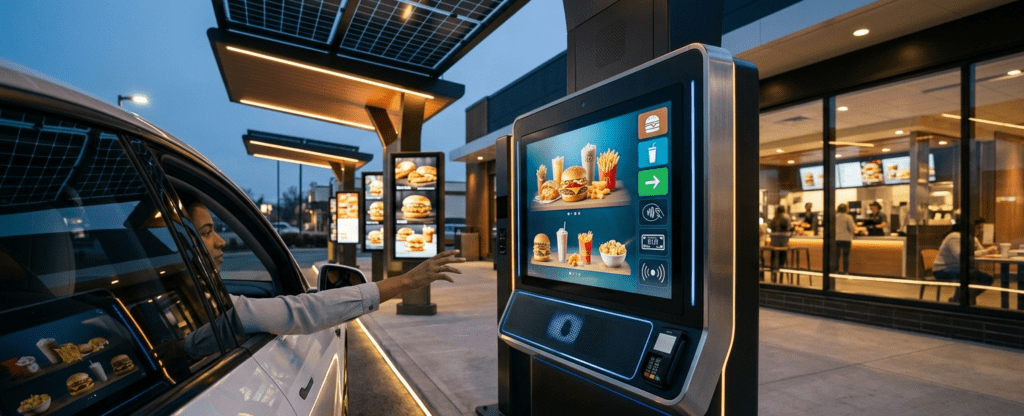
What is Drive Thru Kiosks
Drive-thru kiosks are self-service ordering terminals that are commonly found in fast food restaurants. Customers can use these kiosks to place their order, select menu items, and make payments. Drive-thru kiosks provide customers with an alternative to traditional drive-thru ordering methods and can improve the speed and efficiency of the drive-thru process. The use of drive-thru kiosks also reduces the need for human interaction, which can be beneficial for customers who prefer a contactless ordering experience.
Benefits of drive-thru Kiosk
The benefits of drive-thru kiosks include:
Speed and Efficiency: Drive-thru kiosks allow customers to place their order quickly and efficiently, reducing wait times and improving the overall drive-thru experience.
Reduced human interaction: Drive-thru kiosks provide a contactless ordering experience for customers who prefer to minimize human interaction.
Increased accuracy: Kiosks eliminate the possibility of human error in the ordering process and ensure that orders are accurate and consistent.
Improved convenience: Drive-thru kiosks allow customers to place their order at their own pace and without the need to interact with an attendant.
Personalized experience: Kiosks can be programmed to offer customized menu options and recommendations based on a customer’s previous orders.
Increased sales: By improving the speed and efficiency of the drive-thru process, drive-thru kiosks can increase sales and boost revenue for fast food restaurants.
Cost savings: By reducing the need for human attendants, drive-thru kiosks can help fast food restaurants save on labor costs.
1. Features of Drive Thru Kiosk
The features of drive-thru kiosks include:
Touchscreen interface: Kiosks typically feature a large, user-friendly touchscreen interface that allows customers to easily navigate and select menu items.
Menu customization: Kiosks can be programmed to offer customized menu options and recommendations based on a customer’s previous orders.
Multiple payment options: Drive-thru kiosks typically accept a variety of payment methods, including cash, credit cards, and mobile payments.
Order tracking: Kiosks can track and display the status of a customer’s order in real-time, providing transparency and reducing confusion.
Integration with restaurant POS systems: Drive-thru kiosks can be integrated with a restaurant’s point of sale (POS) system, allowing for seamless and efficient order processing.
Multilingual support: Kiosks can be configured to support multiple languages, making them accessible to a wider range of customers.
Custom branding: Drive-thru kiosks can be customized with a restaurant’s logo and brand colors, providing a consistent and recognizable brand experience.
Audio and visual prompts: Kiosks can be programmed to provide audio and visual prompts to guide customers through the ordering process and provide feedback on the status of their order.
2. Technical Features of Drive Thru Kiosk
Hardware: Drive-thru kiosks typically use robust and durable hardware components, including touchscreens, card readers, and printers, to ensure reliable and long-lasting performance.
Operating system: Kiosks run on a specialized operating system, such as Windows or Android, that is optimized for self-service ordering applications.
Network connectivity: Drive-thru kiosks are typically connected to a local area network (LAN) or a wireless network, allowing for seamless communication with the restaurant’s POS system and other hardware components.
User authentication: Kiosks can be equipped with user authentication features, such as password protection or biometric scanning, to secure customer data and protect against unauthorized access.
Order processing software: Kiosks run specialized order processing software that manages the ordering and payment process and integrates with the restaurant’s POS system.
Printing technology: Kiosks typically use high-quality thermal printers to produce clear and legible receipts and order tickets.
Remote management: Drive-thru kiosks can be remotely managed and monitored, allowing for quick and easy updates, troubleshooting, and maintenance.
Data storage: Kiosks use secure data storage systems to store customer data and transaction information, ensuring data security and privacy.
3. Speed and Efficiency
Staff Training and Workflow :
Training your staff to work efficiently and collaboratively can reduce wait times and increase throughput. Standardizing procedures and workflows can reduce errors and promote consistency. Cross-training employees can enable them to handle multiple roles, reducing the need for dedicated staffing.
Technology and Automation :
Technology and automation can be used to simplify the ordering and fulfillment process. This reduces the need for manual labor and increases accuracy and speed.
Customers can place orders without human interaction by using order-taking kiosks or mobile apps. This reduces wait times and minimizes errors.
4. Quality and Accuracy
Menu Simplification and Standardization :
Simplifying and standardizing the menu can reduce complexity and improve accuracy. Streamline the menu items. Reduce customization options. This will enable staff to focus on preparing and delivering orders quickly and accurately.
Order Tracking and Verification :
Technology, such as order tracking systems or digital receipts, can help staff track and verify orders. This ensures the correct items are delivered to the customer. Additionally, providing quality checks at the payment and pickup windows can prevent mistakes and reduce the need for corrections.
5. Marketing and Promotion
Special Offers and Combos :
Offering special deals and promotions, such as meal combos or limited-time offers, can attract customers and increase sales. Offering discounts or free items to customers who use the drive-thru can encourage them to choose your restaurant. This incentive can help you stand out from competitors.
Loyalty Programs :
Implementing a loyalty program can reward repeat customers and increase customer retention. Offer loyalty points or rewards for drive-thru orders. This will incentivize customers to use your drive-thru service. This can increase their lifetime value.
6.Industries that can get benefits from the drive-thru
The Drive-thru concept has become increasingly popular over the years, and it is now commonly used in a wide range of industries. Here are some of the industries that can benefit from using drive-thru:
Conclusion:
Overall, any industry that values speed, convenience, and customer service can benefit from using the drive-thru. As technology continues to advance, we can expect to see even more industries adopting the drive-thru concept in the years to come. Conclusion: In conclusion, the evolution of drive-thrus has been remarkable, from its humble beginnings as a simple window for customers to receive their food to a highly sophisticated and convenient system. The drive-thru has changed the way we access goods and services, making it easier, enhancing the customer experience, and making it more convenient for people to get what they need without leaving their cars. As the drive-thru industry continues to evolve, it will be exciting to see how it adapts to new technologies and innovations, providing customers with even greater convenience and efficiency.