Introduction
Patient education is an essential part of modern healthcare. Patients and visitors need clear, accessible information about healthcare services, procedures, preventive care, medication awareness, hospital facilities, and general health practices.
Traditionally, hospitals and clinics have relied on brochures, posters, and printed notices to communicate this information. However, static communication can become outdated and may not always capture attention in busy healthcare environments.
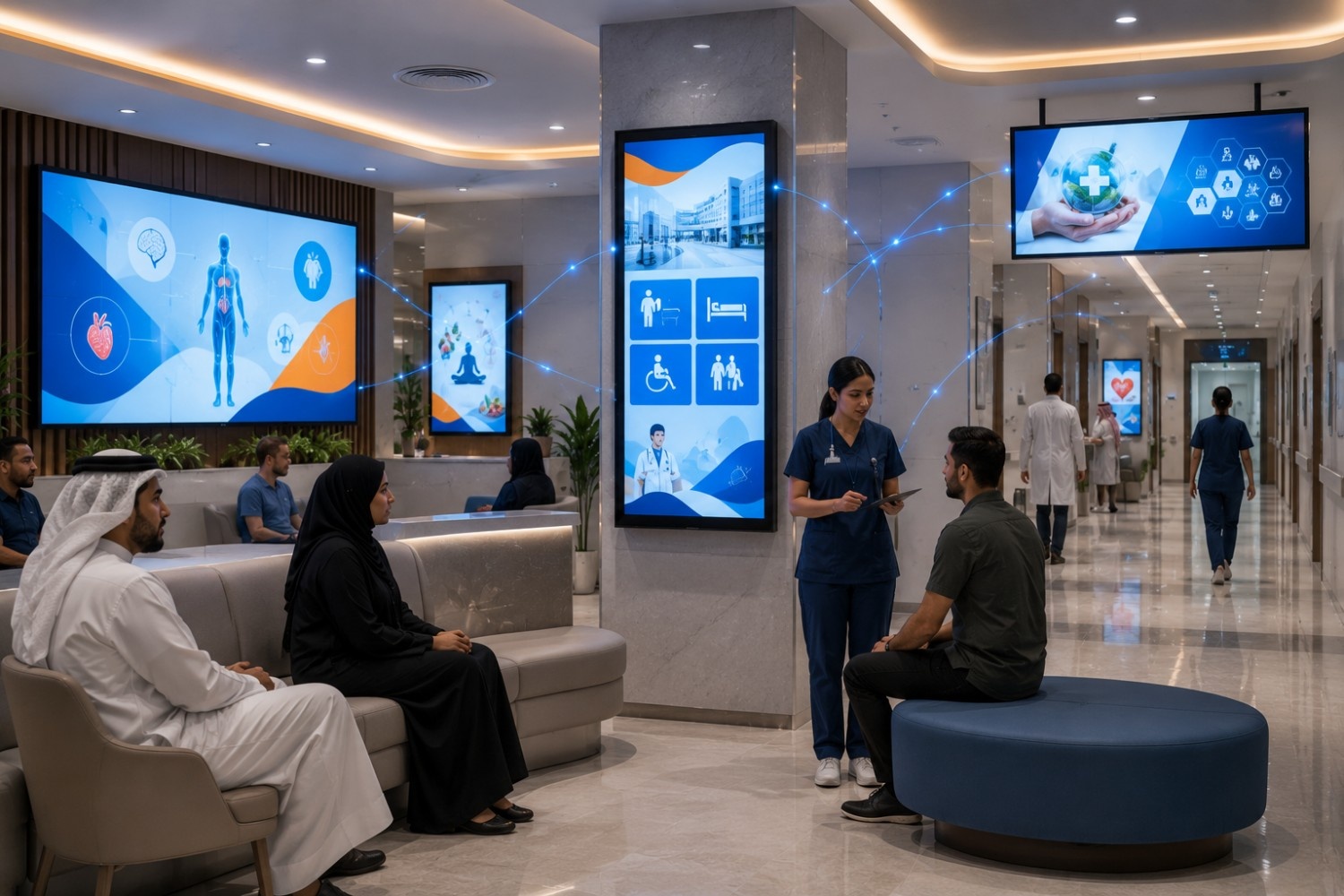
Digital signage for patient education provides a more dynamic approach. Hospitals, clinics, and healthcare facilities can use digital screens to display educational videos, health awareness messages, service information, wayfinding content, and other patient-focused communication.
For healthcare organizations across Saudi Arabia, UAE, Qatar, Kuwait, and the wider Middle East, digital signage can support a more informative and engaging patient experience while allowing communication teams to update content more efficiently.
What Is Digital Signage for Patient Education?
Digital signage for patient education refers to the use of digital screens in hospitals, clinics, diagnostic centers, pharmacies, and other healthcare environments to communicate health-related educational and informational content.
Instead of displaying the same printed poster for months, healthcare facilities can use digital screens to rotate different messages throughout the day.
Content may include:
- General health awareness
- Preventive healthcare information
- Pre-visit instructions
- Department information
- Service explanations
- Health campaign messages
- Hygiene and safety guidance
- Lifestyle education
- Patient preparation information
- Post-visit reminders
The objective is not to replace healthcare professionals. Rather, digital signage can act as a supporting communication channel that reinforces information patients receive from qualified healthcare staff.
1. Digital Screens Can Make Patient Information More Engaging
Patients in hospitals and clinics may spend time in reception areas, waiting rooms, corridors, and outpatient departments.
These environments provide opportunities to communicate useful information through visual content.
Research on audiovisual aids in healthcare waiting rooms suggests that screen-based information can improve patient knowledge in some settings, although results vary depending on factors such as content, exposure time, and audience.
Short videos, animations, illustrations, and simple visual explanations can therefore make educational communication easier to consume than large blocks of printed text.
2. Patient Education Can Start Before the Consultation
Patient education does not necessarily need to begin when the patient enters the consultation room.
Digital screens in waiting areas can introduce general information about:
- Preparing for healthcare visits
- Healthy lifestyle practices
- Preventive care
- Screening awareness
- Hospital services
- General wellness
- Frequently asked healthcare questions
This allows patients to become familiar with relevant information while they are waiting.
Importantly, healthcare facilities should ensure that educational content is reviewed and approved by appropriate clinical or medical teams before publication.
3. Digital Signage Can Support Health Awareness Campaigns
Healthcare organizations frequently conduct awareness campaigns around important health topics.
Digital signage makes it easier to rotate campaign content across multiple screens.
Hospitals and clinics can use digital displays for awareness campaigns related to:
- Diabetes
- Heart health
- Vaccination
- Nutrition
- Women’s health
- Children’s health
- Preventive screening
- Infection prevention
- Healthy lifestyle practices
Instead of printing and replacing posters throughout a facility, communication teams can update approved digital content through a centralized system.
4. Multilingual Patient Education Is Particularly Valuable in the GCC
Healthcare facilities across the Middle East serve diverse populations.
For hospitals and clinics in Saudi Arabia, Dubai, Abu Dhabi, Qatar, and Kuwait, patient communication may need to support Arabic and English, depending on the facility and audience.
Digital signage makes it possible to display different language versions or rotate multilingual content without requiring separate physical signage for every message.
This can make educational communication more accessible while helping healthcare organizations maintain consistent branding.
For GCC healthcare operators with multiple facilities, multilingual and centrally managed content can also simplify communication workflows.
5. Digital Signage Can Improve Hospital Wayfinding
Patient education is not limited to medical information.
Patients also need to understand where they need to go.
Large hospitals can have multiple departments, clinics, laboratories, imaging facilities, pharmacies, and waiting areas. Poor wayfinding can create confusion for patients and visitors.
Research on hospital wayfinding has shown that clear, multilingual signage can help patients and visitors reach their destinations and improve the overall patient experience.
Digital displays can complement conventional signs by providing:
Department directions → Floor information → Service locations → Waiting-area information → Facility navigation
For large healthcare facilities, digital wayfinding can therefore become an important part of patient communication.
6. Digital Screens Can Explain Healthcare Services
Healthcare services are not always easy for patients to understand.
A digital display can provide simple visual explanations of services offered by a hospital or clinic.
For example, a screen near an imaging department could explain the general purpose of different diagnostic services without providing individualized medical advice.
Similarly, a clinic could introduce its departments, specialties, and available services.
The key is to keep information simple, accurate, clinically reviewed, and easy to understand.
7. Digital Signage Can Reinforce Important Instructions
Patients often receive instructions from doctors, nurses and administrative staff.
Digital signage can reinforce general instructions without replacing personalized communication.
Examples include:
- Hand hygiene reminders
- Visitor guidance
- General preparation instructions
- Facility safety information
- Appointment-related guidance
- General post-visit reminders
Research on patient education has demonstrated that important communication domains can sometimes be missed during discharge conversations, highlighting why healthcare communication benefits from multiple complementary channels.
However, digital signage should never be treated as a substitute for individualized clinical instructions.
8. Digital Signage Helps Keep Healthcare Communication Fresh
One major limitation of printed healthcare communication is content maintenance.
A poster displaying an outdated service, campaign, or instruction can remain visible long after the information has changed.
Digital signage allows authorized teams to update content more efficiently.
With a centralized digital signage CMS, healthcare organizations can schedule content, update campaigns, and distribute approved information to selected displays.
FAMA Technologies’ Infinite Digital CMS is positioned as a cloud-based, multilingual platform designed for content creation, scheduling, and distribution, including remote content management.
This can be particularly relevant for healthcare groups operating multiple facilities.
9. Digital Signage Can Support Multi-Location Healthcare Networks
Healthcare groups may operate hospitals, clinics, diagnostic centers and specialty facilities across different cities.
Managing communication across these locations can become challenging when every facility relies on individual teams and printed materials.
A centralized digital signage approach can help organizations maintain:
- Consistent brand communication
- Standardized educational content
- Location-specific information
- Multilingual messaging
- Scheduled campaigns
- Centralized content control
For healthcare groups operating across Riyadh, Jeddah, Dubai, Doha and Kuwait City, this approach can provide a more scalable way to manage patient-facing digital communication.
How FAMA Technologies Can Support Healthcare Digital Signage
FAMA Technologies provides digital transformation solutions, including Infinite Digital, its digital signage platform.
Infinite Digital is positioned as a cloud-based, multilingual CMS that supports content creation, scheduling, and distribution.
For healthcare environments, a digital signage platform can provide the infrastructure needed to manage patient-facing screens across reception areas, waiting rooms, corridors, departments, and other suitable locations.
The content itself should remain under the appropriate healthcare organization’s communication and clinical governance processes.
This distinction is important: the technology manages and distributes information; qualified healthcare professionals should determine the accuracy and suitability of medical education content.
Best Practices for Healthcare Patient Education Screens
Healthcare organizations should follow several principles when deploying digital signage for patient education:
- Keep information simple – Avoid excessive medical terminology.
- Use strong visuals – Videos, illustrations, and animations can make complex information easier to understand.
- Prioritize accuracy – Medical content should be reviewed by appropriate professionals.
- Use multilingual communication – Consider Arabic and English where appropriate.
- Keep content current – Remove outdated campaigns and information.
- Respect privacy – Never display confidential or identifiable patient information on public screens.
- Use appropriate screen placement – Match content to the patient journey.
- Keep messages concise – Patients may only view content for a short period.
- Maintain accessibility – Consider readability, contrast, language and visual clarity.
- Measure and improve – Where possible, evaluate engagement and patient communication outcomes.
The Future of Patient Education Through Digital Signage
Healthcare digital signage is moving beyond simple waiting-room television.
Modern digital displays can become part of a broader healthcare communication ecosystem involving digital wayfinding, multilingual communication, centralized CMS platforms, health awareness campaigns, and connected patient experiences.
The goal should not be to fill healthcare facilities with screens.
Instead, hospitals and clinics should use digital signage where it can answer a genuine communication need.
For healthcare organizations across Saudi Arabia, UAE, Qatar, Kuwait, and the wider Middle East, digital signage can help make patient-facing information more accessible, timely, and engaging.
With platforms such as FAMA Technologies’ Infinite Digital, healthcare organizations can build a more centralized approach to managing digital content while keeping clinical accuracy and patient needs at the center of the communication strategy.