Introduction
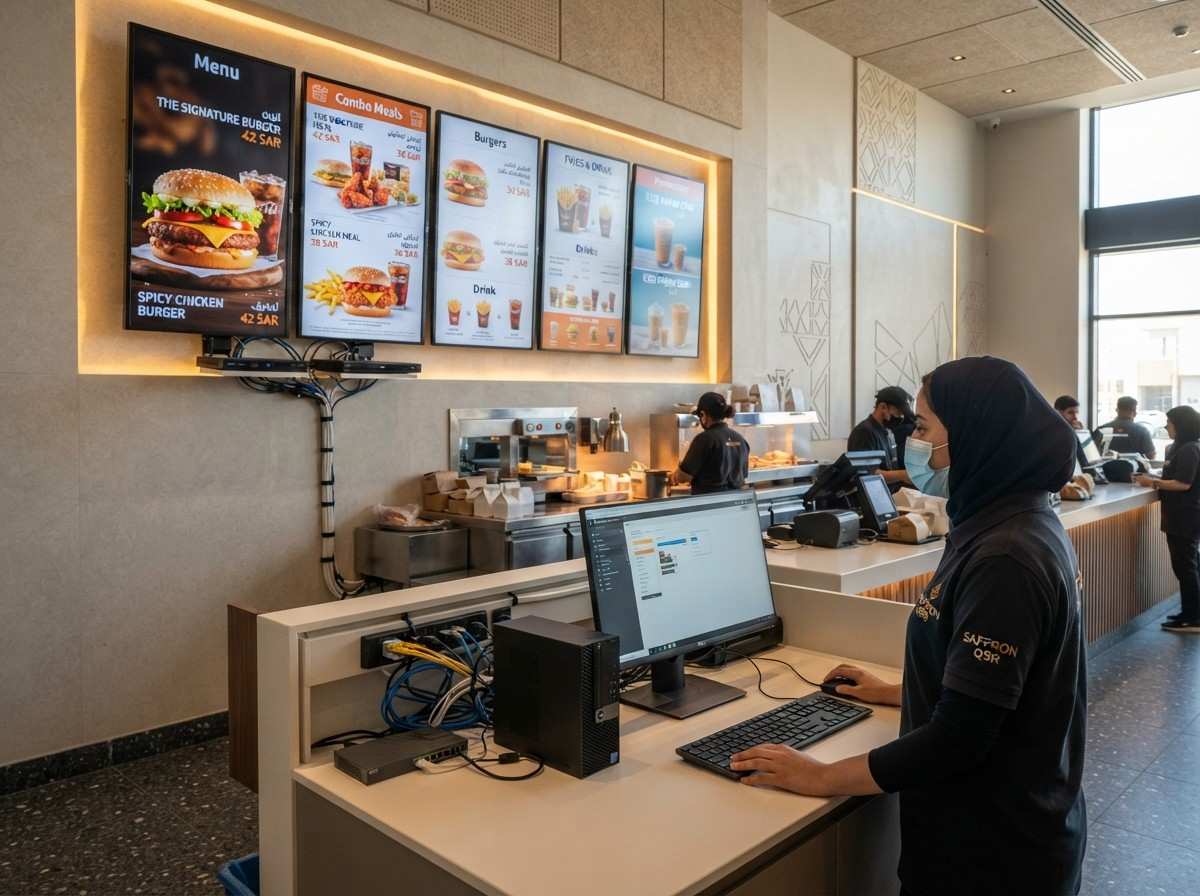
Restaurants and quick-service restaurants (QSRs) are increasingly moving from traditional printed menus to digital menu boards to create more flexible, engaging and manageable customer-facing displays.
However, choosing a digital menu board solution is not simply about purchasing a commercial display and putting a menu on the screen. A complete solution can involve commercial-grade displays, media players, digital signage CMS, content management, networking, installation, scheduling and ongoing support.
For restaurants planning a new digital menu board system—or replacing an existing one—understanding these components can help simplify the buying process.
What Are Digital Menu Boards for Restaurants?
Digital menu boards for restaurants are electronic displays used to present menus, prices, food images, promotions, combos and other customer-facing information.
Unlike static printed menus, digital menu boards can be updated electronically. Depending on the solution, restaurant teams can manage content locally or remotely through a centralized digital signage CMS.
A typical restaurant digital menu board solution may include:
- Commercial digital displays
- Media players or signage devices
- Digital signage CMS
- Content management tools
- Network connectivity
- Mounting and installation
- Remote monitoring and support
- Scheduling and content updates
The exact configuration depends on the restaurant’s size, number of locations and operational requirements.
Why Restaurants Are Moving to Digital Menu Boards
Before selecting a solution, restaurants should evaluate more than screen size and resolution.
1. Choose the Right Commercial Display
The display is one of the most visible parts of the system, but it should be selected according to the environment.
Consider:
- Screen size
- Resolution
- Brightness
- Operating hours
- Viewing distance
- Portrait or landscape orientation
- Installation location
- Commercial durability
Indoor menu boards may have different requirements from displays installed near windows or in semi-outdoor environments.
Restaurants should also consider how many displays are required and whether different screens need to show different content.
2. Evaluate the Digital Signage CMS
https://www.famatechnologies.com/infinite-digital/The digital signage CMS is one of the most important components of a digital menu board solution.
A CMS allows authorized users to manage what appears on connected displays.
Depending on the platform, businesses may be able to:
- Upload menu content
- Schedule campaigns
- Create playlists
- Update promotions
- Manage multiple screens
- Organize content by location
- Publish changes remotely
For a restaurant chain, centralized CMS management can significantly simplify operations compared with manually updating individual screens.
3. Look for Centralized Content Management
A single restaurant may have several menu displays. A growing restaurant chain may have dozens or hundreds across different branches.
Therefore, scalability should be considered before deployment.
A suitable restaurant digital signage solution should make it possible to organize screens and locations logically and publish the appropriate content to each one.
For example:
Location A: Standard menu + local promotion
Location B: Standard menu + regional offer
Location C: Breakfast menu + limited-time promotion
This type of centralized management can provide greater operational control as the restaurant network grows.
4. Consider Content Scheduling and Dayparting
Restaurants rarely serve the same menu throughout the entire day.
A digital menu board system can support scheduled content for:
- Breakfast
- Lunch
- Evening
- Dinner
- Late night
- Weekend promotions
- Seasonal campaigns
With dayparting, restaurants can prepare content in advance and schedule when it should appear.
This reduces the need for staff to manually change menu content and allows businesses to align displays with operating hours and promotional campaigns.
5. Assess Network and Connectivity Requirements
Events can change quickly.
A match may experience delays, schedule changes, gate changes, or operational announcements. Concerts and other large-scale events may also require frequent communication with visitors.
Digital signage enables venue operators to update information without replacing printed signs throughout the facility.
For example, if a particular entrance becomes temporarily unavailable, relevant screens can immediately display an alternative route.
This ability to deliver real-time stadium content can make venue communication more responsive.
6. Plan Digital Menu Board Installation Properly
Installation should be considered before purchasing the equipment.
Restaurants should evaluate:
- Wall structure
- Mounting requirements
- Screen positioning
- Power availability
- Cable routing
- Network connectivity
- Customer viewing angles
- Staff accessibility
- Ventilation and heat considerations
A well-planned installation can help create a cleaner customer-facing environment and make future maintenance easier.
For restaurants opening a new location, it is useful to include digital signage requirements during the initial design and fit-out stage rather than treating installation as an afterthought.
7. Think About Content Management, Not Just Hardware
A common mistake is to focus heavily on displays while overlooking content.
A successful digital menu board needs an effective content strategy.
Restaurants should determine:
- Which products receive priority
- How many products appear on each screen
- Where promotions are displayed
- How prices are presented
- How food photography is used
- How frequently content changes
- Who is responsible for updates
The objective is to create a menu experience that is easy to understand while allowing the restaurant to communicate important products and offers.
8. Consider Multi-Location Scalability
If you operate—or plan to operate—multiple restaurants, scalability should be part of the initial buying decision.
A system designed for one location may not provide the management capabilities required for a larger restaurant network.
Look for capabilities such as:
- Centralized screen management
- Location-based content
- Remote updates
- Scheduled publishing
- User access controls
- Content organization
- Remote monitoring
- Scalable deployment
This can help restaurant groups maintain greater consistency while still allowing location-specific content when necessary.
9. Compare Indoor and Outdoor Requirements
Not every digital menu board is designed for every environment.
Indoor restaurant displays generally have different requirements from outdoor digital menu boards used in drive-thru environments or exposed locations.
Outdoor deployments may require consideration of:
- Higher brightness
- Weather protection
- Temperature conditions
- Visibility in daylight
- Protective housing
- Outdoor-rated equipment
For QSRs with drive-thru operations, the digital menu board system may also need to integrate into the broader drive-thru environment.
10. Evaluate Support and Maintenance
Digital signage is an operational technology system, so support should be part of the buying decision.
Ask potential providers about:
- Installation support
- Configuration
- Training
- Remote troubleshooting
- Hardware support
- Software updates
- Maintenance
- Replacement procedures
- Scalability
A solution provider that can support the system beyond the initial installation can make long-term management easier.
Digital Menu Boards from FAMA Technologies
The role of digital signage in stadiums is moving beyond simply displaying advertisements or scores.
Modern stadiums need communication systems that can respond to changing events, different audiences, and multiple venue zones.
Large-format video walls can create immersive experiences, while smaller digital displays can provide practical information exactly where fans need it.
When combined with real-time data and centralized content management, stadium digital signage can become an important part of the overall venue infrastructure.
For sports venues investing in better fan experiences, digital signage provides a scalable way to communicate, entertain, guide, and engage visitors throughout their entire stadium journey.
Conclusion
Choosing digital menu boards for restaurants requires more than selecting a display with a suitable screen size.
Restaurants should evaluate the complete digital menu board system, including commercial displays, CMS, content management, scheduling, networking, installation, scalability and support.
For a single restaurant, the priority may be simple content management and attractive menu presentation. For a growing QSR chain, centralized management, remote updates and multi-location scalability may become much more important.
By evaluating these requirements before deployment, restaurants can select a digital signage solution that fits their current operation while providing room for future growth.