Introduction
Educational institutions across Saudi Arabia, the UAE, Qatar, Egypt, and the wider Middle East are designed to be open, collaborative, and welcoming environments that support learning, innovation, and community engagement. However, growing student populations, multiple campus entry points, public events, and evolving security challenges have made campus safety more complex than ever. Universities and schools must strike the right balance between providing an accessible learning environment and ensuring the safety of students, faculty, staff, visitors, and critical campus infrastructure.
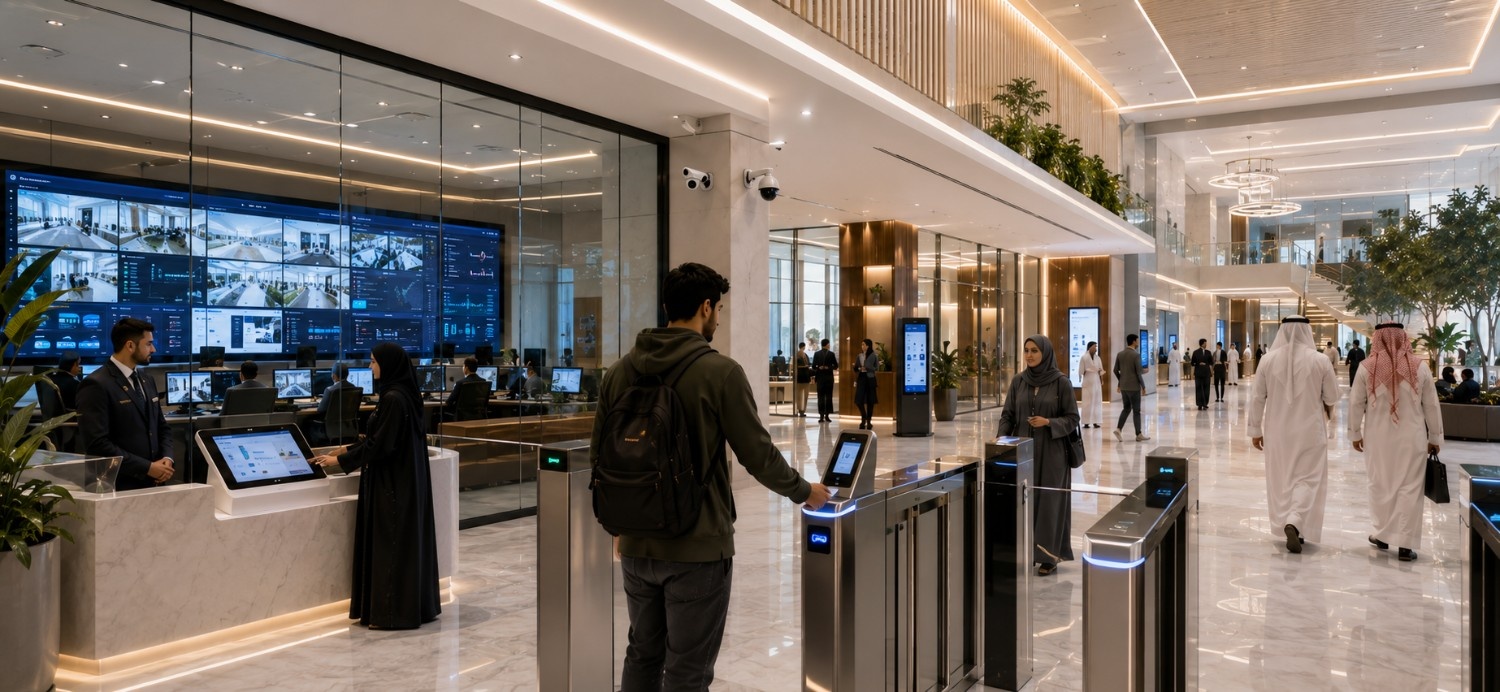
Traditional security measures such as standalone CCTV cameras, on-site security personnel, and manual visitor registration systems are no longer sufficient to meet the demands of today’s Smart Campus environments. Modern educational institutions require integrated security ecosystems that combine intelligent access control, AI-powered video surveillance, visitor management, emergency communication systems, and real-time monitoring into a unified security platform.
As Smart Campus initiatives continue to accelerate across Riyadh, Jeddah, Dammam, Makkah, Madinah, Dubai, Abu Dhabi, Doha, Cairo, and the wider Middle East, intelligent campus security has become a strategic investment that enhances operational resilience, supports regulatory compliance, improves emergency preparedness, and creates a safer, more secure learning environment for everyone.
1.Why Campus Security Matters
A secure learning environment is fundamental to educational success. Students perform better when they
feel safe, faculty can focus on teaching without unnecessary disruption, and administrators can confidently
Manage campus operations.
Today’s institutions face a wide range of security challenges, including:
- Unauthorised campus access
- Visitor verification
- Student and staff safety
- Vehicle access management
- Theft and vandalism
- Emergency evacuation
- Cyber-physical security risks
- Protection of research facilities
- After-hours building access
- Compliance with institutional security policies
Addressing these challenges requires a proactive approach where technology supports prevention,
Detection, response, and continuous monitoring.
2. What is Intelligent Campus Access Control?
Campus access control is the process of regulating who can enter specific buildings, classrooms,
laboratories, dormitories, or restricted areas.
Modern access control systems authenticate users through secure credentials such as:
- Smart ID cards
- Mobile credentials
- QR codes
- PIN codes
- Biometric authentication (where legally permitted and governed by applicable privacy regulations)
- Multi-factor authentication
Unlike traditional lock-and-key systems, digital access control provides real-time visibility into entry events,
Allowing administrators to grant, modify, or revoke permissions instantly.
When integrated with identity management systems, access rights can automatically adjust based on a
person’s role, enrolment status, or employment status.
Core Components of a Smart Campus Security
Ecosystem
1. AI-Powered Video Surveillance
Modern surveillance systems do more than record video. AI-enabled analytics can assist security teams by
detecting predefined events such as:
- Unauthorised entry
- Perimeter intrusion
- Loitering
- Object left behind
- Crowd density
- Restricted area access
- Vehicle movement
These systems generate alerts for human review, enabling faster responses while reducing the need for
constant manual monitoring.
2. Visitor Management
Educational institutions welcome parents, contractors, guest lecturers, alumni, and prospective students
every day.
Digital visitor management systems allow institutions to:
- Pre-register visitors
- Verify identity
- Issue temporary access credentials
- Print visitor badges
- Track visitor movements
- Notify hosts automatically
- Maintain digital visitor logs
This creates a more professional visitor experience while improving accountability.
3. Vehicle Access Management
Universities often manage thousands of vehicles daily. Technologies such as Automatic Number Plate Recognition (ANPR) can automate vehicle entry and exit by:
- Recognising authorised vehicles
- Managing parking permissions
- Recording entry times
- Supporting visitor parking
- Reducing congestion at campus entrances
This improves traffic flow while strengthening perimeter security.
4. Emergency Communication
During emergencies, speed and consistency of communication are critical.
Integrated emergency management platforms can distribute alerts simultaneously through:
- Digital signage
- Mobile applications
- SMS notifications
- Email
- Public address systems
- Desktop notifications
Examples include fire alarms, severe weather warnings, medical emergencies, and security incidents.
Real-World Scenarios
Scenario 1: Visitor Registration During a University Open Day
A university expects hundreds of prospective students and parents for an open day. Visitors register online
before arrival, receive QR codes, and check in at self-service kiosks. Temporary visitor badges are printed
automatically, and hosts receive instant notifications. This reduces waiting times, improves security, and
provides accurate attendance records.
Scenario 2: Laboratory Access Control
A research laboratory contains specialised equipment and sensitive materials. Only authorised researchers
can enter using smart ID cards or approved mobile credentials. Access events are logged automatically, and
administrators receive alerts if unauthorised entry attempts occur outside approved hours.
Scenario 3: Emergency Lockdown
A security incident requires immediate action. The command centre activates an emergency response
protocol that locks selected access-controlled doors, displays evacuation instructions on digital signage,
sends notifications to staff and students, and provides live situational awareness through surveillance
systems. Security personnel receive coordinated information from a single platform.
Scenario 4: Intelligent Parking Management
At the start of the academic year, vehicle traffic increases significantly. ANPR systems identify authorised
vehicles, direct visitors to designated parking areas, and record occupancy levels. Students and staff spend
less time searching for parking, improving traffic flow and reducing congestion.
Integration with Smart Campus Technologies
Security systems deliver greater value when integrated with the wider Smart Campus ecosystem.
Examples include:
- Student Information Systems (SIS)
- Human Resources systems
- Visitor Management
- Building Management Systems (BMS)
- Digital Signage
- Queue Management
- Emergency Notification Platforms
- Mobile Campus Applications
- Command and Control Centres
Integrated platforms provide administrators with a comprehensive operational view while reducing manual
processes.
Best Practices for Campus Security
Educational institutions should adopt a layered security strategy based on people, processes, and
technology.
Recommended practices include:
- Conduct regular security risk assessments.
- Implement role-based access permissions.
- Review visitor policies periodically.
- Integrate physical and cybersecurity strategies.
- Monitor security systems continuously.
- Provide emergency response training.
- Test evacuation procedures regularly.
- Ensure compliance with national regulations and institutional policies.
Technology should support—not replace—well-defined security procedures and trained personnel.
Supporting Saudi Vision 2030
Saudi Vision 2030 promotes digital transformation, innovation, and the development of safe, world-class
educational environments. Intelligent campus security supports these goals by improving operational
resilience, protecting critical infrastructure, and enabling institutions to adopt connected technologies with
confidence (Kingdom of Saudi Arabia, 2023).
As educational institutions invest in Smart Campus initiatives, security must remain a foundational
component rather than an afterthought.
Why FAMA Technologies?
FAMA Technologies delivers integrated campus security solutions tailored to educational institutions,
including:
- Intelligent Access Control Systems
- AI-Powered Video Surveillance
- Visitor Management Platforms
- Automatic Number Plate Recognition (ANPR)
- Digital Signage for Emergency Communication
- Command and Control Centres
- Perimeter Protection
- Smart Parking Solutions
- Network Infrastructure
System Integration and Managed Services
Our solutions are designed to integrate seamlessly with broader Smart Campus platforms, helping
institutions create secure, connected, and future-ready learning environments.
Final Thoughts
Campus safety is no longer limited to installing cameras or controlling entry doors. Modern educational
Institutions require intelligent, integrated security ecosystems that provide real-time visibility, support rapid
decision-making, and enhance the experience of students, staff, and visitors.
By combining access control, AI-powered surveillance, visitor management, emergency communications,
and analytics, schools and universities can strengthen security while maintaining open, welcoming
campuses that foster learning and collaboration.
Investing in integrated campus safety today establishes a secure foundation for a future Smart Campus
Initiatives and supports the long-term goals of educational excellence and digital transformation.
Call to Action
Is your campus security strategy ready for the future?
FAMA Technologies partners with schools, colleges, and universities to design and implement integrated
access control and campus safety solutions tailored to their operational requirements. Contact our
Education Solutions team to learn how we can help create a safer, smarter campus.