Introduction
The modern drive-thru is evolving from a simple speaker-and-menu setup into a connected digital ecosystem. As customer expectations for speed, convenience, and order accuracy continue to rise, restaurants are increasingly turning to automated drive-thru solutions to streamline the entire ordering journey.
AI-powered voice ordering, digital menu boards, POS integration, Kitchen Display Systems (KDS), analytics, and automated order confirmation can work together to create a more efficient drive-thru operation.
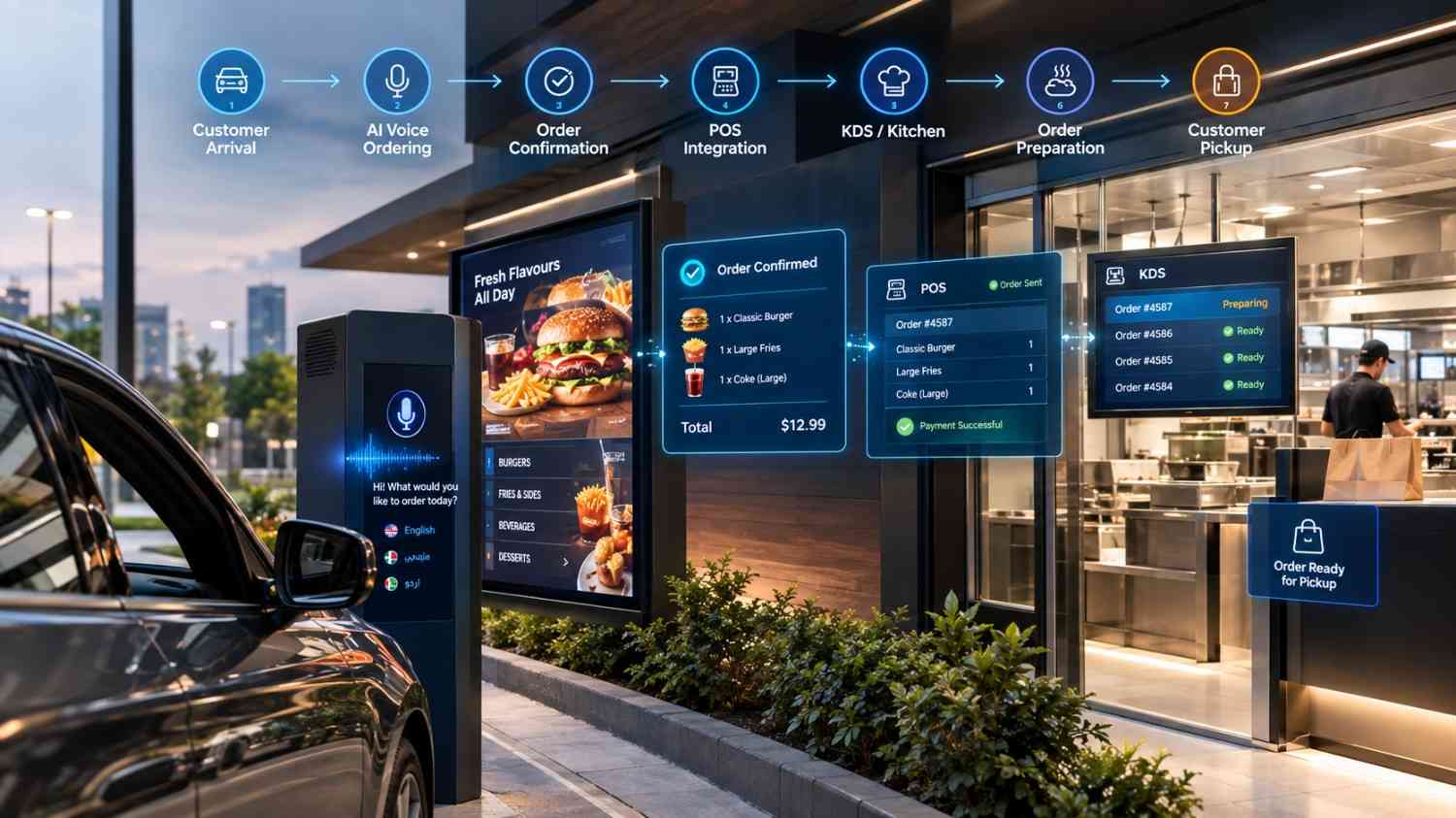
Instead of treating automation as a single technology, leading QSR brands are looking at the complete journey:
Customer Arrival → AI Voice Ordering → Order Confirmation → POS Integration → Kitchen/KDS → Order Preparation → Customer Pickup
This end-to-end approach is where AI drive-thru automation can deliver the greatest operational value.
What Are Automated Drive-Thru Solutions?
Automated drive-thru solutions combine software, AI, audio technology, digital displays, restaurant systems, and operational tools to automate or streamline different stages of the drive-thru experience.
Traditional drive-thru ordering depends heavily on employees listening to customers, entering orders manually, repeating information, and transferring that information to restaurant systems.
An automated drive-thru system can reduce these manual steps by connecting customer interaction directly with digital ordering workflows.
FAMA Technologies, for example, offers end-to-end drive-thru technology incorporating AI voice ordering, digital menu boards, POS integration, customer order displays, KDS, and other restaurant technologies.
The objective is not simply to replace people with AI. Instead, automation can handle repetitive processes while employees remain available for exceptions, complex requests, hospitality, and operational decision-making.
How AI Drive-Thru Automation Works: The Complete Journey
1. Customer Arrives at the Drive-Thru
Automation begins before the customer even places an order.
Smart drive-thru infrastructure can help restaurants monitor vehicle movement, queues, waiting times, and service points. Computer vision and vehicle monitoring technologies can provide operators with additional visibility into drive-thru performance and potential bottlenecks.
This data can help restaurant managers understand where delays occur and make better staffing or operational decisions.
2. AI Voice Ordering Takes the Order
The next stage is automated restaurant ordering through conversational AI.
Instead of relying entirely on a restaurant employee, customers can communicate naturally with an AI voice assistant.
For example, a customer could request a meal, change the size, remove an ingredient, add a side, or ask a question about the menu.
The AI can interpret natural-language requests and identify:
- Menu items
- Quantities
- Sizes
- Add-ons
- Modifications
- Combos
- Special requests
This creates a more conversational ordering experience instead of forcing customers to follow rigid commands.
3. Voice Recognition Handles Real-World Conversations
Drive-thru environments are challenging because they contain vehicle noise, wind, background conversations, and varying speech patterns.
Modern automated ordering systems therefore need more than basic speech-to-text functionality. They need to understand conversational intent and translate spoken requests into structured menu information.
Multilingual capability can be particularly valuable for restaurants operating in diverse markets.
FAMA Technologies states that its conversational Voice AI supports 96+ languages and dialects, including Arabic, English, and Urdu, making multilingual interaction a significant part of its AI drive-thru offering.
4. Automated Order Confirmation
Order accuracy is critical in any drive-thru.
After the AI captures the customer’s request, the system can confirm the selected items before the order moves further into the restaurant workflow.
Digital customer order displays can add another layer of verification by allowing customers to visually check their selections.
This can help identify misunderstandings before food preparation begins, reducing the likelihood of corrections later in the process.
FAMA’s drive-thru technology includes customer order display solutions designed to support this verification stage.
5. POS Integration Connects Ordering With Transactions
Once the customer confirms the order, the information needs to move into the restaurant’s operational systems.
This is where POS integration becomes essential.
Instead of an employee manually re-entering the same order into the POS, an integrated system can transfer relevant order information digitally.
The workflow can become:
AI Voice → Order Management → POS → Kitchen/KDS
This reduces duplicate data entry and can help create a more consistent process, particularly during high-volume periods.
6. Kitchen Display Systems Receive the Order
The automation journey does not end at the POS.
Once the order reaches the kitchen, a Kitchen Display System (KDS) can organize and route orders for preparation.
Kitchen teams can see incoming orders digitally, prioritize tasks, and coordinate preparation more efficiently.
This connection between front-of-house ordering and back-of-house operations is essential. A restaurant may automate order taking, but if the kitchen workflow remains disconnected, the overall customer experience may still suffer.
FAMA Technologies provides KDS technology designed to streamline meal preparation and route orders in real time.
7. Order Preparation and Customer Pickup
After the kitchen receives and prepares the order, the final stage is pickup.
At this point, automation can continue through order-ready displays, drive-thru monitoring, payment systems, and operational tracking.
The goal is a connected journey where information does not need to be repeatedly entered or manually transferred between different teams.
The result is a more seamless path from customer arrival to completed order.
The Role of Digital Menu Boards in Drive-Thru Automation
Digital menu boards are another important component of smart drive-thru solutions.
Unlike static signage, digital displays can be centrally managed and updated according to menu availability, promotions, pricing, and operational requirements.
When connected with other drive-thru technologies, digital menu boards can work alongside:
- AI voice ordering
- Drive-thru audio
- Customer order displays
- POS systems
- KDS
- Cloud-based content management
- Analytics
FAMA Technologies highlights this connected approach to digital signage and drive-thru operations across its restaurant technology portfolio.
How Automation Helps During Peak-Hour Demand
Peak periods are one of the biggest challenges for QSR operators.
Long queues can quickly create customer frustration, while employees may need to balance order taking, payment, food preparation, and customer service.
Drive-thru automation can reduce some of this operational pressure by automating repetitive ordering and data-entry tasks.
Potential benefits include:
- Faster order processing
- Reduced manual order entry
- More consistent order capture
- Better handling of high-volume periods
- Improved visibility into drive-thru performance
- More efficient use of restaurant staff
Importantly, automation should be designed around the restaurant’s complete workflow rather than a single technology.
Human Assistance Still Matters
AI does not need to handle every interaction independently.
Customers may make unusual requests, ask complex questions, encounter technical issues, or provide information that the AI cannot confidently interpret.
A strong automated drive-thru system should therefore include human fallback or escalation.
When AI needs assistance, the interaction can be transferred to a restaurant employee.
This hybrid model combines the consistency and scalability of automation with the judgment and flexibility of human employees.
Why End-to-End Automation Matters
The real value of automated drive-thru solutions comes from connecting multiple technologies.
An AI voice assistant operating independently is useful, but an integrated ecosystem can provide much greater operational value.
The complete workflow can connect:
Customer → Voice AI → Confirmation → POS → KDS → Kitchen → Pickup → Analytics
This creates a digital information flow across the restaurant rather than isolated technology at individual touchpoints.
For QSR brands looking to scale across multiple locations, this connected approach can also support centralized management and more consistent operating processes.
FAMA Technologies positions its restaurant technology portfolio around this broader ecosystem, combining drive-thru technology with POS, KDS, digital signage, self-service, surveillance, and back-office capabilities.
The Future of Automated Restaurant Ordering
The future of drive-thru operations is moving beyond simple automated order taking.
AI-powered voice interaction, multilingual conversations, intelligent menu systems, POS integration, KDS automation, computer vision, analytics, and predictive technologies can increasingly work together.
For restaurant operators, the opportunity is not simply to install an AI assistant. It is to build a connected automated restaurant ordering workflow that improves the customer journey while making restaurant operations more efficient.
As QSR brands continue to scale, AI drive-thru automation can become an important part of creating faster, smarter, and more scalable restaurant operations.
Conclusion
Automated drive-thru solutions are transforming restaurant ordering from a manual, disconnected process into an integrated digital workflow.
From the moment a customer arrives to the moment they pick up their order, AI and connected restaurant technologies can help streamline communication, order confirmation, POS processing, kitchen operations, and service monitoring.
For QSR brands evaluating their next generation of restaurant technology, the key is to think beyond an individual AI tool and focus on the entire customer journey.
With solutions spanning AI voice ordering, drive-thru technology, digital signage, POS, KDS, and analytics, FAMA Technologies can help restaurants move toward a more connected and intelligent drive-thru operation.