Introduction
Drive-thru restaurants across Saudi Arabia and the wider Middle East are entering a new phase of automation. Customers increasingly expect faster service, accurate orders, convenient payment options, and a smooth experience without unnecessary waiting.
One technology gaining attention in this transformation is AI voice ordering for drive-thru restaurants.
Instead of relying entirely on a restaurant employee to listen to every order through a speaker, conversational AI can understand a customer’s spoken request, identify menu items and modifications, confirm the order, and connect the interaction with the restaurant’s ordering workflow.
For QSR brands in Saudi Arabia, Dubai and the UAE, Qatar, and Kuwait, AI voice ordering can become an important part of a modern drive-thru technology ecosystem.
What Is AI Voice Ordering for Drive-Thru Restaurants?
AI voice ordering is a conversational artificial intelligence system designed to communicate with customers using natural speech.
At a drive-thru, the customer can speak naturally instead of following a rigid sequence of buttons or commands. The AI processes the customer’s speech, identifies the requested menu items, understands modifications, asks follow-up questions when necessary, and confirms the final order.
A complete AI drive-thru environment can combine voice AI, drive-thru audio, digital menu boards, customer order displays, POS integration, kitchen systems, and analytics.
FAMA Technologies’ AI On-Go Drive-Thru Solution, for example, uses conversational voice AI to streamline ordering and provide multilingual support across Saudi Arabia and the GCC.
How Does AI Voice Ordering Work?
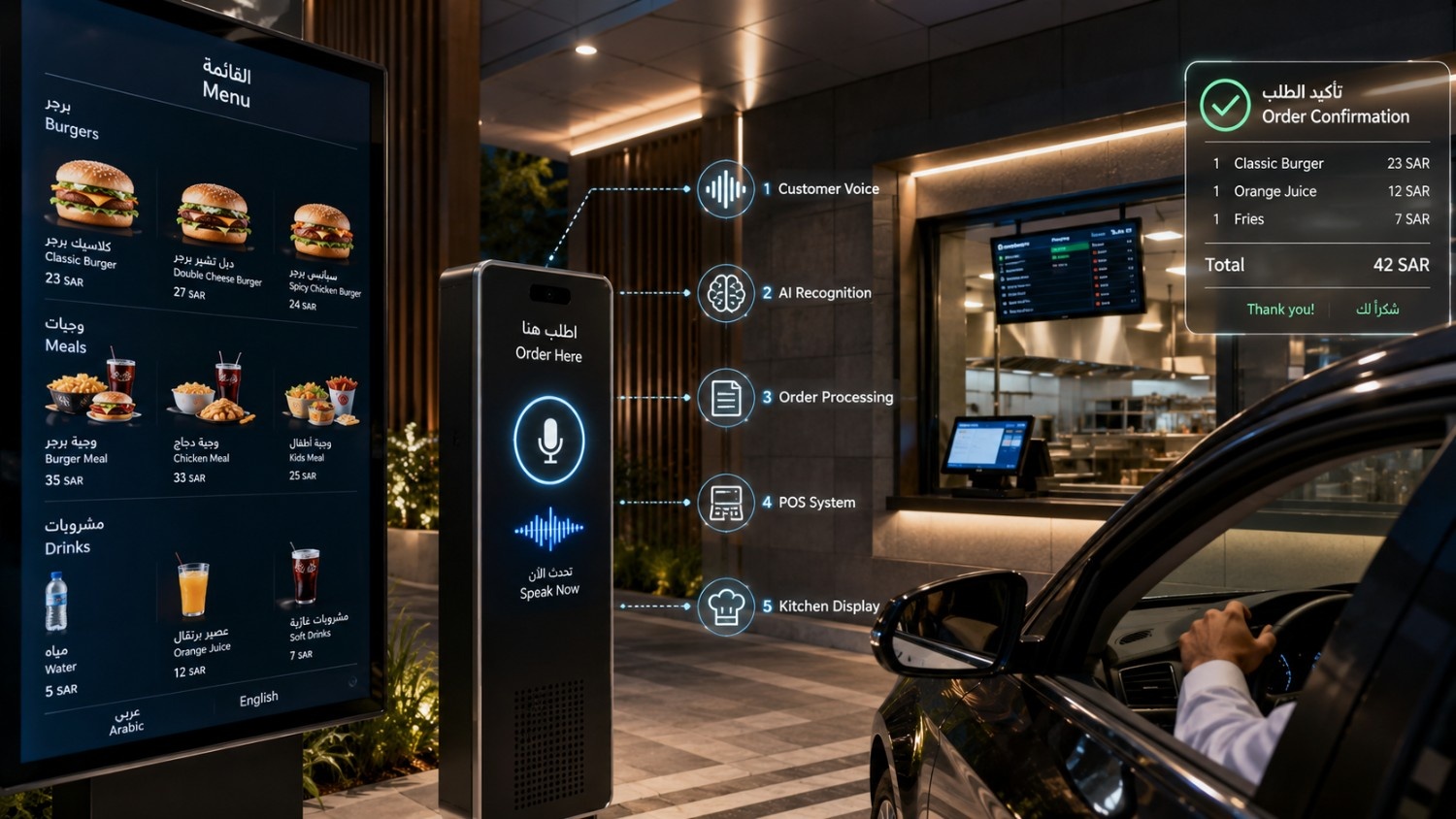
The process can be understood through five main stages.
1. Customer Speaks Naturally
The experience starts when the vehicle reaches the drive-thru ordering point.
Instead of speaking to a traditional order taker, the customer interacts with a voice AI assistant. They might say:
“I’d like a chicken burger meal with large fries and a Coke, please.”
The customer does not necessarily need to use predefined commands. Modern conversational AI is designed to understand natural language and conversational requests.
2. AI Recognizes the Order
The voice system converts the customer’s speech into information that the ordering platform can understand.
It identifies:
- Menu items
- Quantities
- Sizes
- Add-ons
- Modifications
- Special requests
- Combos and meal options
This is particularly important in a busy drive-thru environment where traffic noise, vehicle engines, multiple accents, and background sounds can affect communication.
FAMA Technologies highlights AI-powered voice recognition as a component of its drive-thru solutions, alongside clear two-way audio and digital menu technology.
3. AI Handles Questions and Recommendations
A major advantage of conversational AI is that the interaction does not have to be limited to simply repeating the menu.
The AI can ask clarifying questions such as:
“Would you like the regular or large meal?”
It can also potentially recommend relevant products, promotions, or add-ons based on the restaurant’s configured rules.
For QSR operators, this creates an opportunity to combine voice ordering with upselling and personalized recommendations.
Context-aware recommendation systems have also been studied for drive-thru environments, demonstrating how factors such as order context and other available data can be used to improve recommendations.
4. The Order Is Confirmed
Before the order is finalized, the AI can read the order back to the customer.
For example:
“Your order is one chicken burger meal, large fries, and one Coke. Is that correct?”
The customer can then confirm or correct.
This confirmation stage is important because order accuracy is one of the biggest factors in the success of AI ordering. AI voice ordering should not simply be about automation; it should be about creating a reliable ordering workflow.
5. Order Moves Into the Restaurant Workflow
After confirmation, the order can be transferred into the restaurant’s digital ordering environment, depending on the integration architecture.
This may include:
AI Voice → Order Management → POS → Kitchen Display → Preparation → Customer Pickup
This connected workflow reduces the need for employees to manually re-enter information and can help create a more consistent drive-thru operation.
Why AI Voice Ordering Matters for Saudi Arabia and the GCC
Saudi Arabia is particularly relevant for advanced QSR and drive-thru technology because restaurants operate in a multilingual and highly competitive environment.
Customers may communicate in Arabic, English, or a mixture of languages, while restaurant brands need technology that can work consistently across multiple locations.
FAMA Technologies states that its conversational AI supports 96+ languages and dialects, including Arabic, English, and Urdu, positioning multilingual interaction as an important consideration for markets such as Saudi Arabia, Kuwait, and Qatar.
For restaurants expanding across Riyadh, Jeddah, Dammam, Dubai, Abu Dhabi, Doha, Kuwait City, and other GCC markets, multilingual capability can therefore be an important consideration when evaluating voice AI.
Key Benefits of AI Voice Ordering for QSRs
Faster Order Taking :
AI can handle repetitive ordering interactions without requiring an employee to manually enter every item.
This can help restaurants manage busy periods more efficiently.
Improved Order Consistency :
A structured AI ordering workflow can confirm items, quantities, and modifications before an order is submitted.
Multilingual Customer Experience :
Arabic and English support can be particularly valuable across GCC markets, while additional language support can help restaurants serve diverse customer populations.
Better Staff Utilization :
AI can handle defined ordering tasks while restaurant employees focus on food preparation, fulfillment, customer service, and other operational responsibilities.
The goal is not necessarily to eliminate human involvement. A better approach is to use AI for repetitive tasks while keeping employees available for situations that require human judgment.
Data and Operational Insights :
A connected drive-thru technology platform can provide valuable operational information such as order patterns, service times, menu performance, and customer behavior.
FAMA’s drive-thru solutions also combine ordering technology with digital menu boards and analytics capabilities to support data-driven restaurant operations.
What Should Restaurants Consider Before Implementing AI Voice Ordering?
Before investing in an AI drive-thru system, restaurant operators should evaluate more than the voice assistant itself.
Important considerations include:
- Arabic and multilingual speech recognition
- Noise cancellation and high-quality drive-thru audio
- POS and ordering-system integration
- Menu and pricing synchronization
- Human handoff or escalation
- Customer order confirmation
- Data security and privacy
- Analytics and reporting
- Scalability across multiple branches
- Integration with digital menu boards and customer displays
This is why an AI drive-thru should be viewed as an end-to-end technology ecosystem, rather than simply a voice chatbot.
The Future of AI-Powered Drive-Thrus in the Middle East
AI voice ordering is only one part of the next generation of restaurant automation.
Future drive-thru environments are likely to combine voice AI, computer vision, smart digital menu boards, customer recognition, predictive analytics, POS integration, kitchen automation, and real-time operational intelligence.
For QSR brands in Saudi Arabia and the wider GCC, this creates an opportunity to build drive-thru experiences that are faster, more connected, and more personalized.
FAMA Technologies is already positioning its AI On-Go Drive-Thru Solution around conversational voice AI, multilingual support, drive-thru audio, digital ordering, and connected restaurant technology for Saudi Arabia and GCC markets.
Conclusion:
AI voice ordering for drive-thru restaurants can transform the way QSRs interact with customers. By combining natural-language voice recognition with menu intelligence, order confirmation, POS integration, and operational analytics, restaurants can create a more connected drive-thru experience.
For brands operating in Saudi Arabia, Dubai and the UAE, Qatar, Kuwait, and the wider Middle East, the most effective strategy is not simply to install an AI voice assistant. The real opportunity lies in integrating voice AI with the entire drive-thru infrastructure.
As restaurant technology continues to evolve, AI-powered ordering could become an important component of the modern GCC QSR.