Introduction
Restaurants are constantly looking for ways to increase order value without making the ordering experience complicated. Traditional printed menus and static displays provide limited opportunities to adapt offers, highlight high-margin products, or promote complementary items based on changing customer behavior.
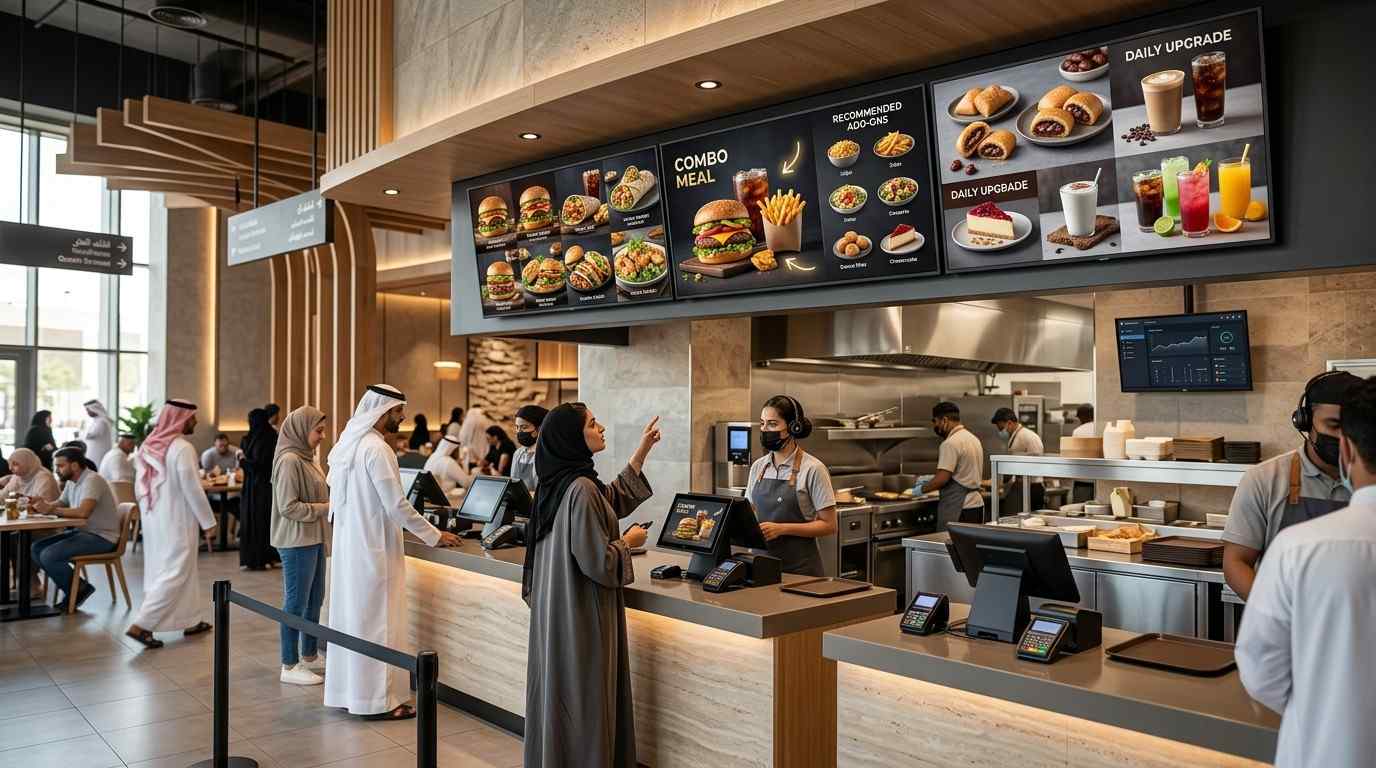
AI-driven digital menu boards offer a more flexible approach. By combining digital displays with data-driven content strategies, restaurants can present relevant products, combinations, promotions, and recommendations at the right stage of the customer journey.
For QSRs, cafés, bakeries, food courts, and multi-location restaurant chains, this can create additional opportunities for restaurant upselling while keeping the ordering experience visually engaging and easier to manage.
What Are AI-Driven Digital Menu Boards?
AI-driven digital menu boards are digital menu displays that can use data, automation, customer behavior, business rules, or intelligent recommendation technologies to dynamically manage and personalize menu content.
Unlike static menu boards, digital displays can be changed remotely and scheduled according to factors such as:
- Time of day
- Product availability
- Promotions
- Customer preferences
- Sales performance
- Location
- Seasonal campaigns
- Inventory conditions
For example, a restaurant could promote breakfast combinations during the morning, highlight lunch bundles around midday, and switch to dinner recommendations later in the day.
The objective is not simply to display more products. It is to present relevant products and combinations that can encourage customers to consider additional purchases.
Why Upselling Matters for Restaurants
Upselling involves encouraging customers to purchase a higher-value option or add complementary products to their order.
A simple example is:
Burger → Burger + Fries → Burger + Fries + Beverage
Another example could be:
Coffee → Coffee + Pastry → Coffee + Pastry + Sandwich
Small increases in average order value can become commercially significant when a restaurant processes hundreds or thousands of orders every day.
Digital menu boards can support this process by giving restaurants more opportunities to visually present upgrades, combinations, add-ons, and limited-time offers.
1. Highlight High-Margin Products
One of the most direct ways digital menu boards can support upselling is by giving restaurants greater control over product visibility.
A printed menu gives every customer essentially the same presentation. Digital displays can change the prominence of selected products throughout the day.
Restaurants can highlight:
- Signature products
- Premium meals
- High-margin items
- New products
- Seasonal products
- Limited-time offers
- Meal combinations
For example, instead of simply showing a burger, a restaurant could visually present the burger alongside fries and a beverage as a complete meal.
The goal is to make the higher-value option easy for customers to notice and understand.
2. Promote Meal Bundles and Combos
Digital menu boards for restaurants are particularly useful for promoting bundles.
Customers often appreciate combinations because they simplify the decision-making process.
A menu board could visually present:
Main Item + Side + Beverage = Complete Meal
Instead of asking customers to identify complementary products themselves, the display can make the combination immediately visible.
Restaurants can also change combinations based on:
- Time of day
- Product availability
- Seasonal campaigns
- Promotional periods
- Customer demand
This provides more flexibility than static printed menus.
3. Use Cross-Selling to Promote Complementary Products
Upselling is not limited to premium versions of the same product.
Restaurants can also use cross-selling to recommend products that naturally complement the customer’s selection.
Examples include:
- Burger + fries
- Pizza + beverage
- Coffee + pastry
- Chicken meal + dessert
- Sandwich + side
- Breakfast + coffee
Digital menu boards provide visual space to communicate these combinations clearly.
High-quality product photography can also make complementary products more noticeable and help customers understand the complete offering.
4. Adapt Menus According to Time of Day
One of the major advantages of digital menu boards is the ability to schedule different content.
A restaurant does not need to promote the same products throughout the entire day.
For example:
Morning :
Breakfast meals, coffee, pastries, and breakfast combos.
Afternoon :
Lunch meals, sandwiches, sides and beverages.
Evening :
Dinner combinations, family meals and desserts.
Late Night :
Late-night meals, snacks, and beverages.
This allows restaurants to make their menu presentation more relevant to the customer’s likely needs at different times.
5. Use Customer and Sales Data More Effectively
AI-driven menu strategies become more useful when businesses connect menu decisions with available data.
Restaurants can analyze information such as:
- Best-selling products
- Average order value
- Popular combinations
- Product performance
- Time-based demand
- Promotional performance
- Location-level sales trends
This information can help restaurants determine which products should receive greater visibility.
For example, if data shows that customers frequently purchase a particular burger with a specific beverage, the restaurant could feature that combination more prominently.
The important point is that AI should support data-informed decisions rather than simply adding technology for its own sake.
6. Create More Relevant Recommendations
A traditional menu presents products. An intelligent digital menu strategy can go a step further by presenting recommendations based on business rules and available data.
For example, a customer viewing a premium burger could be shown:
Complete Your Meal
- Crispy fries
- Soft drink
- Dessert
The recommendation can be visually positioned near the primary product to make the additional options easy to notice.
Depending on the technology infrastructure, recommendations can become increasingly sophisticated by incorporating customer behavior, historical data, product relationships, and other signals.
7. Create Urgency Around Limited-Time Offers
Restaurants regularly introduce limited-time products and seasonal promotions.
Digital menu boards make it easier to give these campaigns prominent placement.
Restaurants can highlight:
- New product launches
- Seasonal beverages
- Festive menus
- Limited-time combos
- Promotional discounts
- Special desserts
Because content can be changed remotely, marketing teams can replace expired campaigns without manually changing physical menu materials.
This can also help reduce the risk of customers seeing outdated promotions.
8. Support Multi-Location Restaurant Chains
For restaurant groups with multiple branches, centralized digital menu management becomes particularly important.
A restaurant chain may want the same core menu across all locations while still allowing individual branches to promote local products or offers.
A centralized digital signage platform can help corporate teams manage:
- Menu content
- Promotions
- Product images
- Screen groups
- Campaign schedules
- Location-specific messaging
This is where FAMA Technologies’ Infinite Digital can be relevant.
FAMA Technologies provides digital signage capabilities through Infinite Digital, supporting environments such as digital menu boards, promotional displays, video walls, and centralized content management.
For growing QSR and restaurant chains, centralized management can help marketing and operations teams maintain consistency while adapting content to individual locations.
9. Improve Visual Product Presentation
Upselling depends partly on how easily customers can discover additional products.
Digital displays offer significantly more visual flexibility than printed menus.
Restaurants can use:
- High-quality product photography
- Product animations
- Short promotional videos
- Dynamic layouts
- Highlight sections
- Promotional banners
- Rotating product displays
For example, a dessert that might receive little attention on a printed menu can be displayed prominently on a digital screen during the appropriate ordering period.
The visual presentation should remain clear, however. Showing too many products or excessive animation can make menus difficult to understand.
Effective digital menu design should balance visual appeal, readability, product discovery, and ordering speed.
10. Test and Optimize Menu Content
Another advantage of digital menu boards is that restaurants can modify content without replacing printed materials.
Businesses can test different:
- Product placements
- Promotions
- Combo presentations
- Product images
- Calls to action
- Menu layouts
Sales and operational data can then help teams understand which approaches perform better.
Over time, restaurants can use these insights to refine their digital menu strategy.
This creates a continuous improvement cycle:
Display → Customer Response → Data → Analysis → Content Update
For large restaurant networks, this type of iterative approach can make digital menu management more measurable and adaptable.
Best Practices for AI-Driven Restaurant Upselling
AI-driven digital menu boards should enhance the customer experience rather than overwhelm it.
Restaurants should consider the following best practices:
Keep recommendations relevant :
Promote products that naturally complement the customer’s likely selection.
Avoid excessive choices :
Too many recommendations can make the ordering process confusing.
Prioritize high-value products :
Give appropriate visibility to premium products, profitable combinations, and strategic promotions.
Use accurate product : information
Prices, availability, ingredients, and promotional details should remain current.
Combine automation with human oversight :
AI and data can support content decisions, but restaurant teams should retain control over business rules and customer communication.
Measure performance :
Track relevant metrics such as average order value, item attachment rates, promotion performance, and product sales where the necessary data is available.
Conclusion
AI-driven digital menu boards can give restaurants a more flexible way to approach upselling and cross-selling. Instead of relying on static menus, restaurants can dynamically promote combinations, complementary products, premium options, seasonal campaigns, and time-sensitive offers.
The greatest opportunity comes from combining relevant recommendations, strong visual merchandising, centralized management, and reliable sales data.
For growing QSRs and restaurant chains, solutions such as FAMA Technologies’ Infinite Digital can support the digital signage infrastructure needed to manage modern menu boards across multiple locations.
When implemented thoughtfully, digital menu boards can become more than electronic replacements for printed menus. They can become an important part of a restaurant’s broader strategy for product discovery, customer engagement, and increasing order value.