Introduction
For a small restaurant, implementing an AI drive-thru may simply mean adding conversational voice AI to the ordering point. For a large Quick Service Restaurant (QSR) brand, the challenge is much bigger.
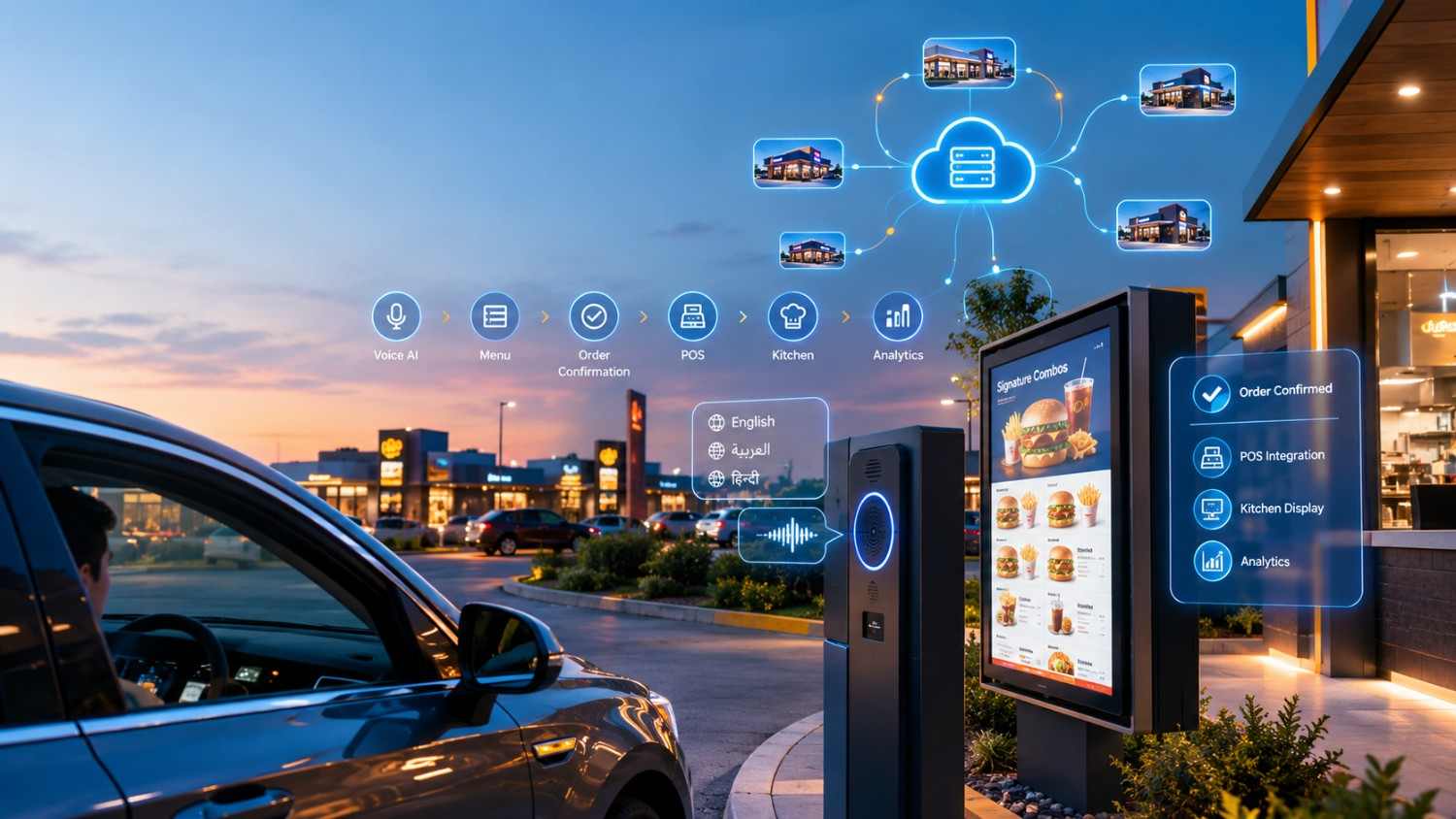
When a brand operates dozens or hundreds of locations, an enterprise AI drive-thru must work as part of a connected technology ecosystem. It needs to understand customer requests, follow the correct menu and pricing rules, confirm orders, integrate with restaurant systems, support multiple languages, provide centralized management, and maintain a consistent brand experience across every location.
This is where enterprise AI drive-thru solutions move beyond basic voice automation and become a strategic component of restaurant technology.
FAMA Technologies, for example, positions its AI Innovation offering around conversational Voice AI for drive-thru and self-checkout environments. Its solution combines conversational AI capabilities with multilingual interaction and integration-focused restaurant technology, including support for QSR environments across Saudi Arabia and the GCC.
What Makes an AI Drive-Thru an Enterprise Solution?
An AI drive-thru solution becomes enterprise-ready when it can be deployed, managed, monitored, and optimized across an entire restaurant network.
A single-location implementation may have a relatively simple architecture:
Customer → Voice AI → Order → POS
An enterprise deployment is considerably more sophisticated:
Customer → Voice AI → Menu Intelligence → Order Confirmation → POS → Kitchen/Order Management → Analytics
Across multiple branches, a central management layer also becomes essential.
Enterprise capabilities typically include:
- Centralized menu management
- Location-specific configuration
- POS and ordering-system integration
- Multilingual voice AI
- Order confirmation
- Analytics and monitoring
- Brand and pricing consistency
- Human fallback
- Exception handling
- Scalable deployment architecture
FAMA Technologies describes its drive-thru ecosystem as incorporating conversational Voice AI alongside technologies such as digital menu boards, POS, analytics and centralized management.
1. AI Ordering Across Multiple Restaurant Branches
Scaling AI ordering for QSR brands requires more than installing the same software at every location.
Menus, prices, promotions, operating hours and product availability can vary between branches. An enterprise platform therefore needs to distinguish between global brand rules and local restaurant configuration.
For example, a QSR headquarters might establish:
- Brand-wide menu standards
- Approved promotional messaging
- Voice and conversation guidelines
- Pricing policies
- Upselling rules
- Customer service standards
Individual branches could then manage location-specific details such as temporary product availability or operating hours.
This centralized-but-flexible model makes it easier to manage hundreds of locations without manually configuring every drive-thru individually.
2. Centralized Menu and AI Configuration
One of the biggest advantages of enterprise drive-thru technology is centralized control.
Imagine a QSR brand launches a new meal across 300 restaurants. With a properly designed enterprise platform, headquarters should be able to update the relevant menu information centrally and distribute the configuration across locations.
The AI needs access to accurate information about:
- Products
- Sizes
- Modifiers
- Combos
- Prices
- Promotions
- Allergens or product information
- Availability
- Upselling opportunities
FAMA Technologies highlights centralized content management as part of its drive-thru technology approach, enabling restaurant brands to manage products, pricing and promotional content across locations.
This is critical because an AI assistant is only as reliable as the information it uses.
3. POS Integration: Connecting Conversation to Operations
Voice AI should not operate as an isolated chatbot.
The real value of an AI ordering system for restaurants comes when the customer’s conversation becomes an actionable restaurant order.
A typical workflow could look like:
Customer speaks → AI understands → Menu logic validates → Customer confirms → POS receives order → Kitchen receives order → Restaurant prepares order
POS integration reduces the need for employees to manually re-enter orders and creates a more connected customer journey.
For enterprise QSRs, integration architecture should also account for different POS configurations, APIs, order management platforms and location-specific requirements.
FAMA’s drive-thru materials describe integration with restaurant POS and ordering environments as part of its connected technology approach.
4. Automated Order Confirmation
Accuracy matters just as much as speed.
A customer may say:
“I’ll have a chicken burger meal, make the fries large, and add an extra sauce.”
The AI must correctly identify the items and modifications before sending the order forward.
An effective enterprise AI drive-thru should therefore provide a clear confirmation stage.
This can involve the AI verbally repeating the order and, where available, displaying it through a customer-facing order display.
The objective is simple: catch misunderstandings before they become kitchen errors.
FAMA’s drive-thru technology also incorporates customer order verification through digital display solutions, supporting a more transparent ordering process.
5. Multilingual Voice AI for Diverse Customers
Language can become a major consideration when QSR brands operate across regions with multilingual customer bases.
Customers may speak different languages or switch between languages during a conversation. An enterprise AI drive-thru solution therefore needs more than basic speech recognition.
It needs conversational understanding that can handle accents, regional terminology and natural speech.
FAMA Technologies’ AI Innovation offering describes support for more than 96 languages and dialects, including Arabic and Urdu, while its partnership with Sodaclick focuses on conversational Voice AI for QSRs in the GCC.
For international QSR brands, multilingual capability can help create a more inclusive and consistent ordering experience across markets.
6. Monitoring and Analytics Across the Network
Enterprise deployment creates another major opportunity: data.
Instead of looking at individual restaurants in isolation, headquarters can potentially analyze drive-thru performance across the network.
Relevant metrics may include:
- Order volume
- Average interaction time
- Order completion rate
- Customer wait time
- Frequently ordered products
- Upsell performance
- AI-to-human handoff frequency
- Failed or incomplete interactions
- Location-level performance
FAMA Technologies describes cloud-based management and analytics capabilities designed to provide visibility into information such as order statistics, sales trends and queue performance.
These insights can help restaurant operators identify bottlenecks and determine where AI configuration or operational processes need improvement.
7. Maintaining Brand Consistency Across Locations
Large QSR brands invest heavily in consistent customer experiences.
The voice assistant at one restaurant should not sound completely different from the one operating hundreds of kilometers away.
Enterprise AI can help standardize:
- Greeting language
- Brand terminology
- Promotional messaging
- Upselling behavior
- Menu descriptions
- Customer service tone
- Confirmation workflows
At the same time, the system should allow appropriate regional customization.
This balance between global consistency and local flexibility is one of the defining characteristics of enterprise drive-thru technology.
8. Scaling From a Few Branches to Hundreds
The best way to approach enterprise AI ordering is not necessarily to deploy everywhere immediately.
QSR brands can begin with a controlled pilot involving a small number of locations.
The pilot can evaluate:
- Voice recognition accuracy
- Menu understanding
- POS integration
- Customer acceptance
- Order completion
- Human handoffs
- Operational performance
Once the system demonstrates reliable performance, deployment can expand to additional branches.
This approach allows the enterprise to learn from real-world interactions before scaling across the entire network.
9. Human Fallback and Exception Handling
Enterprise automation should not mean eliminating humans from every interaction.
Some customer requests will always be complicated, ambiguous or outside the AI’s configured capabilities.
A robust enterprise AI drive-thru should therefore include human fallback.
For example, if the AI cannot confidently understand an unusual request, it can transfer the interaction to a restaurant employee.
This creates a hybrid model:
AI handles routine interactions → Human handles exceptions
That approach can improve resilience while allowing employees to focus on situations that genuinely require human judgment.
FAMA Technologies and the Enterprise AI Drive-Thru Opportunity
For QSR brands looking beyond standalone voice automation, FAMA Technologies’ AI Innovation offering can be positioned as a technology layer connecting conversational Voice AI with the wider drive-thru ecosystem.
FAMA’s current AI Innovation materials describe conversational Voice AI for drive-thru and self-checkout, multilingual capabilities, automatic speech recognition and integration-oriented solutions.
Its broader drive-thru offering also spans technologies such as speaker posts, digital menu boards, POS, analytics and centralized management.
This ecosystem approach is particularly relevant to enterprise QSRs because successful AI ordering is not simply about making a machine talk to customers. It is about connecting the customer conversation to the restaurant’s operational infrastructure.
The Future of Enterprise AI Ordering for QSRs
The future of enterprise AI drive-thru solutions is likely to involve increasingly connected systems.
Voice AI, digital menu boards, POS platforms, kitchen systems, analytics, customer displays and centralized management can work together to create a unified drive-thru experience.
For QSR brands, the biggest opportunity is therefore not simply automating order taking. It is creating a scalable technology architecture that can operate consistently across locations while remaining flexible enough to adapt to different markets.
As brands expand from a handful of restaurants to hundreds or thousands of locations, enterprise architecture becomes increasingly important.
The winning AI drive-thru will not be the one that simply talks to customers. It will be the one that connects the entire ordering ecosystem.