Introduction
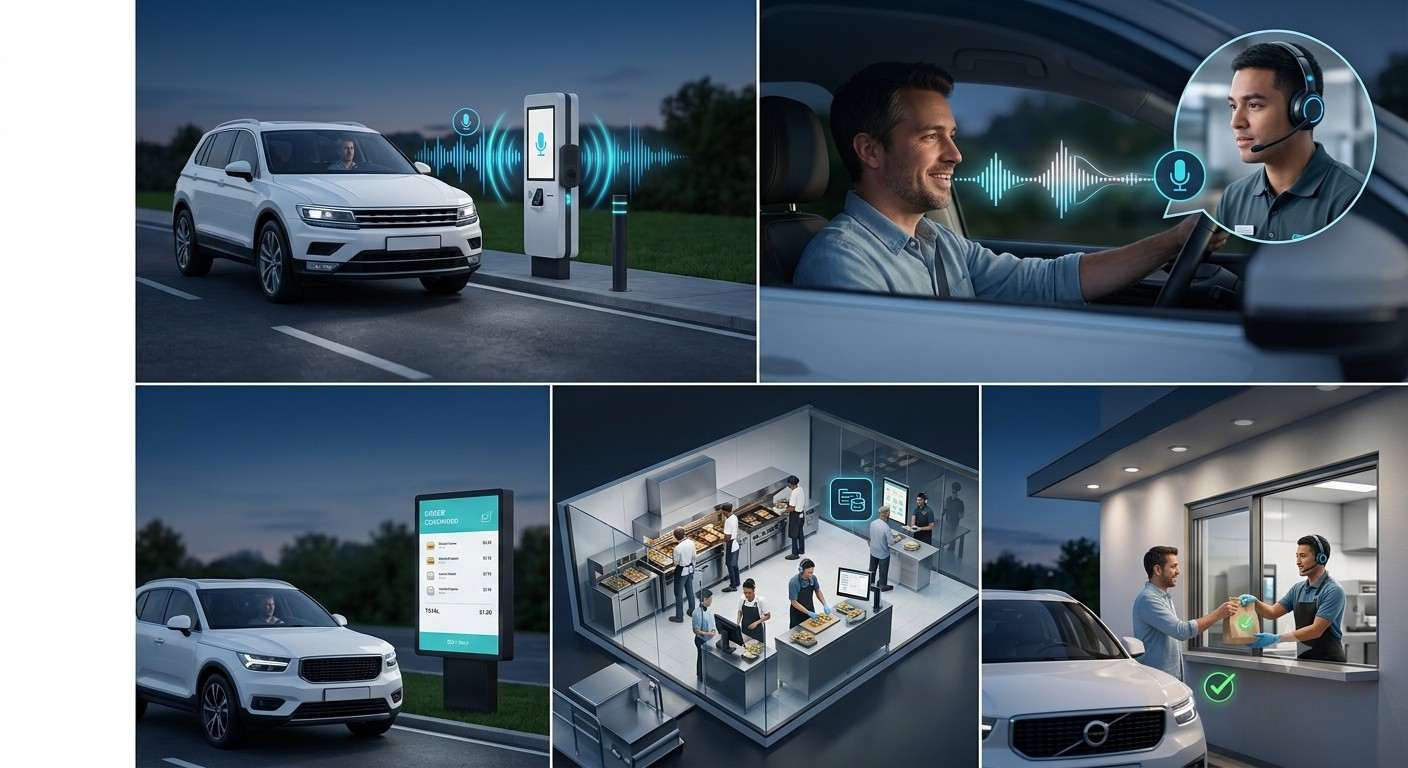
For quick-service restaurants (QSRs), the drive-thru is one of the most important customer touchpoints. Customers expect their orders to be fast, convenient, and accurate—but achieving all three can be challenging during busy periods.
One frequently overlooked factor behind drive-thru order accuracy is the quality of communication between the customer and restaurant team. When employees struggle to hear an order because of traffic, engine noise, kitchen equipment, wind, or overlapping conversations, even a simple request can become an incorrect ticket.
This is where modern drive-thru headsets can make a significant difference.
Advanced headset systems use technologies such as noise reduction, improved microphones, wireless connectivity, and clearer audio transmission to help employees understand customers more accurately. For QSR operators, upgrading this seemingly simple piece of equipment can contribute to better order accuracy, smoother operations, and an improved customer experience.
Why Order Accuracy Matters in QSR Drive-Thrus
Speed is important in a QSR, but speed without accuracy can create additional operational problems.
A customer who receives the wrong meal may need to return to the restaurant, request a correction, or simply decide not to visit again. Meanwhile, the restaurant may have to remake food, consume additional ingredients, spend employee time correcting the order, and potentially deal with customer dissatisfaction.
Industry research continues to identify communication quality as an important part of drive-thru performance. Poor sound quality can contribute to incorrect orders, delays, and customer-service issues.
For that reason, QSR operators should view drive-thru order accuracy as more than a customer-service metric. It is also an operational and profitability consideration.
How Drive-Thru Headsets Improve Order Accuracy
1. Clearer Communication Reduces Misheard Orders
The most obvious advantage of a quality headset is improved communication.
Traditional or aging headset systems can suffer from static, interference, low volume, distorted audio, or inconsistent microphone performance. These issues become especially noticeable during lunch and dinner rushes.
A modern headset gives the order taker clearer audio and a more reliable microphone, making it easier to distinguish menu items, quantities, sizes, substitutions, and special requests.
For example, a customer ordering a customized meal may specify several modifications. If even one modification is missed, the final order can be incorrect.
Clearer communication helps reduce these avoidable mistakes.
The most obvious advantage of a quality headset is improved communication.
Traditional or aging headset systems can suffer from static, interference, low volume, distorted audio, or inconsistent microphone performance. These issues become especially noticeable during lunch and dinner rushes.
A modern headset gives the order taker clearer audio and a more reliable microphone, making it easier to distinguish menu items, quantities, sizes, substitutions, and special requests.
For example, a customer ordering a customized meal may specify several modifications. If even one modification is missed, the final order can be incorrect.
Clearer communication helps reduce these avoidable mistakes.
2. Noise Cancellation Helps in Busy Environments
QSR drive-thrus operate in acoustically challenging environments.
Employees may be surrounded by:
- Kitchen equipment
- Blenders and cooking appliances
- Conversations between staff
- Vehicle engines
- Road traffic
- Wind and rain
- Multiple simultaneous conversations
Noise-cancelling technology helps separate the customer’s voice from surrounding sounds, allowing the employee to concentrate on the actual order.
Modern drive-thru systems increasingly use advanced noise reduction, microphone technologies, and other audio-processing techniques to address these challenges.
This becomes particularly valuable during peak hours, when background noise is at its highest.
3. Better Microphones Capture Customer Speech More Reliably
A headset is only as useful as its microphone.
High-quality microphones are designed to capture speech clearly while reducing unwanted environmental noise. This can be especially useful when customers speak quietly, when vehicles have loud engines, or when weather conditions affect the outdoor speaker system.
Better voice pickup means employees spend less time asking customers to repeat themselves.
That can create a chain reaction:
Clearer speech → fewer repetitions → fewer misunderstandings → more accurate orders → faster service.
The objective isn’t simply to make the drive-thru louder. It is to make communication more intelligible.
4. Full-Duplex Communication Makes Conversations Easier
Modern communication systems can support more natural two-way conversations.
With effective full-duplex communication, employees and customers can communicate without unnecessary interruptions or awkward pauses. This is especially useful when customers modify their orders midway through the conversation.
For example:
“I’d like a chicken meal—actually, make that a large meal with no…”
If the communication system cuts out or one speaker cannot hear the other properly, the modification may be missed.
A reliable communication channel gives employees a better opportunity to capture the complete request.
5. Wireless Headsets Improve Staff Mobility
Order accuracy doesn’t depend only on the customer conversation. It also depends on what happens after the order is taken.
Wireless drive-thru headsets allow employees to move around the restaurant while remaining connected to the communication system. Team members can coordinate between the order point, kitchen, preparation area, and pickup window without being tied to a fixed position.
This can improve internal communication and help employees respond quickly when order volumes increase.
FAMA Technologies highlights this broader role of wireless drive-thru communication, where headsets can connect employees across different operational areas rather than functioning only as a customer-facing audio device.
6. Headsets Can Support a More Connected Drive-Thru Ecosystem
The modern QSR is becoming increasingly digital.
A drive-thru headset can operate as part of a larger technology ecosystem that may include:
- Drive-thru speaker posts
- Customer order confirmation displays
- POS integration
- Kitchen display systems
- Vehicle detection
- Drive-thru timers
- Digital menu boards
- Analytics and reporting
- AI-powered communication technologies
This connected approach can make it easier for restaurants to monitor and improve different stages of the customer journey.
FAMA Technologies’ drive-thru solutions, for example, position headset technology alongside speaker posts and order-display capabilities as components of a broader drive-thru communication infrastructure.
7. Accurate Orders Can Reduce Remakes and Waste
Every incorrect order creates additional work.
Suppose an employee misses a customer’s request for a specific beverage, sauce, ingredient modification, or meal size. The mistake might only become apparent when the customer reaches the pickup window.
At that point, the restaurant may need to:
- Identify the mistake.
- Confirm what the customer originally requested.
- Remake the item.
- Repackage the order.
- Spend additional employee time.
- Delay the customer and potentially the cars behind them.
Better communication at the ordering stage can help prevent these issues before they reach the kitchen.
8. Better Communication Improves the Customer Experience
Customers generally don’t know whether an incorrect order resulted from a headset problem, a POS mistake, a kitchen error, or another operational issue.
They simply experience the result.
When customers can communicate naturally with restaurant employees and their orders are captured correctly the first time, the entire experience becomes smoother.
This matters because drive-thru customers are often choosing the channel specifically for convenience. They don’t want to repeat their order several times or wait at the window while an incorrect meal is remade.
As QSR technology evolves, operators are increasingly combining upgraded headsets with other technologies to address both accuracy and speed.
Choosing the Right Drive-Thru Headset System
QSR operators should consider more than just headset price when evaluating a new system.
Important factors include:
Audio Quality :
Look for systems designed to deliver clear speech in noisy restaurant and outdoor environments.
Noise Cancellation :
Effective noise reduction can help minimise interference from engines, kitchen equipment, traffic, and other background sounds.
Battery Performance :
Wireless headsets should provide sufficient operating time for busy shifts without frequent interruptions.
Comfort :
Employees may wear headsets for several hours, so lightweight and ergonomic designs are important.
Range and Connectivity :
The system should provide reliable communication throughout the operational areas where employees need to work.
Scalability :
Multi-lane and high-volume QSR locations may need systems capable of supporting multiple users and operational requirements.
Integration :
The greatest value can come from integrating headset communication with other drive-thru technologies rather than treating the headset as an isolated device.
Why FAMA Technologies Can Be Relevant to QSR Digital Transformation
For QSR brands looking to modernize their drive-thru operations, FAMA Technologies can be considered as part of a broader technology strategy.
Rather than focusing exclusively on individual hardware components, a modern drive-thru approach can connect communication, customer-facing displays, ordering infrastructure, and operational systems.
FAMA Technologies’ drive-thru solutions emphasize noise-cancelling headset technology, speaker posts, customer order displays, and integration with restaurant systems.
For growing QSR chains, this type of connected infrastructure can provide a foundation for more consistent drive-thru operations across multiple locations.
The Future of Drive-Thru Communication
Drive-thru technology is moving beyond basic speaker-and-headset communication.
AI-powered audio processing, voice recognition, digital ordering systems, customer confirmation displays, and real-time analytics are increasingly becoming part of the modern QSR technology landscape. Current industry developments show that noise cancellation, microphone arrays, beamforming, and speech-recognition technologies are being used to address the unique acoustic challenges of drive-thru environments.
However, advanced technology does not eliminate the importance of reliable fundamentals.
A customer still needs to be heard.
The employee still needs to understand the order.
And the kitchen still needs to receive the correct information.
That makes the drive-thru headset an important component of the overall QSR technology stack.
Conclusion
Order accuracy begins before the order reaches the kitchen. It begins with the conversation between the customer and the restaurant.
High-quality drive-thru headsets can improve that first critical communication point through clearer audio, noise cancellation, reliable microphones, wireless mobility, and better team coordination.
For QSR operators, the goal isn’t simply to make employees hear customers better. It is to create a more reliable ordering process that reduces misunderstandings, minimizes corrections, improves operational efficiency, and delivers a better customer experience.
As restaurants continue investing in digital transformation, combining modern headset systems with customer order displays, POS integration, analytics, and other drive-thru technologies can help create a more connected and accurate QSR operation.