Introduction
Patient experience has become an increasingly important part of modern healthcare. Beyond clinical treatment, patients and visitors expect hospitals to provide clear information, convenient navigation, shorter perceived waiting times, and a comfortable environment.
For large hospitals in Saudi Arabia, meeting these expectations can be challenging. Patients may need to navigate multiple departments, understand unfamiliar medical services, wait for appointments, or find information in a multilingual environment.
This is where digital signage in Saudi Arabian hospitals can play an important role.
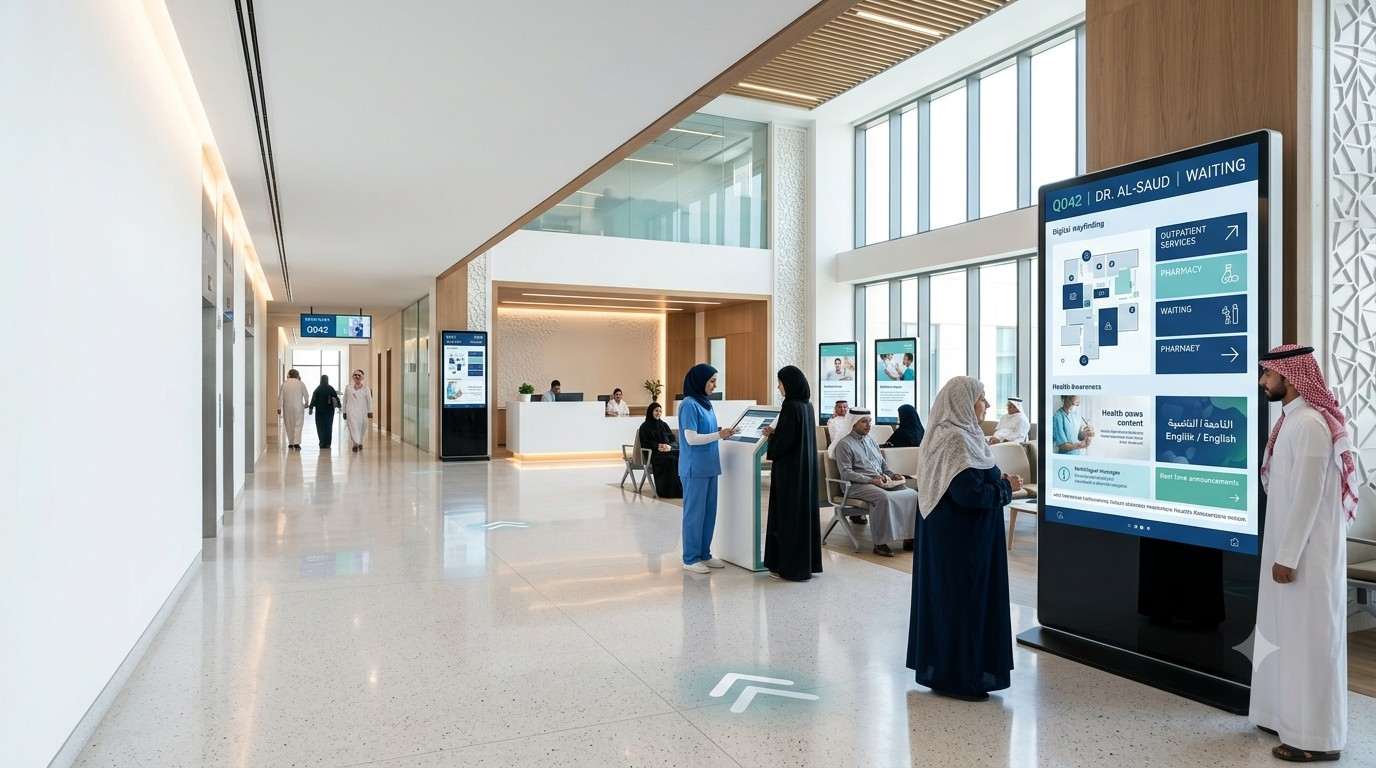
Modern healthcare digital signage goes far beyond displaying announcements on screens. It can support digital wayfinding, patient education, health-awareness campaigns, queue communication, real-time alerts, and more engaging waiting-room experiences.
What Is Digital Signage for Hospitals?
Hospital digital signage refers to electronic displays installed throughout healthcare facilities to communicate relevant information to patients, visitors, and staff.
Screens can be positioned in reception areas, waiting rooms, corridors, elevators, outpatient departments, pharmacies, laboratories, and other appropriate locations.
Depending on the system, hospitals can display:
- Department information
- Digital wayfinding
- Health education videos
- Hospital announcements
- Appointment and queue information
- Emergency notifications
- Doctor and facility information
- Health-awareness campaigns
- Visitor instructions
- Multilingual content
FAMA Technologies’ patient-engagement solutions specifically include interactive digital signage for dynamic wayfinding, health-awareness content, real-time alerts, multi-zone content, and touchscreen interaction.
1. Simplifying Hospital Wayfinding
Large hospitals can be confusing, especially for first-time visitors.
A patient may need to locate a cardiology clinic, laboratory, imaging department, pharmacy, or specialist consultation room—sometimes across several floors.
Traditional signs can help, but digital wayfinding adds another layer of flexibility.
Digital displays can provide clear directions, department locations, floor information, and visual navigation. Interactive systems can potentially allow visitors to search for a specific clinic or service and receive step-by-step directions.
FAMA Technologies highlights interactive maps and step-by-step navigation to clinics and laboratories as part of its patient-engagement solutions.
Better wayfinding can reduce confusion and help visitors move through the hospital more confidently.
2. Making Waiting Areas More Informative
Waiting is an unavoidable part of many healthcare journeys. However, the way waiting time is experienced can significantly affect patient perception.
Instead of leaving patients in a room with nothing but static posters, hospitals can use digital displays to provide useful and engaging content.
Screens can show:
- General health education
- Hospital information
- Wellness advice
- Preventive-care campaigns
- News and weather
- Department information
- Doctor introductions
- General service information
FAMA Technologies describes video-based engagement displays as a way to turn waiting time into an opportunity for education and engagement, including speciality-specific playlists and treatment-overview content.
The goal is not simply to entertain patients but to make the environment more informative and purposeful.
3. Supporting Patient Education
Healthcare information can sometimes be difficult for patients to understand.
Digital displays allow hospitals to communicate general educational information through short videos, animations, illustrations, and easy-to-read messages.
For example, screens can provide approved educational content about:
- Preventive healthcare
- Healthy lifestyles
- Hygiene
- Vaccination awareness
- Nutrition
- Diabetes awareness
- Heart health
- Women’s health
- Children’s health
FAMA Technologies also positions digital signage as a patient-education tool that can deliver health-awareness content, service information, and educational videos across healthcare environments.
Importantly, digital signage should support—not replace—personalized communication between healthcare professionals and patients. Medical content should also go through the hospital’s appropriate clinical review and approval process.
4. Improving Multilingual Communication
Saudi Arabian hospitals serve diverse patient populations, making accessible communication particularly important.
Digital signage can help hospitals provide information in Arabic and English, and potentially additional languages where appropriate.
Instead of installing separate printed posters for every language, digital displays can rotate approved versions of content or present multilingual information in a structured format.
This can make hospital communication easier to understand while helping healthcare organizations maintain consistent messaging across their facilities.
5. Delivering Real-Time Hospital Updates
Healthcare environments can change quickly.
A clinic may move temporarily, a department may experience a service interruption, or a particular area may need to communicate an urgent notice.
Printed signs are not ideal for constantly changing information.
Digital signage allows authorized hospital teams to update information centrally and distribute it to selected displays.
FAMA Technologies highlights real-time alerts and centralized digital communication among its patient-engagement capabilities.
This can help hospitals respond faster while reducing the operational burden associated with replacing physical notices.
6. Helping Patients Understand Queue Information
Waiting-room uncertainty can be frustrating.
Digital displays can be integrated with appropriate queue-management systems to provide information such as:
Token 124 → Counter 3
or
Clinic 5 – Please proceed to Room 12
Depending on the hospital’s technology infrastructure, displays may also provide queue status or other non-sensitive operational information.
FAMA Technologies’ patient-engagement offering includes queue-status access through self-service kiosks as well as paging and notification solutions that can notify patients when their doctor is ready.
These technologies can help create a more organized patient journey and reduce the need for repeated inquiries at reception.
7. Creating a Calmer Hospital Environment
Hospital environments can sometimes feel stressful, particularly for patients waiting for appointments or accompanying family members.
Digital displays can contribute to a calmer environment by providing structured information rather than relying heavily on repeated overhead announcements.
For example, hospitals can use screens for general announcements, educational videos, wayfinding, and queue information while keeping critical notifications visually distinct.
FAMA Technologies also offers paging and notification solutions designed around quieter patient communication, including silent paging and SMS-based queue alerts.
The objective should be thoughtful communication—not simply adding more screens and noise to the environment.
8. Strengthening Hospital Communication
Digital signage can also improve communication between hospital departments and patient-facing areas.
A centralized system can allow authorized teams to manage different content for different zones.
For example:
Pediatric Department: child-friendly educational content
Cardiology Area: approved heart-health awareness content
Main Lobby: hospital announcements and wayfinding
Pharmacy: general medication-awareness information
FAMA Technologies’ patient-engagement solutions include multi-zone content, allowing different information to be presented in different areas.
This makes hospital communication more relevant to the people viewing it.
9. Supporting a More Connected Patient Journey
Digital signage becomes even more valuable when it works alongside other hospital technologies.
Modern patient-experience ecosystems can include:
- Digital signage
- Self-service kiosks
- Queue management
- Interactive wayfinding
- Patient Wi-Fi
- Digital feedback
- Paging and notifications
- Hospital information systems
FAMA Technologies’ patient-engagement portfolio combines digital signage with self-service kiosks, connected Wi-Fi, behavioral analytics, paging, and video-based engagement solutions.
This connected approach can help hospitals address several patient-experience challenges through complementary technologies rather than treating every communication problem separately.
10. Using Patient-Flow Insights to Improve Experience
Digital technology can also help hospitals understand how people move through their facilities.
FAMA Technologies describes footfall intelligence and behavioral analytics capabilities that can help identify crowded areas, dwell times, peak periods, and common patient pathways.
These insights can potentially help hospital administrators identify bottlenecks and reconsider the placement of signage, kiosks, waiting areas, and other patient touchpoints.
The result is a more data-informed approach to improving the physical patient journey.
How to Implement Digital Signage in Saudi Arabian Hospitals
Installing screens is only the first step. Hospitals should develop a clear communication strategy before deployment.
Choose the right locations
Identify areas where patients genuinely need information, such as entrances, reception desks, waiting rooms, elevators, corridors, and major department intersections.
Prioritize readability
Use large typography, strong contrast, simple layouts, and concise messages. Patients should be able to understand important information quickly.
Use multilingual content
Consider Arabic and English requirements and determine where additional language support may be appropriate.
Establish content governance
Healthcare content should be reviewed by the appropriate clinical and communications teams before publication.
Protect patient privacy
Never display confidential or personally identifiable patient information on public-facing screens.
Keep information current
Outdated information can create confusion and undermine trust. A centralized CMS can make content updates easier.
Why FAMA Technologies for Healthcare Digital Signage?
For healthcare organizations seeking to modernize patient communication, FAMA Technologies offers a broader patient-engagement technology ecosystem rather than focusing solely on display hardware.
Its healthcare solutions include interactive digital signage, wayfinding, health-awareness content, real-time alerts, self-service kiosks, patient feedback, Wi-Fi engagement, analytics, paging, and video-based content.
Its digital signage and patient-education solutions can therefore support different stages of the patient journey—from entering the facility and finding the right department to waiting, learning, receiving notifications, and navigating services.
The Future of Digital Signage in Saudi Arabian Healthcare
As Saudi Arabia’s healthcare sector continues to embrace digital transformation, patient experience will increasingly depend on how effectively technology supports people—not simply how much technology a hospital installs.
Digital signage for hospitals can become a practical communication layer connecting patients with information at the moments they need it.
From interactive wayfinding and multilingual education to real-time alerts and engaging waiting-room content, digital signage can help healthcare organizations create journeys that are more informed, accessible, and organized.
For Saudi Arabian hospitals, the opportunity is not to replace human interaction with technology. It is to use technology strategically so healthcare professionals can focus on care while patients receive clearer information and a more seamless experience.