Introduction
Saudi Arabia’s quick-service restaurant (QSR) industry is becoming increasingly technology-driven. As customers expect faster service, clearer information, convenient ordering, and more engaging experiences, restaurant operators are looking for technologies that can improve both customer experience and operational efficiency.
One technology gaining increasing attention is the digital menu board.
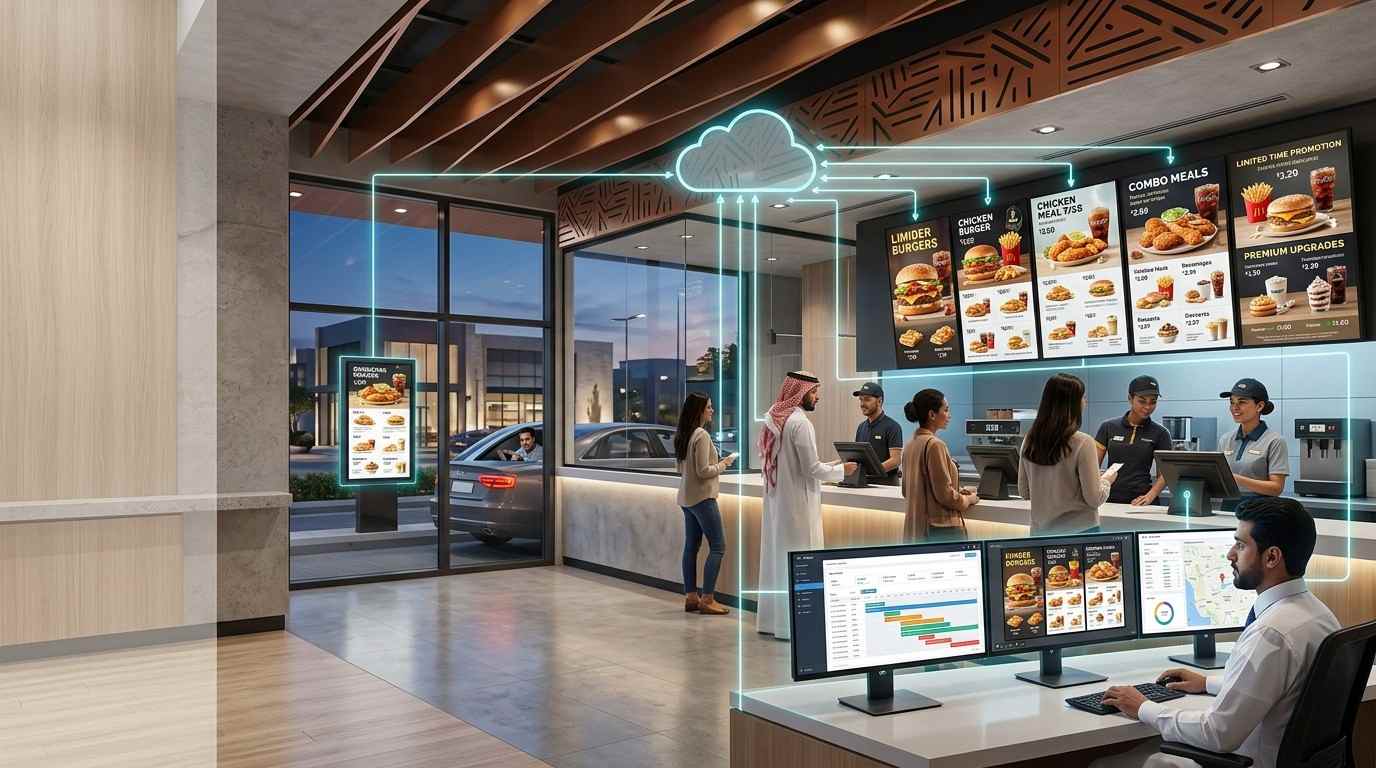
Unlike traditional printed menus, digital menu boards allow QSRs to update products, prices, promotions, images, and meal combinations remotely. This flexibility is particularly valuable for restaurants operating multiple locations or frequently changing their menus.
From Riyadh and Jeddah to Dammam, Al Khobar, Makkah, and Madinah, digital signage is becoming an important part of the modern QSR environment. FAMA Technologies, for example, provides digital menu board and restaurant technology solutions designed to support dynamic menus, centralized content management, and connected restaurant operations.
What Are Digital Menu Boards?
A digital menu board is an electronic display used by restaurants to present menu items, prices, promotions, product images, nutritional information, and other customer-facing content.
Modern digital menu boards can be connected to content management platforms, allowing restaurant teams to update information remotely. Instead of printing a new menu whenever an item or price changes, operators can update the digital content through a centralized system.
For QSRs, this can make menu management considerably more flexible.
FAMA Technologies’ Infinite Digital Menu Board solution, for instance, is designed to provide dynamic menus with remote content updates, making it suitable for QSRs, cafés, and restaurants.
1. Faster Menu and Price Updates
One of the biggest advantages of digital menu boards in Saudi Arabia is the ability to make changes quickly.
QSRs may need to update their menus because of:
- Ingredient cost changes
- New products
- Limited-time offers
- Seasonal campaigns
- Out-of-stock items
- Promotional pricing
- Combo meal changes
- Breakfast, lunch, and dinner menus
With printed signage, every change requires design, printing, delivery, and installation. Digital signage can reduce this dependency by allowing authorized teams to make changes through a content management system.
For restaurant chains with multiple branches, the efficiency gains can be even more significant.
2. Better Customer Engagement Through Visual Content
Food is highly visual, and customers often respond strongly to appetizing product photography.
A static menu can communicate information, but digital displays can combine high-resolution imagery, video, animation, and carefully designed layouts.
QSRs can use digital menu boards to highlight:
- Best-selling meals
- New products
- Premium upgrades
- Desserts
- Beverages
- Limited-time products
- Family meals
- Value combinations
Instead of presenting every menu item with equal visual weight, restaurants can strategically emphasize products they want customers to notice.
This makes the menu more than an information board—it becomes a customer engagement and merchandising tool.
3. Easier Promotion of Limited-Time Offers
Not every seasonal promotion needs to run all day.
Restaurants can use scheduled content to match different periods of the day.
A restaurant could display:
Morning: Seasonal breakfast offers
Afternoon: Lunch combinations
Evening: Family meals or dinner specials
Late evening: Desserts and beverages
This type of scheduling, often referred to as dayparting, can make digital menus more relevant to customers at different times.
FAMA Technologies highlights scheduled content and real-time updates as key capabilities of digital signage, so businesses can change displayed content based on time and operational needs.
3. Make Seasonal Food More Visually Appealing
Limited-time offers are an important part of QSR marketing.
A restaurant may introduce a seasonal burger, a new beverage, a festive meal, or a short-term discount. Digital menu boards make it easier to promote these offers prominently.
Promotional content can also be scheduled to appear during specific dates or periods and automatically replaced when the campaign ends.
This reduces the possibility of outdated promotional material remaining visible after an offer has expired.
FAMA Technologies highlights real-time promotions and scheduled content as important applications of digital signage for QSRs, including the ability to change promotional messaging and menu content dynamically.
4. Dayparting Makes Menus More Relevant
Breakfast customers do not necessarily need to see the same menu as customers visiting during dinner.
Dayparting allows QSRs to automatically display different menus according to the time of day.
For example:
6 AM–11 AM: Breakfast menu
11 AM–4 PM: Lunch combinations
4 PM–8 PM: Main meals and family offers
8 PM–Close: Dinner, snacks, and desserts
This can simplify menu navigation and ensure customers see products that are actually available at that time.
FAMA Technologies specifically identifies dayparting as a feature of its digital menu and drive-thru solutions.
5. Multilingual Communication for Saudi Arabia
Saudi Arabia’s restaurant market serves a diverse customer base. QSRs may need to communicate menu information to both Arabic-speaking customers and international residents and visitors.
Digital displays make multilingual communication more flexible.
Restaurants can design content that presents Arabic and English information clearly, switch language-specific content where appropriate, or create layouts that accommodate both languages without overcrowding the menu.
FAMA Technologies identifies Arabic-English multilingual support as a useful capability for QSR digital signage in Saudi Arabia.
6. Stronger Upselling and Cross-Selling
Digital menu boards can also support restaurant revenue strategies.
Instead of simply displaying a burger, a QSR can visually present the burger alongside fries and a beverage as a complete meal.
Restaurants can use screens to promote:
- Combo upgrades
- Extra toppings
- Premium sizes
- Desserts
- Beverages
- Side dishes
- Family bundles
Strategic placement and attractive product imagery can make these options more noticeable during the ordering process.
FAMA Technologies positions digital menu boards as tools for highlighting combos, premium items, promotions, and other products that can support upselling.
7. Digital Menu Boards Are Especially Valuable for Drive-Thrus
Drive-thru operations are a major part of QSR business models, making outdoor digital menu boards particularly useful.
Customers need to understand menu choices quickly while moving through the ordering lane. Static menus can become difficult to manage when products or prices change frequently.
Modern outdoor digital menu boards can provide:
- High-brightness displays
- Dynamic menus
- Real-time promotional updates
- Dayparting
- Multilingual content
- Location-specific menus
- Integration with ordering systems
FAMA Technologies offers drive-thru solutions incorporating outdoor digital menu boards, order displays, and other connected technologies for QSR environments in Saudi Arabia.
8. Centralized Management Across Multiple Locations
A growing QSR chain may have dozens or hundreds of restaurants. Managing printed menus individually across every branch can become inefficient and difficult to control.
Cloud-based digital signage changes this model.
Restaurant headquarters can create campaigns centrally and distribute them to selected locations. Individual branches can also receive location-specific menus or promotions when necessary.
This creates greater consistency while reducing the operational effort involved in managing menus across a growing network.
FAMA Technologies describes centralized content management and remote updates as core capabilities of its digital menu board solutions.
9. Integration With the Connected Restaurant
Digital menu boards do not have to operate as isolated screens.
Modern QSR technology ecosystems can connect digital menus with POS systems, self-ordering kiosks, kitchen display systems, order-ready boards, and other restaurant technologies.
This creates a more connected customer journey.
FAMA Technologies’ restaurant technology portfolio includes digital menu boards, POS, self-checkout, kitchen display systems, order-ready boards, and other QSR technologies.
For restaurant operators, this can help move digital signage from a simple advertising tool toward a broader operational technology platform.
10. Why Digital Menu Boards Are Becoming a Strategic Investment
The shift toward digital menu boards is not simply about replacing printed signs with screens.
For Saudi QSRs, the larger opportunity is flexibility.
Restaurants can change menus faster, promote products more dynamically, support different dayparts, manage multiple locations centrally, and create more engaging customer-facing experiences.
FAMA Technologies’ restaurant solutions are designed around this broader approach, combining dynamic digital menus with technologies such as self-ordering, POS, kitchen display systems, and drive-thru solutions.
What Should QSRs Look for in a Digital Menu Board?
Before investing in digital signage solutions in Saudi Arabia, QSR operators should consider several factors:
High display quality: Food imagery should remain sharp and attractive.
Remote content management: Teams should be able to update menus without visiting every location.
Scheduling: The system should support breakfast, lunch, dinner, and campaign scheduling.
Outdoor durability: Drive-thru displays need to withstand local environmental conditions.
Multilingual capability: Arabic and English support can improve communication.
Scalability: The solution should work for one restaurant and continue to support future locations.
Integration: Connectivity with POS, ordering, and restaurant systems can provide additional operational value.
The Future of QSR Digital Signage in Saudi Arabia
Saudi Arabia’s QSR market is moving toward faster, more connected, and more technology-enabled customer experiences. Digital menu boards are becoming an important component of that transformation because they combine visual marketing with operational flexibility.
For QSR operators, the benefits go beyond attractive screens. Digital menu boards can help restaurants manage changing prices, promote products, simplify menu updates, support multilingual communication, and create more consistent experiences across locations.
With solutions from technology providers such as FAMA Technologies, Saudi QSR brands can build digital signage into a broader restaurant technology ecosystem rather than treating it as an isolated display investment.
As competition increases and customer expectations continue to evolve, the ability to communicate the right product, price, and promotion at the right time can become a significant competitive advantage.
For modern QSRs in Saudi Arabia, the menu is no longer just a list of food items. It is becoming a dynamic digital customer experience.