Introduction
Retail is becoming increasingly dynamic. Customers expect relevant offers, quick information, engaging experiences, and seamless interactions across physical and digital channels. Traditional printed posters and static promotional boards often struggle to keep pace with rapidly changing prices, inventory, seasonal campaigns, and customer expectations.
This is where digital signage for retail can make a significant difference.
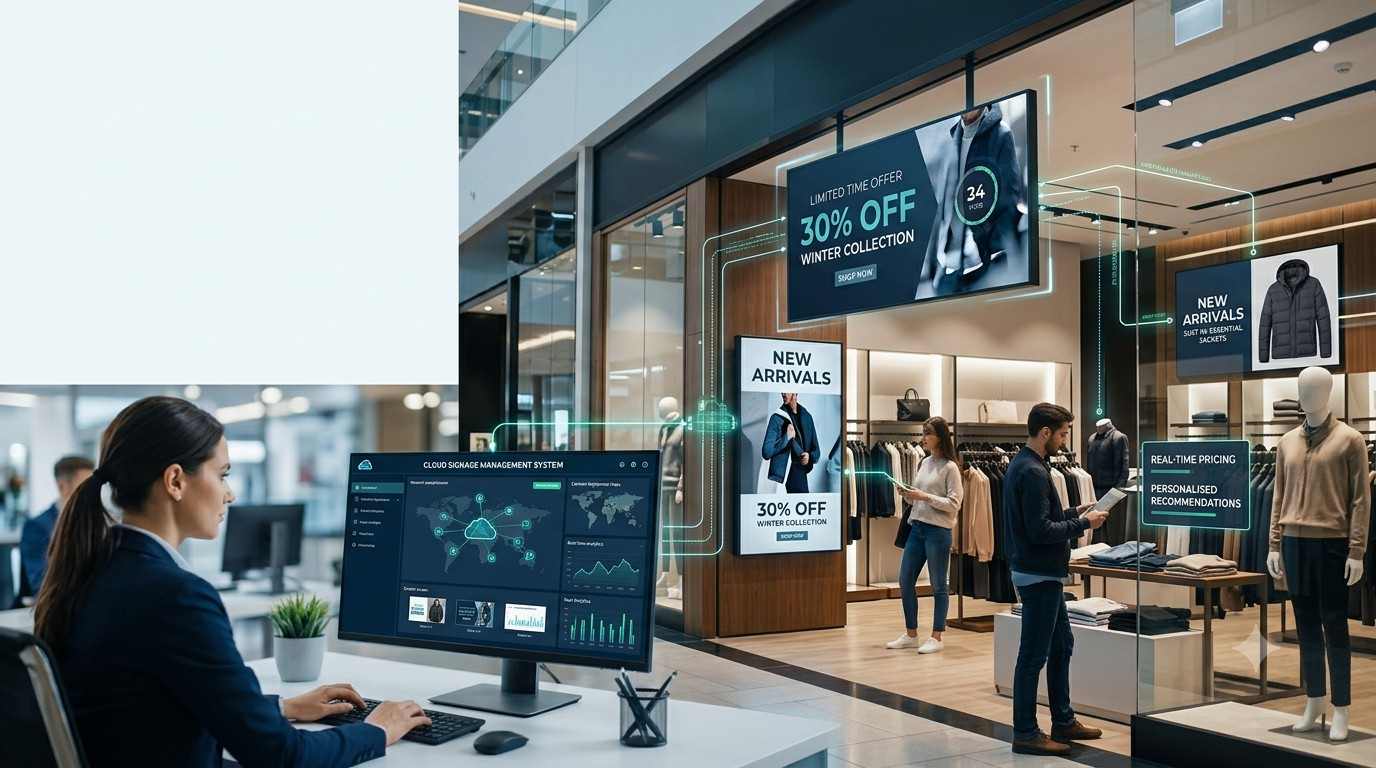
Modern digital signage allows retailers to display promotional content that can be updated, scheduled, and managed remotely. Instead of printing new posters whenever an offer changes, businesses can update screens across one or multiple stores through a centralized content management system.
For retailers looking to make their physical stores more responsive and engaging, real-time digital signage can become an important part of their marketing and customer experience strategy.
What Is Digital Signage in Retail?
Retail digital signage refers to network-connected displays used to communicate promotions, product information, brand messages, announcements, and other visual content inside or outside a store.
These displays can show videos, product demonstrations, promotional graphics, pricing information, countdowns, seasonal campaigns, and more. Modern systems can also schedule content according to specific locations, dates, times, and business requirements.
Unlike traditional signage, digital displays give retailers the flexibility to change their messaging without physically replacing printed materials.
This flexibility is particularly valuable for retailers running frequent promotions or managing multiple locations. Shopify also highlights the ability of digital signage to support product discovery, promotions, upselling, brand storytelling, and the connection between online and in-store experiences.
Why Real-Time Promotions Matter
Retail promotions can change quickly.
A store may launch a weekend sale, introduce a flash discount, promote excess inventory, announce a new product, or adjust an offer based on customer demand. With printed signage, every change requires new creative production, printing, distribution, and installation.
Digital signage removes much of that delay.
Retail teams can prepare promotional content in advance and schedule when it should appear. They can also update messaging when business conditions change.
For example, a retailer could display:
- A breakfast promotion in the morning
- A lunchtime offer during afternoon hours
- A fashion promotion during peak evening traffic
- A limited-time discount during the final hours of a sale
- A product recommendation near a complementary product
This creates a more responsive in-store marketing environment.
1. Promote Flash Sales and Limited-Time Offers
One of the strongest applications of digital signage for promotions is creating urgency.
A static poster may communicate that a sale is happening, but digital displays can make the promotion feel more immediate through motion, changing visuals, countdowns, and time-sensitive messaging.
Retailers can use screens to promote:
- Flash sales
- Weekend offers
- Clearance events
- Seasonal discounts
- Buy-one-get-one promotions
- Loyalty-member offers
- Limited-stock products
- New product launches
When the promotion ends, the content can automatically switch to another campaign, reducing the risk of outdated promotional material remaining on display.
2. Target Promotions by Time and Location
Not every customer should necessarily see the same message.
A retailer operating multiple stores may have different inventory levels, customer demographics, local events, or promotional priorities at each location.
A centralized digital signage platform allows businesses to create location-specific campaigns while maintaining consistent brand standards.
For example, a retailer could promote winter clothing more heavily in one region while highlighting summer products in another. Individual stores can also display localized offers without requiring the corporate team to manually replace signage.
FAMA Technologies’ digital signage solutions are designed around centralized content management, scheduling, distribution, and remote management, making this type of multi-location communication more practical for growing businesses.
3. Connect Promotions With Inventory
One of the most useful opportunities for real-time retail signage is connecting promotional messaging with business data.
Imagine a retailer has excess stock of a particular product. Instead of relying only on staff recommendations, a digital display can highlight the product with a special promotion.
Similarly, when a popular product becomes unavailable, promotional messaging can be changed to recommend an alternative product.
This approach can make digital signage more than a marketing tool. It can become part of a retailer’s operational communication system.
For large retailers, integrating signage with inventory, pricing, or other business systems can help ensure that customers receive more relevant information at the point of purchase.
4. Improve In-Store Product Discovery
Customers cannot purchase products they fail to notice.
Digital displays can direct attention toward specific product categories, explain product benefits, showcase demonstrations, and recommend complementary products.
For example, an electronics retailer could display a television promotion alongside content explaining compatible sound systems. A fashion retailer could show a new collection while recommending accessories. A supermarket could promote a meal idea alongside the ingredients needed to prepare it.
This creates opportunities for cross-selling and upselling while making product discovery easier.
Research published in the Journal of Marketing involving 237 advertising campaigns and approximately 30 million shoppers found that digital signage increased the likelihood of purchasing featured products by 8.1%, with stronger effects for certain product categories.
5. Create More Personalized Shopping Experiences
Personalization is no longer limited to e-commerce.
Retailers can use digital signage to deliver different messages according to factors such as location, time of day, campaign, audience, or product availability.
For example, a store could use different promotional content during peak shopping hours compared with quieter periods.
However, personalization should be useful rather than overwhelming. The objective is to provide shoppers with relevant information at the right moment—not fill every screen with excessive messaging.
6. Manage Multiple Stores From One Platform
For retail chains, consistency can be difficult when every store manages signage independently.
A centralized digital signage platform can help marketing teams create campaigns once and distribute them across multiple locations.
Teams can control:
- What content appears
- Where it appears
- When it starts
- When it ends
- Which screens receive it
- Which stores receive specific campaigns
This can reduce the operational burden associated with manually managing printed promotional materials.
FAMA Technologies can support retailers with centralized digital signage management, enabling businesses to manage and distribute content across screens remotely.
7. Measure What Works
Digital signage should not simply look attractive—it should support measurable business objectives.
Retailers should establish clear KPIs before launching campaigns. Depending on the campaign, these could include:
- Promotional sales
- Product conversion
- Average transaction value
- Foot traffic
- Customer engagement
- Coupon or offer redemption
- Sales of featured products
- Campaign performance by location
Interestingly, recent retail digital signage research indicates that many operators still do not measure signage ROI consistently, highlighting an opportunity for retailers to build stronger measurement practices.
The best strategy is to test different messages, placements, offers, and scheduling patterns, then use the results to improve future campaigns.
Best Practices for Real-Time Retail Promotions
To get the most from digital signage, retailers should follow a few principles.
Keep messages simple: Customers may only look at a screen for a few seconds. Use a strong headline, compelling visual, clear offer, and concise call to action.
Match content to location: Entrance screens, aisle displays, product-zone screens, and checkout displays can serve different purposes.
Use scheduling intelligently: Match promotions to shopping patterns, store hours, seasonal events, and campaign periods.
Keep content fresh: Repeated or outdated content can quickly become background noise.
Maintain brand consistency: Even localized promotions should follow established visual identity guidelines.
Monitor performance: Use sales and engagement data to identify which campaigns generate meaningful results.
The Future of Retail Promotions Is More Dynamic
Digital signage is changing how retailers communicate with customers inside physical stores. Instead of treating displays as electronic versions of printed posters, businesses can use them as flexible, centrally managed communication channels.
Real-time promotions, scheduled campaigns, localized messaging, product recommendations, and data-driven content can help retailers create a more responsive shopping environment.
For businesses operating multiple locations, the ability to manage content remotely can be especially valuable. Solutions from FAMA Technologies can help retailers bring centralized digital signage management into their broader technology strategy.
As physical and digital retail experiences continue to converge, the retailers that communicate with customers at the right place and the right time will be better positioned to turn store traffic into meaningful engagement and sales.