Introduction
Running a restaurant or hospitality business involves much more than taking orders and serving customers. Businesses need to manage sales, Point of Sale (POS), inventory, purchasing, recipes, staff, suppliers, accounting, customer data, and daily operations while maintaining a consistent customer experience.
As restaurants grow from one location to multiple branches, managing these activities through separate systems or spreadsheets can become difficult. Data can become fragmented, inventory information may not be updated on time, and management may struggle to get a clear view of overall business performance.
This is where Odoo ERP for restaurants and hospitality businesses can provide a more connected approach.
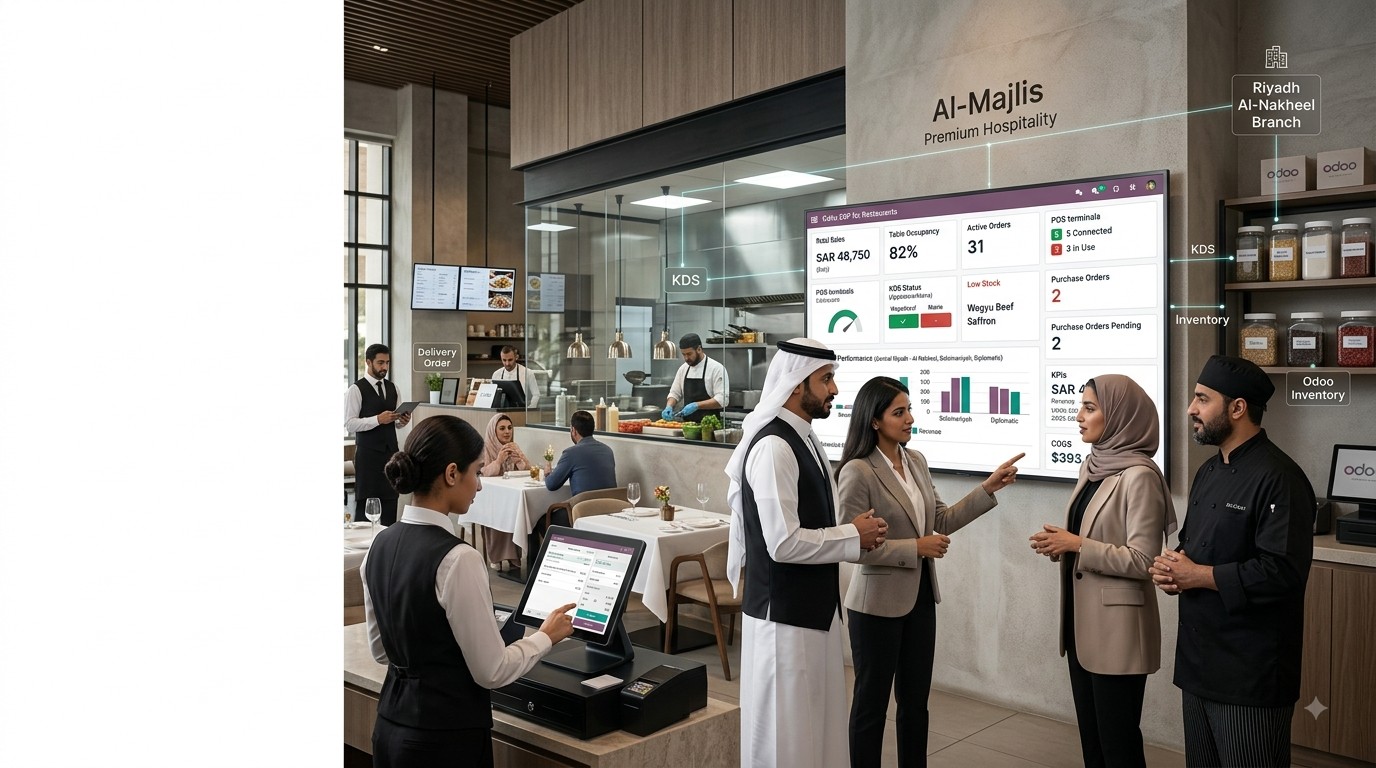
Odoo brings different business operations together within one platform, while its Point of Sale system includes restaurant-specific capabilities such as floor and table management, order handling, kitchen communication, bill splitting, tips, and takeaway tax configuration.
For restaurants, cafés, QSRs, cloud kitchens, catering businesses, and hospitality companies in Saudi Arabia and across the GCC, an appropriately configured Odoo ERP system can help create a more organized and scalable operation.
What Is Odoo ERP for Restaurants?
Odoo ERP is a business management platform that can connect multiple operational functions within one system.
For a restaurant business, Odoo can bring together areas such as:
- Point of Sale
- Restaurant and table management
- Kitchen order management
- Inventory management
- Purchasing
- Accounting
- Customer management
- Employee management
- Sales reporting
- Loyalty and promotions
- Online and self-ordering
- Business analytics
Odoo POS is designed to work for restaurants as well as retail environments, and its current documentation includes restaurant-specific functions such as tables, orders, bookings, kitchen communication, bill splitting, and takeaway tax handling.
1. Manage Restaurant Sales Through One POS System
The Point of Sale system is at the center of most restaurant operations.
Instead of using disconnected sales and management systems, restaurants can use Odoo POS to process customer orders and connect those transactions with the wider ERP environment.
Restaurants can configure POS operations around different service models, including dine-in, takeaway, and other order workflows.
For multi-branch restaurant groups, this can also provide management with a more centralized view of sales performance across locations.
This is especially useful for restaurant groups operating across cities such as Riyadh, Jeddah, Dammam, Madinah, and other Saudi locations, where management needs visibility across multiple outlets.
2. Simplify Table and Floor Management
Dine-in restaurants have operational requirements that are different from conventional retail stores.
Odoo’s restaurant features allow businesses to organize floors and tables and monitor table status through the POS interface. Restaurants can manage table occupancy, reservations, and orders from the floor plan.
Staff can associate orders with specific tables, transfer orders between tables, and manage customer orders as service progresses.
This can help restaurants reduce confusion during busy periods and give front-of-house teams a clearer view of table activity.
3. Connect Front-of-House Orders with the Kitchen
Communication between the service team and kitchen is one of the most important parts of restaurant operations.
When an order is entered into the POS, Odoo can communicate the order to the appropriate preparation area. Restaurants can use preparation printers or preparation displays to help kitchen teams manage incoming orders.
Odoo’s Preparation Display can show order stages such as To Prepare, Ready, and Completed, helping kitchen teams track what needs to be prepared and what has already been completed.
This creates a more connected workflow between the cashier, waiter, kitchen, and customer.
4. Improve Inventory and Ingredient Management
Inventory is one of the biggest operational challenges for restaurants.
Restaurants need to manage ingredients, beverages, packaging materials, finished products, and other supplies. Poor inventory visibility can contribute to stock shortages, excess purchasing, and unnecessary waste.
With an ERP system, restaurant businesses can connect purchasing and inventory processes with their wider operations.
Management can monitor stock movements, coordinate purchasing, and maintain better visibility into available supplies.
For businesses operating multiple branches, centralized inventory information can also help management understand which locations require replenishment and where stock needs to be allocated.
5. Manage Purchasing and Suppliers More Efficiently
Restaurants work with multiple suppliers for food ingredients, beverages, packaging, cleaning products, equipment, and other operational requirements.
Managing these suppliers through emails, spreadsheets, and separate documents can become increasingly difficult as the business grows.
Odoo can bring purchasing activities into the same business environment as inventory and other operations.
Restaurant management can organize purchase orders, supplier information, incoming products, and purchasing workflows in a more structured manner.
This can help businesses make purchasing decisions based on actual operational requirements instead of relying entirely on manual tracking.
6. Support Self-Ordering and Digital Restaurant Experiences
Customers increasingly expect faster and more convenient ways to place orders.
Odoo’s current POS capabilities include self-ordering, allowing customers to place orders through their own mobile devices using QR codes or through a dedicated kiosk.
This can be useful for restaurants, cafés, food courts, and QSR environments looking to reduce ordering friction.
Restaurants can also explore integrations for online food delivery. Odoo’s current restaurant documentation references third-party delivery integration through UrbanPiper for centralizing external orders within POS.
7. Manage Restaurant Employees and Operations
Restaurant operations depend heavily on employees working across different shifts and responsibilities.
An integrated system can help businesses bring employee-related processes closer to their operational data.
Odoo also supports multi-employee POS management, allowing different employees to use the same POS register with assigned roles and permissions.
For restaurant groups, this can support more structured management of cashiers, waiters, supervisors, and other POS users.
8. Monitor Restaurant Performance with Better Reporting
Restaurant owners and management teams need more than daily sales numbers. They need to understand what is driving revenue and where operational improvements are required.
An ERP system can help management analyze information such as:
- Sales by restaurant
- Sales by POS
- Best-selling products
- Order volumes
- Inventory movement
- Purchasing activity
- Customer activity
- Product performance
- Operational trends
When multiple branches are involved, centralized reporting can make it easier to compare locations and identify differences in performance.
For example, if one branch consistently sells more of a particular menu category, management can investigate whether the difference is related to customer demand, location, promotions, or product availability.
9. Create a More Connected Hospitality Operation
Odoo is not limited to restaurant POS functions. Its broader ERP approach allows businesses to connect different operational areas instead of treating each department as a separate system.
For hospitality businesses, the exact Odoo setup should be designed around the organization’s business model and may involve POS, inventory, purchasing, accounting, employees, customer management, and relevant integrations.
This is particularly important for growing businesses where adding more locations or services can otherwise create additional operational complexity.
Why Choose FAMA Technologies for Odoo ERP?
Choosing an ERP platform is only one part of the process. Implementation, configuration, integration, and alignment with business processes are equally important.
FAMA Technologies can support businesses looking to implement technology solutions around their specific operational requirements.
For restaurants and hospitality businesses, an Odoo ERP implementation can be structured around areas such as restaurant POS, inventory, purchasing, accounting, customer management, reporting, and integrations.
For Saudi and GCC businesses, the objective should be more than simply installing an ERP platform. The solution should be configured around the restaurant’s actual workflows, number of branches, service model, operational requirements, and future growth plans.
With the right implementation approach, FAMA Technologies can help businesses move toward a more connected technology environment where restaurant operations and management information work together.
Is Odoo ERP Right for Your Restaurant or Hospitality Business?
Odoo can be a strong option for businesses that want to bring multiple operational functions into a connected ERP environment.
It can be particularly useful for:
- Restaurant chains
- Cafés and coffee shops
- QSR businesses
- Cloud kitchens
- Food courts
- Catering companies
- Hospitality businesses
- Multi-location food businesses
- Restaurants planning expansion
However, the ideal setup depends on the organization’s size, business model, number of locations, existing systems, integrations, and operational processes.
A proper business assessment before implementation can help determine which Odoo applications and integrations are actually required.
Conclusion
Restaurant and hospitality businesses need technology that can keep up with fast-moving operations. From taking orders and managing tables to controlling inventory, coordinating kitchens, purchasing supplies, and monitoring financial performance, disconnected systems can make everyday management more complicated.
Odoo ERP for restaurants and hospitality businesses provides an opportunity to connect these processes within one broader business management environment.
With features for restaurant POS, table management, kitchen preparation, self-ordering, inventory, purchasing, and reporting, Odoo can support restaurants as they improve operational visibility and prepare for growth.
For restaurants and hospitality businesses in Saudi Arabia and the wider GCC, working with an experienced implementation partner such as FAMA Technologies can help ensure the ERP solution is aligned with real operational requirements rather than being treated as a one-size-fits-all software installation.