Introduction
As businesses in Saudi Arabia continue to adopt digital technologies, improving operational efficiency has become a major priority. Companies need to manage sales, finance, inventory, purchasing, employees, customers, and other business processes while maintaining accurate and accessible information.
When these functions are managed through disconnected systems, spreadsheets, emails, and manual processes, businesses can face delays, duplicate data, communication gaps, and limited visibility into daily operations.
This is where Odoo ERP for Saudi businesses can help.
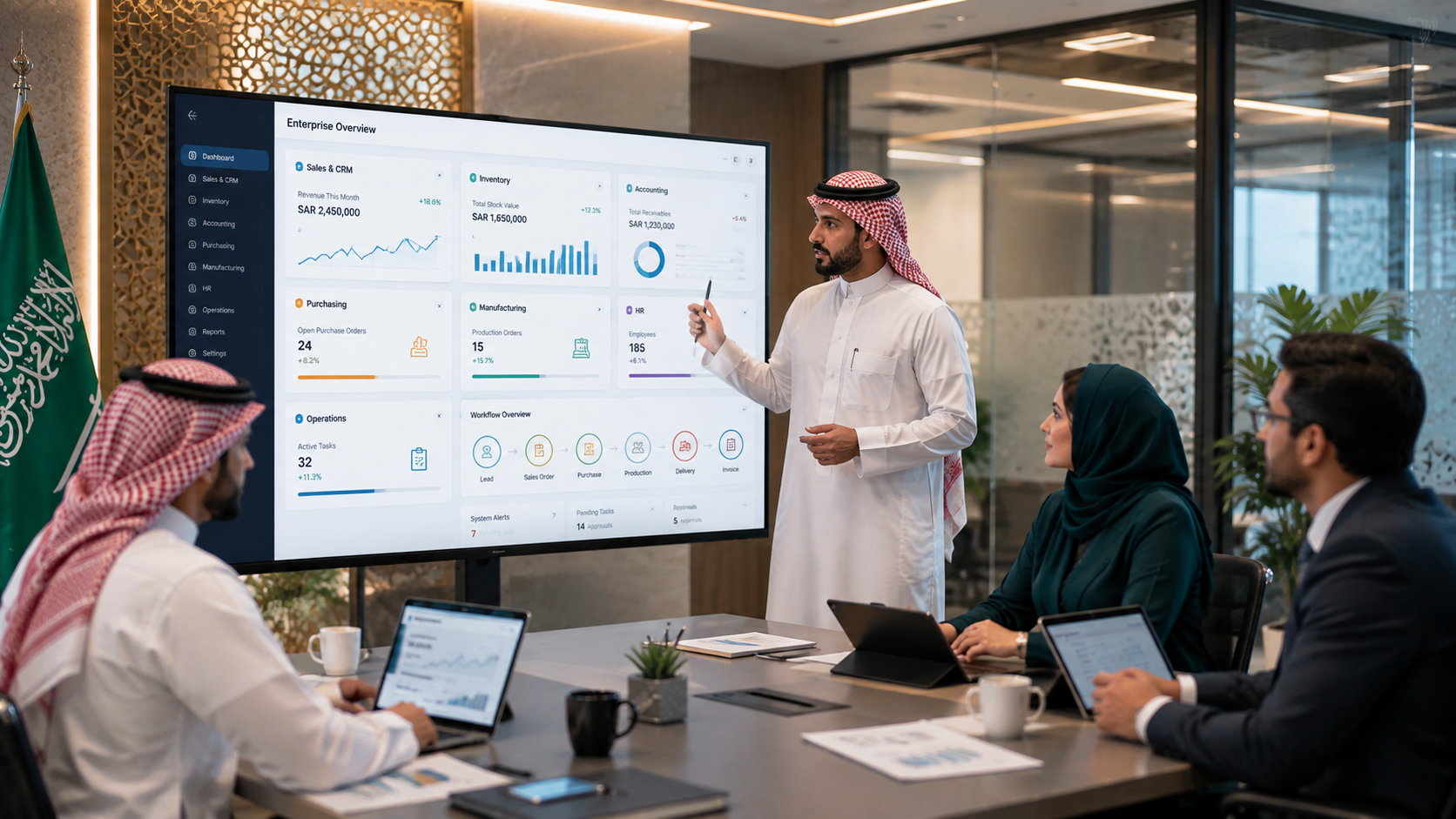
Odoo is a modular business management platform that brings different business functions together in one connected environment. By connecting areas such as sales, CRM, accounting, inventory, purchasing, manufacturing, HR, and eCommerce, businesses can create more streamlined workflows and improve operational visibility.
For Saudi companies looking to automate repetitive tasks, centralize information, and build scalable business processes, Odoo ERP can be a practical solution.
What Is Odoo ERP?
Odoo ERP is a suite of integrated business applications designed to manage different areas of an organization from a centralized platform.
Depending on business requirements, companies can use Odoo applications for:
- Sales and CRM
- Accounting and invoicing
- Inventory management
- Purchasing
- Manufacturing
- Human resources
- Point of Sale
- eCommerce
- Project management
- Marketing
The modular structure allows businesses to start with the applications they need and expand the system as their requirements grow.
For companies in Saudi Arabia, Odoo also provides Saudi-specific fiscal localization features. Odoo’s Saudi localization includes accounting configuration and support for ZATCA e-invoicing, while additional localization features support areas such as Point of Sale.
Why Operational Efficiency Matters for Saudi Businesses
Operational efficiency is not simply about doing tasks faster. It is about reducing unnecessary work, improving the flow of information, minimizing errors, and helping employees spend more time on valuable business activities.
Businesses may experience operational problems when:
- Different departments use separate software
- Employees manually enter the same data multiple times
- Inventory information is not updated quickly
- Sales and finance teams work with different records
- Managers lack real-time business visibility
- Reports take too long to prepare
- Manual approvals slow down workflows
- Customer information is scattered across systems
An ERP system can help address these challenges by bringing key processes and information into one connected environment.
1. Centralize Business Data
One of the biggest advantages of Odoo ERP is centralized data management.
Instead of maintaining separate systems for sales, inventory, accounting, purchasing, and other functions, businesses can connect these processes within Odoo.
For example, when a sales order is created, relevant information can flow into connected business processes rather than requiring employees to manually recreate the same information in different systems.
This can reduce duplicate data entry and give departments better access to consistent information.
For a growing Saudi business, centralized data can also make it easier for management to understand what is happening across different areas of the organization.
2. Automate Repetitive Business Processes
Manual administrative work can consume significant amounts of employee time.
Odoo can help businesses automate selected workflows, depending on how the system is configured.
Examples may include:
- Sales order processing
- Purchase workflows
- Invoice generation
- Inventory operations
- Customer follow-ups
- Approval processes
- Reporting
- Reordering activities
Automation does not mean every process should operate without human involvement. Instead, it can reduce repetitive administrative tasks and allow employees to focus on activities that require decision-making and customer interaction.
This can contribute to better productivity and more consistent business processes.
3. Improve Inventory Visibility
Inventory management is particularly important for retailers, distributors, manufacturers, FMCG companies, and eCommerce businesses.
Without accurate inventory information, businesses can experience overstocking, stockouts, delayed orders, or unnecessary purchasing.
Odoo’s connected approach can help businesses manage inventory alongside sales, purchasing, and other operational processes.
For example, sales information can be connected with inventory operations, while purchasing teams can use stock information to support procurement decisions.
FAMA Technologies serves industries including manufacturing, eCommerce, transport and logistics, FMCG, retail, wholesale, food and beverages, distribution, and supply chain, making industry-specific Odoo configuration an important consideration for businesses in these sectors.
4. Connect Sales, CRM and Finance
Sales teams need accurate customer and order information, while finance teams need accurate transaction data.
When these functions operate separately, employees may spend time transferring information between systems.
With an integrated Odoo environment, businesses can connect CRM, sales, and accounting processes.
For example, a customer opportunity can move through the sales pipeline, become a quotation or sales order, and connect with subsequent financial processes.
This creates better continuity between departments and can help reduce information gaps.
5. Make Business Reporting Easier
Management decisions depend on accurate information.
If employees have to manually collect data from different spreadsheets and systems before preparing reports, management may not have a clear view of business performance.
An integrated ERP environment can make business information easier to access and analyze.
Depending on the applications and configuration used, Odoo can provide visibility into areas such as:
- Sales performance
- Inventory levels
- Purchase activities
- Financial information
- Customer opportunities
- Manufacturing operations
- Business expenses
Better reporting can help managers identify operational issues and make decisions based on more current business information.
6. Improve Collaboration Between Departments
Operational efficiency often depends on how well departments communicate.
For example, the sales department may promise a delivery date without having accurate inventory information. Similarly, the purchasing team may order stock without having sufficient visibility into upcoming demand.
An integrated ERP system can help departments work from connected business information.
Sales, inventory, purchasing, finance, and management teams can access information relevant to their responsibilities instead of relying entirely on manual communication.
This can create a more coordinated working environment.
7. Support Saudi Business Requirements
For businesses operating in Saudi Arabia, ERP implementation also needs to consider local accounting and electronic invoicing requirements.
Odoo provides a Saudi Arabia localization package that includes country-specific accounting features. Its documentation also provides configuration for ZATCA electronic invoicing and related processes.
This means Saudi businesses can configure Odoo around relevant local requirements rather than treating ERP implementation as a completely generic process.
However, businesses should still ensure that their configuration, tax setup, invoicing workflows, and implementation approach are reviewed appropriately for their specific circumstances.
8. Scale as the Business Grows
An ERP system should support business growth rather than become a limitation.
A small business may initially need CRM, Sales, Accounting, and Inventory. As the company expands, it may need additional applications for manufacturing, HR, eCommerce, purchasing, or other functions.
Odoo’s modular approach allows businesses to expand their system according to changing requirements.
This can be useful for Saudi SMEs and growing companies that want to introduce digital processes gradually rather than replacing every business system at once.
9. Connect Multiple Sales Channels and Systems
Modern businesses may operate through physical stores, websites, marketplaces, distributors, sales teams, and other channels.
Managing each channel independently can create information gaps.
FAMA Technologies highlights Odoo integration capabilities for payment processing, eCommerce platforms, shipping gateways, warehouse logistics, and multi-sales-channel operations.
With the right integration strategy, businesses can create a more centralized operational environment where information moves between connected systems more efficiently.
10. Reduce Operational Errors
Manual data entry increases the possibility of mistakes.
An employee may enter the wrong quantity, duplicate a customer record, forget to update inventory, or transfer incorrect information from one spreadsheet to another.
By connecting business processes and reducing unnecessary manual data entry, an ERP system can help businesses create more consistent workflows.
However, technology alone does not eliminate errors. Proper system configuration, user permissions, process design, testing, and employee training remain essential.
How FAMA Technologies Can Help With Odoo ERP in KSA
Choosing an ERP platform is only one part of digital transformation. The way the system is implemented can significantly influence its effectiveness.
FAMA Technologies provides Odoo ERP services in KSA covering implementation, configuration, customization, integration, migration, consultancy, upgrades, training, and ongoing support. Its KSA service page specifically emphasizes business analysis, implementation planning, post-implementation training, integration, data migration, process assessment, and support.
FAMA Technologies can help businesses assess their existing processes, identify operational gaps, determine the relevant Odoo modules, and configure the system around their requirements.
For companies in Riyadh, Jeddah, Dammam, Makkah, Madinah, and other Saudi markets, this type of localized implementation approach can help ensure that the ERP system supports actual business workflows rather than simply replacing existing software.
Is Odoo ERP Suitable for Saudi SMEs?
Odoo can be a suitable option for SMEs that want to centralize their business operations while maintaining flexibility as they grow.
Instead of implementing every available module immediately, an organization can identify its most important operational requirements and prioritize those areas.
For example, a growing retailer might start with:
Sales + CRM + Inventory + Accounting + POS
A manufacturing business might require:
Sales + Purchase + Inventory + Manufacturing + Accounting
The right combination depends on the organization’s industry, workflow, size, and operational requirements.
Conclusion
Improving operational efficiency requires more than adding another software system. Businesses need connected processes, reliable information, automation, clear workflows, and employees who understand how to use the technology effectively.
Odoo ERP for Saudi businesses can help bring these elements together by connecting key business functions through a modular ERP platform.
From sales and CRM to inventory, accounting, purchasing, manufacturing, and eCommerce, Odoo can provide businesses with a centralized environment for managing daily operations.
For Saudi companies planning an ERP transformation, working with an experienced implementation and consulting partner such as FAMA Technologies can help ensure that Odoo is configured around actual business processes, local requirements, and future growth.
The goal should not simply be to implement ERP software. The goal should be to create a more connected, automated, and efficient way of running the business.
Take The Next Step