Introduction
For businesses in Saudi Arabia, managing sales effectively is becoming increasingly important as competition grows and customer expectations continue to change. Sales teams need more than spreadsheets, emails, and disconnected customer records to manage leads and close opportunities efficiently.
This is where Odoo CRM for Saudi businesses can make a significant difference.
Odoo CRM provides businesses with a centralized platform to organize leads, manage sales opportunities, track customer interactions, schedule activities, and monitor sales performance. It is part of the wider Odoo ERP ecosystem, allowing businesses to connect CRM with other functions such as sales, accounting, inventory, marketing, and customer operations.
For Saudi companies looking to improve sales visibility and automate repetitive processes, Odoo CRM can provide a scalable foundation for better sales management.
What Is Odoo CRM?
Odoo CRM is a customer relationship management application designed to help businesses manage their sales activities from lead generation to opportunity conversion and closing.
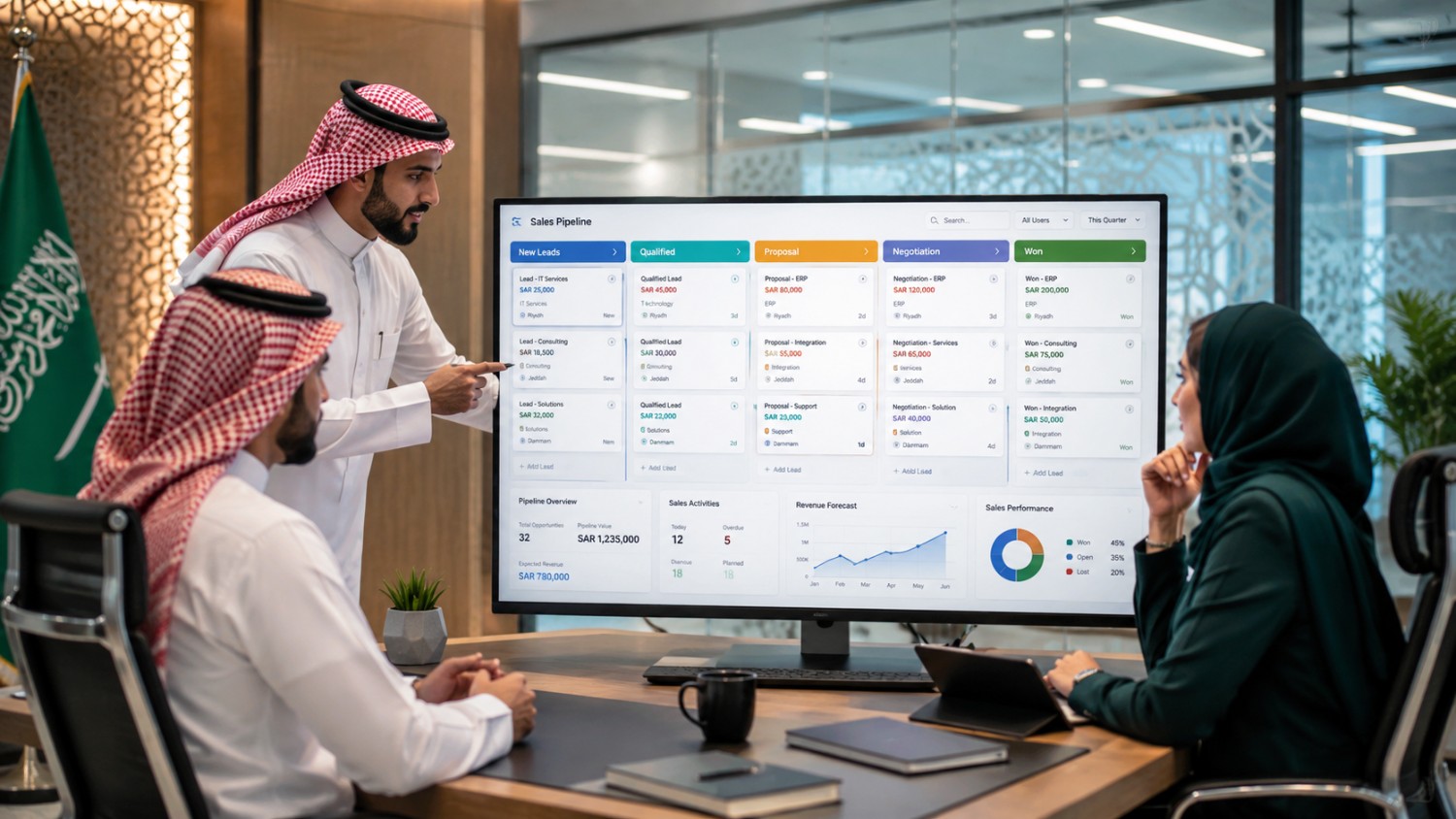
The system provides a visual sales pipeline where sales teams can organize opportunities according to their current stage. Businesses can also track activities, manage leads, create opportunities, analyze pipeline performance, and generate sales forecasts.
Odoo’s official documentation describes CRM as a system for organizing sales activities, tracking leads, closing opportunities, and improving sales forecasting.
For Saudi businesses, this can be particularly useful when sales teams are handling large numbers of prospects across different branches, territories, products, or customer segments.
Why Saudi Businesses Need Better Sales Management
Many businesses still manage parts of their sales process using spreadsheets, emails, messaging applications, and separate databases. While these tools may work for a small sales team, they can create problems as the business grows.
Common challenges include:
- Leads being missed or forgotten
- Limited visibility into sales activities
- Difficulty tracking follow-ups
- Duplicate customer information
- Poor coordination between sales teams
- Limited visibility into pipeline value
- Manual sales reporting
- Difficulty forecasting future revenue
A centralized CRM system can help bring this information together.
With Odoo CRM implementation in Saudi Arabia, businesses can create a structured sales process where sales teams have better visibility of leads, opportunities, activities, and customer information.
1. Centralize Leads and Customer Information
One of the biggest advantages of Odoo CRM is centralized customer and lead management.
Instead of storing customer information across different spreadsheets, email accounts, or individual sales representatives’ records, businesses can maintain customer and prospect information within one system.
Odoo can also generate leads and opportunities from sources such as website contact forms and email aliases.
This means businesses can create a more organized process for capturing and managing new enquiries.
For example, a Saudi company receiving enquiries through its website can connect the enquiry process with its CRM workflow, allowing the sales team to follow up without manually transferring every enquiry into a spreadsheet.
2. Manage the Sales Pipeline More Effectively
A clear sales pipeline allows sales managers to understand where opportunities currently stand.
Odoo CRM provides a visual pipeline that helps sales teams organize opportunities according to different stages of the sales process.
A typical process could include:
New Lead → Qualified Lead → Meeting → Proposal → Negotiation → Won/Lost
The exact stages can be configured according to the company’s sales process.
This gives sales managers a clearer view of active opportunities and helps teams prioritize the prospects that require attention.
Instead of asking sales representatives for individual updates, managers can use the CRM pipeline to understand the current status of sales opportunities.
3. Improve Lead Follow-Up
Following up at the right time is critical to sales success.
A lead may be interested in a product today but may not be ready to purchase immediately. Without a proper follow-up process, sales representatives can easily forget important prospects.
Odoo CRM allows sales teams to organize activities and next actions associated with opportunities. This helps representatives maintain a structured follow-up process rather than relying entirely on memory or separate reminders.
For businesses with multiple sales representatives, this can also make sales activities easier for managers to monitor.
4. Qualify Leads Before Spending Sales Resources
Not every enquiry represents the same level of sales potential.
Odoo CRM supports a lead qualification process where leads can be reviewed before being converted into opportunities. Odoo documentation explains that leads can act as a qualification step before a formal opportunity is created.
This can help Saudi businesses prioritize their sales resources.
For example, a company may receive hundreds of enquiries every month. Instead of treating every enquiry equally, the sales team can qualify prospects based on factors such as:
- Customer requirements
- Budget
- Industry
- Purchase timeline
- Product interest
- Business size
- Location
Qualified prospects can then move further through the sales pipeline.
5. Get Better Sales Forecasting
Not every enquiry represents the same level of sales potential.
Odoo CRM supports a lead qualification process where leads can be reviewed before being converted into opportunities. Odoo documentation explains that leads can act as a qualification step before a formal opportunity is created.
This can help Saudi businesses prioritize their sales resources.
For example, a company may receive hundreds of enquiries every month. Instead of treating every enquiry equally, the sales team can qualify prospects based on factors such as:
- Customer requirements
- Budget
- Industry
- Purchase timeline
- Product interest
- Business size
- Location
Qualified prospects can then move further through the sales pipeline.
6. Connect CRM With Other Business Operations
One of the major benefits of using Odoo is that CRM does not have to operate as an isolated system.
Odoo is designed as a modular business platform, allowing businesses to connect CRM with applications such as sales, inventory, accounting, marketing, and other business functions.
For example, when a sales opportunity progresses into an actual order, the wider Odoo environment can help connect sales information with other operational processes.
This can reduce the need for employees to repeatedly enter the same information into multiple systems.
For growing Saudi businesses, this connected approach can be particularly valuable when sales, finance, inventory, and management teams need access to consistent business information.
7. Support Multi-Branch and Growing Sales Teams
One of the major benefits of using Odoo is that CRM does not have to operate as an isolated system.
Odoo is designed as a modular business platform, allowing businesses to connect CRM with applications such as sales, inventory, accounting, marketing, and other business functions.
For example, when a sales opportunity progresses into an actual order, the wider Odoo environment can help connect sales information with other operational processes.
This can reduce the need for employees to repeatedly enter the same information into multiple systems.
For growing Saudi businesses, this connected approach can be particularly valuable when sales, finance, inventory, and management teams need access to consistent business information.
8. Make Sales Performance Easier to Measure
A CRM system should not only store customer information. It should also help businesses understand how their sales process is performing.
With Odoo CRM, businesses can analyze pipeline activity and sales performance using available reporting capabilities.
Sales managers can use this information to identify areas where the sales process may need improvement.
For example, if opportunities are frequently being lost at the proposal stage, management can investigate whether pricing, product positioning, follow-up, or sales processes need improvement.
This turns CRM data into a tool for continuous sales improvement.
9. Improve Customer Experience
A customer may interact with multiple people within the same organization during the buying journey.
If customer information is scattered across different systems, the customer may have to repeatedly explain their requirements.
A centralized CRM can help sales teams access relevant customer and opportunity information more easily.
This can support a more consistent customer experience because sales representatives have greater context when communicating with prospects and customers.
For businesses competing in Saudi Arabia’s increasingly digital market, providing a professional and organized customer journey can be an important part of building long-term relationships.
Why Choose FAMA Technologies for Odoo CRM Services in KSA?
Implementing CRM software successfully is not only about installing the application. The CRM needs to match the company’s actual sales process.
FAMA Technologies provides Odoo ERP services in Saudi Arabia, including implementation, customization, integration, training, and support. Its Odoo offering includes modules such as Sales & CRM, Accounting, Inventory, HR, Manufacturing, POS, and eCommerce.
For businesses considering Odoo CRM services in KSA, FAMA Technologies can help businesses assess their requirements, configure relevant Odoo modules, integrate systems where required, migrate data, and support users through implementation.
The right approach depends on factors such as business size, sales workflow, number of users, existing software, industry requirements, and reporting needs.
Is Odoo CRM Suitable for Saudi SMEs?
Yes, Odoo CRM can be suitable for both growing SMEs and larger organizations when it is configured according to their business requirements.
A small business may initially require only CRM and Sales functionality, while a growing organization may later connect CRM with Accounting, Inventory, POS, Marketing, or other Odoo applications.
This modular approach allows businesses to expand their system as their operational requirements change.
For Saudi SMEs looking for an Odoo CRM implementation partner, the important consideration is not simply choosing software but designing a CRM workflow that the sales team can actually use consistently.
Conclusion
Managing sales effectively requires visibility, organization, timely follow-ups, accurate information, and a clear understanding of the sales pipeline.
Odoo CRM for Saudi businesses provides a centralized way to manage leads, opportunities, activities, customer information, pipeline performance, and forecasting.
For businesses in KSA that are still relying on spreadsheets or disconnected sales tools, moving to a properly implemented CRM can help create a more structured and scalable sales process.
With the right implementation strategy, customization, integration, training, and ongoing support, Odoo CRM can become an important part of a company’s wider digital transformation journey.
Businesses looking for Odoo CRM services in Saudi Arabia can work with an experienced implementation partner such as FAMA Technologies to assess their requirements and build an Odoo environment aligned with their sales and operational goals.
Take The Next Step