Introduction
For modern quick-service restaurants (QSRs), the drive-thru is no longer simply a lane with a speaker and a static menu. Customers increasingly expect fast ordering, clear product information, attractive visuals, and a convenient experience from the moment they enter the lane until they collect their order.
This is where digital menu boards for drive-thru restaurants can make a significant difference.
Unlike traditional printed menus, digital menu boards allow restaurants to display dynamic food imagery, update menus remotely, promote specific products and adapt content according to different times or customer requirements.
For QSRs operating in Saudi Arabia, Dubai, Qatar, Kuwait and the wider GCC, outdoor digital menu boards can also be designed for high visibility and demanding outdoor conditions. FAMA Technologies’ On-Go Drive Thru Solution includes Infinite Outdoor Digital Menu Boards, managed through its Infinite Digital CMS, as part of an integrated drive-thru technology ecosystem.
What Is a Drive-Thru Digital Menu Board?
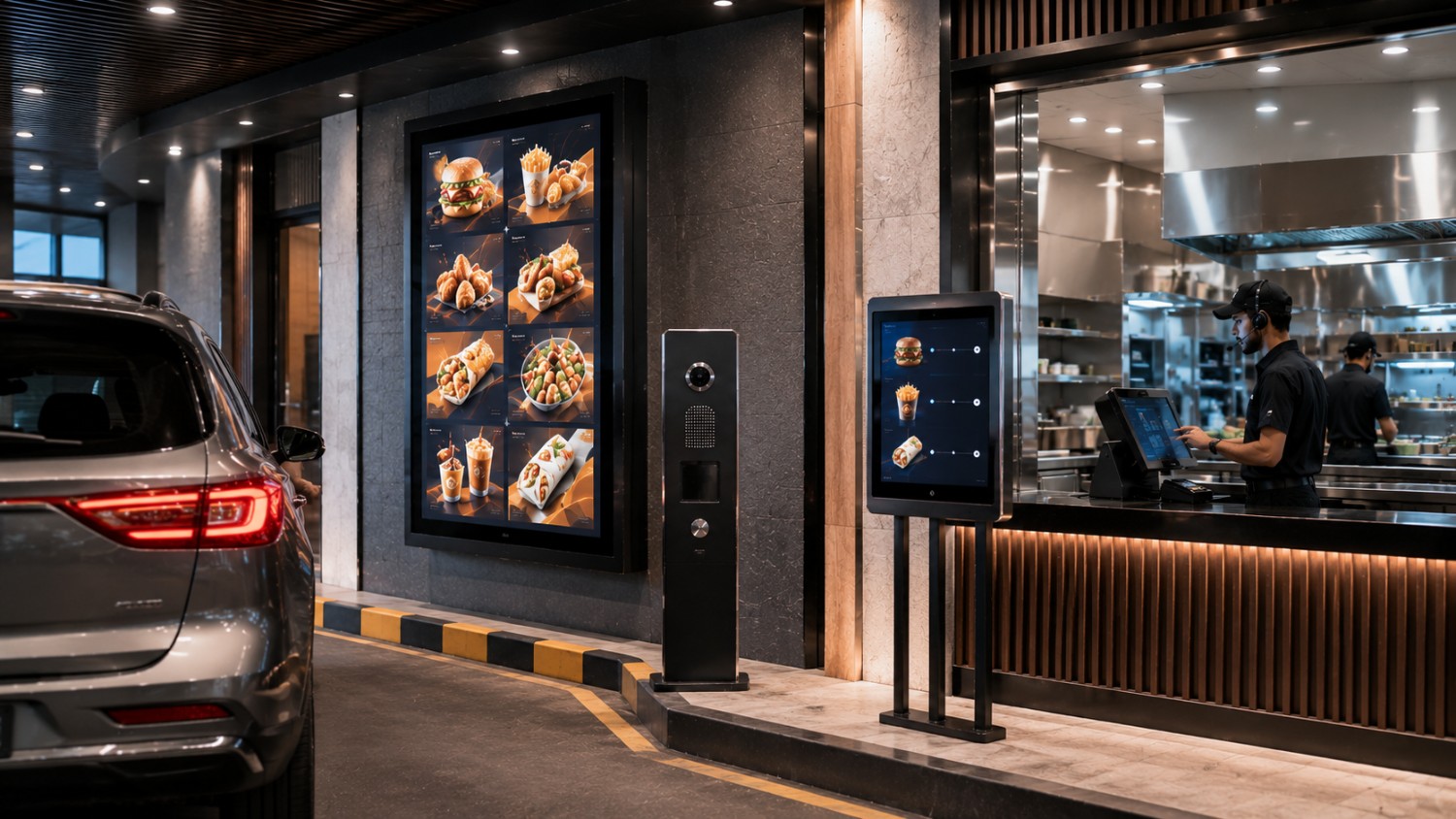
A drive-thru digital menu board is a commercial-grade digital display positioned along a restaurant’s drive-thru lane to present menu items, food imagery, promotions and other customer-facing information.
Instead of manually replacing printed boards, restaurant operators can manage digital content electronically.
A modern system can support:
- High-resolution food images
- Menu categories
- Promotional content
- Combo meals
- Limited-time offers
- Product recommendations
- Pricing updates
- Time-based menu changes
- Multilingual content
- Location-specific content
FAMA’s Infinite Outdoor Digital Menu Boards are designed to provide high-definition menu presentation and support real-time content updates through its cloud-based CMS.
1. Digital Menus Make Food Choices Easier
One of the simplest ways digital menu boards improve customer experience is by making the menu easier to understand.
A static menu can become crowded when a restaurant has multiple categories, meal combinations and promotional products.
Digital displays allow QSRs to organize information visually.
For example, a restaurant can highlight:
Popular Meals → Combos → Beverages → Desserts → Limited-Time Offers
Large food images can also help customers understand what they are ordering before they reach the speaker post.
For customers in a busy drive-thru, this can make the decision-making process easier and more convenient.
2. High-Quality Food Visuals Increase Engagement
Food is highly visual.
A well-designed digital menu can showcase burgers, sandwiches, beverages, desserts and meal combinations using high-resolution photography.
Instead of seeing a static product name, customers can immediately understand what the meal looks like.
This makes visual merchandising an important part of drive-thru technology.
FAMA describes its outdoor digital menu boards as a way to create an engaging visual experience while supporting tailored customer journeys and ordering variety.
The objective should not be to fill the screen with excessive animation. A professional menu should make the customer’s decision faster, clearer and easier.
3. Real-Time Menu Updates Reduce Operational Problems
One major advantage of digital menu boards is flexibility.
Traditional printed menus require physical replacement whenever prices, products or promotions change.
With a connected digital signage system, content can be updated remotely.
For example, a QSR can change:
- Breakfast menus in the morning
- Lunch menus during the afternoon
- Dinner menus later in the day
- Limited-time offers
- Seasonal products
- Product availability
- Promotional campaigns
FAMA’s Infinite Digital CMS is described as a cloud-based, multilingual platform that enables content creation, scheduling and remote distribution.
For a restaurant group operating multiple branches, this can significantly simplify menu management.
4. Day-Parting Creates a More Relevant Customer Journey
A customer visiting at 8 AM should not necessarily see exactly the same menu as someone visiting at 8 PM.
This is where day-parting becomes useful.
A digital menu board can be scheduled to automatically display different content based on the time of day.
For example:
Morning :
Breakfast meals, coffee, and bakery products.
Afternoon :
Lunch combinations and beverages.
Evening :
Dinner meals, family combos and desserts.
This approach helps customers see information that is relevant to the time they are visiting.
FAMA’s drive-thru content highlights real-time customization and time-based menu management as capabilities of modern digital menu systems.
5. Digital Menu Boards Create Better Upselling Opportunities
A digital menu board can do more than display the basic menu.
It can strategically introduce:
- Combo upgrades
- Add-on items
- Desserts
- Beverages
- Side dishes
- Limited-time products
- Premium meal options
For example, after showing a meal, the next content panel could visually highlight a beverage or dessert combination.
This can help restaurants create additional purchasing opportunities without requiring staff to verbally promote every offer.
FAMA specifically identifies enhanced upselling opportunities as one of the benefits of its outdoor digital menu board solution.
However, effective upselling should remain relevant. Too many promotions can make the menu confusing and slow down customer decisions.
6. Digital Displays Improve Menu Visibility in GCC Conditions
For the KSA and wider GCC market, outdoor display performance is especially important.
Drive-thru menu boards need to remain visible in different lighting conditions and operate reliably in outdoor environments.
FAMA’s KSA drive-thru offering specifically positions its outdoor digital menu boards for locations across Saudi Arabia, including Riyadh, Jeddah, Al Khobar, Dammam, NEOM, Tabuk, Jazan, Abha, Taif, Al Kharj, Al Madinah and Al Qassim.
For restaurant operators, choosing an appropriate high-brightness, weather-resistant commercial display is therefore an important part of the overall drive-thru design.
7. Multilingual Content Supports GCC Customers
The Middle East is a highly diverse market.
In Saudi Arabia, UAE, Qatar and Kuwait, restaurants may serve local customers as well as international residents and visitors.
Digital signage can support multiple languages and allow operators to adapt content according to their audience.
For example, a restaurant can use:
Arabic + English
for key menu information and promotional communication.
FAMA’s Infinite Digital CMS is positioned as a multilingual platform, making centralized management of content across different locations and audiences easier.
8. Digital Menu Boards Can Work With Other Drive-Thru Technology
A digital menu board becomes even more useful when it is part of a connected drive-thru system.
A modern customer journey can look like:
Digital Menu → Speaker Post → Order Entry → Customer Order Display → Kitchen → Pickup
Each component has a specific role.
The digital menu helps customers decide what to order.
The speaker system enables communication.
The customer order display allows order verification.
The kitchen system helps staff prepare the order.
This is why FAMA positions its On-Go Drive Thru Solution as an integrated system containing digital menu boards, iCOD customer order displays, speaker posts, and other drive-thru technologies.
9. Cloud-Based Management Helps Multi-Branch QSRs
Imagine a restaurant group has 50 drive-thru locations across Saudi Arabia.
Changing a promotion manually at every location would be time-consuming.
With centralized digital signage management, content can be prepared and distributed remotely.
This can help businesses maintain:
- Consistent branding
- Consistent pricing
- Centralized promotions
- Scheduled campaigns
- Location-specific menus
- Faster content updates
FAMA’s Infinite Digital CMS is designed for remote content creation, scheduling and distribution across digital displays.
This capability becomes particularly valuable for QSR brands operating across Riyadh, Jeddah, Dubai, Doha and Kuwait City.
10. Digital Menu Boards Support a Better Overall Drive-Thru Experience
The biggest advantage isn’t simply that the menu becomes digital.
The real benefit is that digital signage can remove friction from the customer’s journey.
A well-designed drive-thru menu can help customers:
See → Understand → Decide → Order → Confirm → Collect
When menu information is clear and relevant, customers can make decisions more confidently before reaching the ordering point.
This can work alongside other technologies such as customer order displays, drive-thru communication systems and vehicle tracking.
FAMA’s On-Go solution is designed around improving customer experience, reducing waiting times, improving order accuracy and supporting restaurant profitability through connected drive-thru technologies.
Digital Menu Boards for Saudi Arabia and the Middle East
The opportunity for drive-thru digital menu boards in Saudi Arabia extends beyond Riyadh.
QSR operators across Jeddah, Dammam, Al Khobar, Madinah, Makkah, NEOM and other Saudi cities can use digital signage to create more flexible drive-thru experiences.
In the wider GCC, the same technology can support QSR operations in:
- Dubai and Abu Dhabi, UAE
- Doha, Qatar
- Kuwait City, Kuwait
FAMA maintains dedicated drive-thru solution offerings for KSA, UAE, Kuwait and Qatar, reflecting the wider regional application of its technology.
How FAMA Technologies Uses Digital Menu Boards in Drive-Thru Solutions
FAMA Technologies does not position the digital menu board as an isolated display.
Its On-Go Drive Thru Solution combines the outdoor digital menu board with other technologies such as:
- Infinite Outdoor Digital Menu Boards
- iCOD Customer Order Display
- Drive-Thru Speaker Post
- Noise-Cancelling Headsets
- Drive-Thru Timer
- Vehicle Tracking
- Infinite Digital CMS
- Cloud-based management
This integrated approach allows restaurants to address multiple parts of the drive-thru journey rather than focusing only on menu presentation.
FAMA also highlights its outdoor digital menu boards as supporting real-time updates, tailored customer journeys, engaging visual experiences and enhanced upselling opportunities.
What Should a Good Drive-Thru Digital Menu Board Include?
When selecting a digital menu board for a QSR, businesses should consider:
1. High Brightness :
The display should remain easy to see in outdoor lighting.
2. Weather Resistance :
Drive-thru equipment needs to be suitable for outdoor operating conditions.
3. Remote CMS :
Managers should be able to update content without physically visiting every location.
4. High Resolution :
Food imagery should remain sharp and visually attractive.
5. Multilingual Support :
Arabic and English content can help serve diverse GCC audiences.
6. Scheduled Content :
Menus and promotions should automatically change according to time or campaign.
7. Scalability :
The system should support additional locations as the restaurant business grows.
8. Integration :
The menu board should work as part of a broader drive-thru technology ecosystem.
Conclusion
Digital menu boards improve the drive-thru experience by making menus more visual, flexible, relevant and easier to manage.
For customers, they can provide clearer product information, attractive food imagery and a more convenient ordering journey.
For QSR operators, they provide the ability to update menus remotely, schedule different content, promote relevant products and manage digital experiences across multiple locations.
In Saudi Arabia, Dubai, Qatar, Kuwait and the wider GCC, the right outdoor digital menu board also needs to be designed for real-world commercial conditions, not simply chosen as a standard indoor display.
When combined with technologies such as customer order displays, speaker systems, noise-cancelling headsets, drive-thru timers and cloud-based CMS, digital menu boards become part of a complete drive-thru technology ecosystem.
For businesses looking to modernize their QSR operations, FAMA Technologies’ On-Go Drive Thru Solution provides an integrated approach to digital menus, ordering, communication and drive-thru management.