Introduction
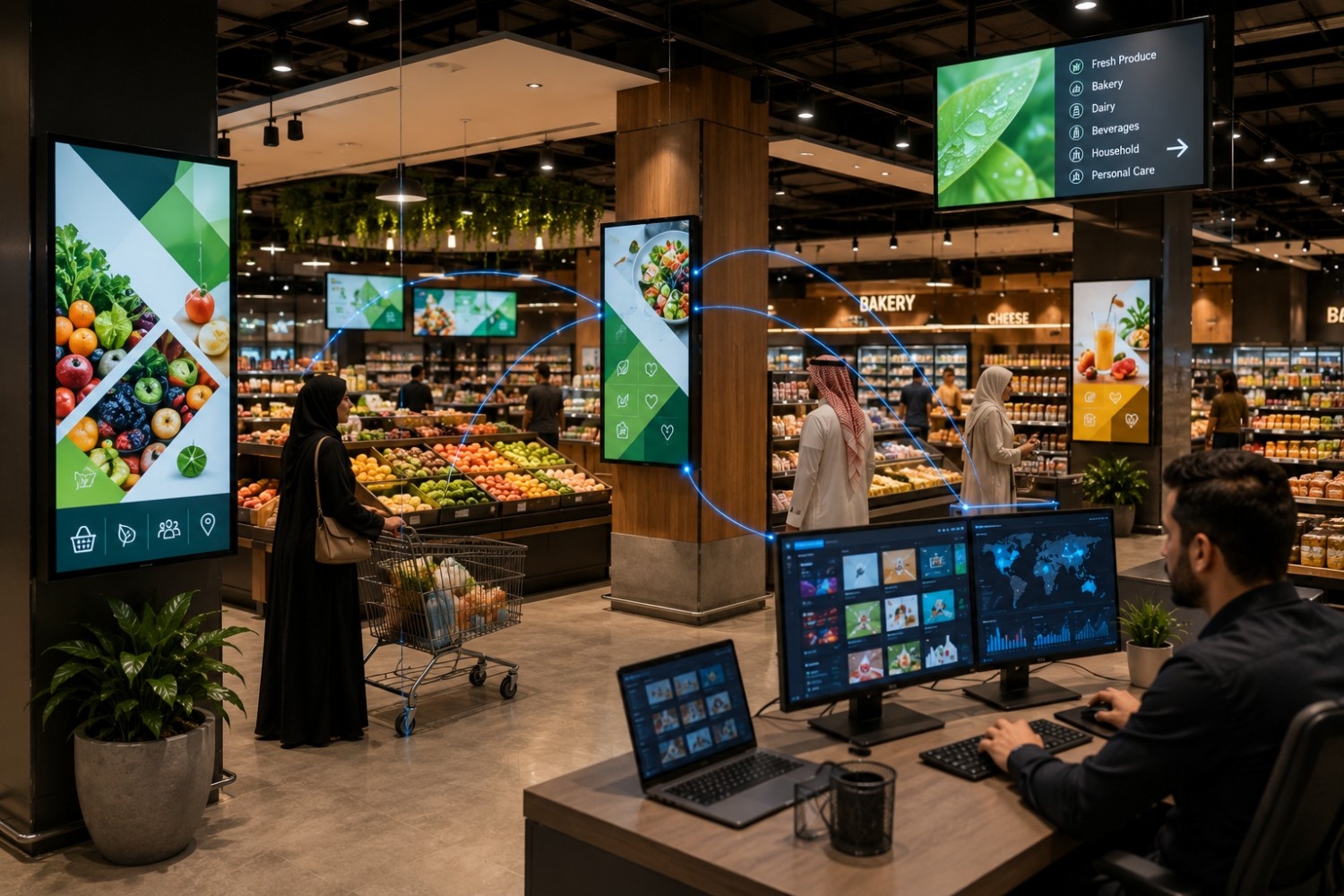
When people think about digital signage in supermarkets, promotions and discounts are often the first use cases that come to mind. However, modern digital signage can do much more than display promotional offers.
From helping shoppers find products to communicating prices, highlighting new products, supporting cross-selling, reducing perceived waiting time, and improving the overall shopping experience, digital screens are becoming an important part of modern supermarket operations.
For supermarkets across Saudi Arabia, the UAE, Qatar, Kuwait, and the wider Middle East, digital signage can connect customer communication, merchandising, and operational efficiency through a single digital ecosystem.
What Is Digital Signage for Supermarkets?
Digital signage for supermarkets refers to the use of commercial digital displays to communicate product information, promotions, prices, announcements, directions and other customer-facing content inside a supermarket.
Unlike printed posters and static signs, digital displays can be updated remotely and scheduled according to location, time, campaign or business requirement.
A supermarket can therefore use the same digital signage infrastructure for promotions, product discovery, wayfinding, brand communication, seasonal campaigns and customer information.
1. Digital Signage Helps Customers Find Products
Large supermarkets can sometimes be difficult to navigate, particularly for first-time visitors.
Digital screens can provide visual directions to important sections such as:
- Fresh produce
- Bakery
- Dairy
- Meat and seafood
- Beverages
- Household products
- Personal care
- Electronics
- Checkout areas
Digital wayfinding can make the shopping journey easier by helping customers understand where different categories are located.
For large supermarkets, shopping centres, and hypermarkets in cities such as Riyadh, Jeddah, Dubai, Doha, and Kuwait City, this can become an important part of the customer experience.
2. Digital Screens Can Improve Product Discovery
Supermarket shelves contain thousands of products, making it difficult for every product to receive equal customer attention.
Digital displays can highlight selected products, new arrivals, seasonal items, or specific categories.
For example, a screen positioned near a beverage section could introduce a new product, show serving ideas, or highlight complementary food items.
This allows supermarkets to use digital signage as an extension of their merchandising strategy rather than simply as an advertising channel.
3. Digital Signage Can Support Cross-Selling
A supermarket purchase rarely consists of just one product.
Digital screens can help connect related products and encourage customers to consider additional items.
For example:
Pasta → Pasta sauce → Cheese → Garlic bread
Or:
Coffee → Biscuits → Creamer → Chocolate
This type of contextual merchandising can make customers aware of products they may not have originally planned to purchase.
Digital signage can therefore support cross-selling and basket-building strategies without requiring additional printed promotional materials.
4. Digital Screens Can Communicate Product Information
Price alone may not always explain why a customer should choose one product over another.
Digital screens can communicate useful product information such as:
- Product features
- Ingredients
- Usage instructions
- Product benefits
- Origin
- Preparation ideas
- Seasonal information
- New product announcements
This can be particularly valuable for premium, imported, health-focused, or newly launched products.
Instead of relying entirely on small shelf labels, supermarkets can use larger digital displays to provide customers with more engaging visual information.
5. Digital Signage Makes Price and Offer Communication More Flexible
Supermarket pricing and promotional campaigns can change frequently.
With printed signage, updating large numbers of promotional materials can become time-consuming.
Digital signage allows authorized teams to update content centrally and distribute changes to selected screens.
For example, a supermarket chain can update a campaign across multiple branches without physically visiting every store.
FAMA Technologies’ Infinite Digital solution can support centralized digital content management, allowing businesses to create, schedule, and distribute content across digital displays.
This type of centralized approach can be especially useful for supermarket groups operating across multiple locations.
6. Digital Signage Can Improve the Checkout Experience
The checkout area is another valuable location for digital displays.
Customers waiting in queues can be shown:
- Promotional products
- Loyalty program information
- Seasonal campaigns
- New product announcements
- Brand content
- Store information
- Complementary product recommendations
Rather than leaving customers with a blank wall or static poster while they wait, supermarkets can use digital screens to provide useful and engaging content.
The goal should not always be to sell something. Informational and entertaining content can also contribute to a better perceived customer experience.
7. Digital Screens Can Reduce Communication Gaps
Large supermarket environments often need to communicate information quickly.
Digital signage can be used for:
Store announcements → Safety information → Service updates → Queue information → Department information → Customer guidance
Because the content can be changed quickly, supermarkets can respond more efficiently when information needs to be updated.
This can be particularly useful for large-format stores where a single announcement may need to reach customers across multiple areas.
8. Multilingual Digital Signage Is Important in the GCC
The Middle East has highly diverse customer populations, making multilingual communication an important consideration for many retailers.
Supermarkets in Saudi Arabia, UAE, Qatar, and Kuwait can use digital displays to communicate information in Arabic and English, while adapting content according to their customer base and location.
Digital signage also makes it easier to manage different content versions for different branches.
For example, a supermarket chain could maintain consistent corporate branding while displaying location-specific promotions, announcements, or information.
For businesses operating across the GCC, this flexibility can be significantly more practical than producing and distributing multiple sets of printed materials.
9. Digital Signage Supports Seasonal Retail Campaigns
Supermarkets frequently change their merchandising strategy around seasonal events and shopping periods.
Digital screens can support campaigns around:
- Ramadan
- Eid
- Back-to-school
- National celebrations
- Summer promotions
- Winter campaigns
- New product launches
- Weekend offers
- End-of-season campaigns
Instead of replacing printed signs throughout the store, marketing teams can schedule new digital content across selected displays.
This creates opportunities for more responsive and visually engaging campaigns.
10. Digital Signage Can Strengthen the Supermarket Brand
A supermarket is not only a place where people purchase products. It is also a physical representation of the brand.
Consistent digital content can help supermarkets communicate:
- Brand identity
- Premium positioning
- Sustainability initiatives
- Private-label products
- Customer loyalty programs
- Corporate campaigns
- Community initiatives
A well-designed digital environment can make a supermarket feel more organized, modern, and connected.
For premium supermarkets and large retail chains across the GCC, this can contribute to a more sophisticated in-store experience.
11. Digital Signage Can Help Multi-Location Supermarket Chains
Managing digital content across one supermarket is relatively straightforward. Managing hundreds of screens across multiple branches is a different challenge.
A centralized digital signage CMS can help businesses manage:
- Multiple stores
- Multiple screens
- Different departments
- Different campaigns
- Different languages
- Scheduled content
- Location-specific messaging
FAMA Technologies’ Infinite Digital is positioned around centralized digital content management and remote distribution, making this type of approach relevant for businesses with distributed digital displays.
For a supermarket group operating across Riyadh, Jeddah, Dammam, Dubai, Abu Dhabi, Doha, or Kuwait City, centralized management can help maintain consistency while allowing individual locations to receive relevant content.
12. Digital Signage Can Work With a Broader Retail Technology Ecosystem
The future of supermarket digital signage is not necessarily about isolated screens.
Digital signage can become part of a wider connected retail environment involving:
- Digital signage CMS
- Retail analytics
- Footfall intelligence
- Point-of-sale systems
- Product information systems
- Customer loyalty platforms
- Digital menu or promotional systems
- Retail business intelligence
This creates opportunities for supermarkets to move from basic digital advertising toward more connected customer experiences.
For example, retail analytics can help businesses understand customer traffic patterns, while digital signage can deliver relevant messaging in selected areas.
This type of integration can make digital signage more measurable and strategically useful.
Digital Signage for Supermarkets in Saudi Arabia and the Middle East
The supermarket and hypermarket sector across Saudi Arabia, UAE, Qatar, and Kuwait presents strong opportunities for digital signage because retailers often operate large physical stores, multiple branches, and diverse product categories.
In Saudi Arabia, supermarkets and hypermarkets in Riyadh, Jeddah, Dammam, Khobar, Madinah and other major cities can use digital displays for product discovery, wayfinding, multilingual communication and dynamic merchandising.
In the UAE, retailers in Dubai and Abu Dhabi can use digital signage to support premium shopping experiences, promotions and multi-location communication.
Similarly, supermarkets in Qatar and Kuwait can use centralized digital signage to manage customer-facing content across stores and departments.
The most effective strategy, however, is not simply to install more screens.
It is to identify where customers need information, what decision they need help making, and what content will provide the most value at that moment.
Best Practices for Supermarket Digital Signage
To get better results from digital signage, supermarkets should focus on:
- Use short and clear messages – Customers should understand the message quickly.
- Place screens strategically – Match the display location with the customer journey.
- Use high-quality visuals – Product photography and video should be clear and attractive.
- Keep content fresh – Avoid showing outdated promotions.
- Use multilingual content where appropriate – Arabic and English can support GCC audiences.
- Connect content with merchandising – Promote products in relevant departments.
- Schedule content intelligently – Match messaging to time, location, and campaigns.
- Maintain consistent branding – Keep screens aligned with the supermarket’s identity.
- Measure performance – Track relevant business and engagement indicators where data is available.
- Use centralized management – Simplify control of multiple screens and branches.
Why Supermarket Digital Signage Is About More Than Promotions
Promotional content will remain an important part of supermarket digital signage, but it is only one application.
Modern digital screens can help customers find products, understand products, discover new items, navigate stores, receive important information, explore complementary products, and experience a more engaging shopping environment.
For supermarket chains across Saudi Arabia, Dubai, Qatar, Kuwait, and the wider Middle East, digital signage can become a strategic retail technology rather than simply another advertising medium.
With solutions such as FAMA Technologies’ Infinite Digital, businesses can move toward centralized, remotely managed digital experiences that support both customer engagement and operational flexibility.
The future of supermarket digital signage is therefore not about asking, “What promotion should we put on the screen?”
It is about asking:
“What does the customer need to see at this point in their shopping journey?”
That shift—from promotional signage to intelligent customer communication—is what makes digital signage increasingly valuable for modern supermarkets.