Introduction
Cybersecurity has changed significantly as businesses have moved toward cloud applications, remote work, connected devices, digital platforms, and increasingly complex IT environments.
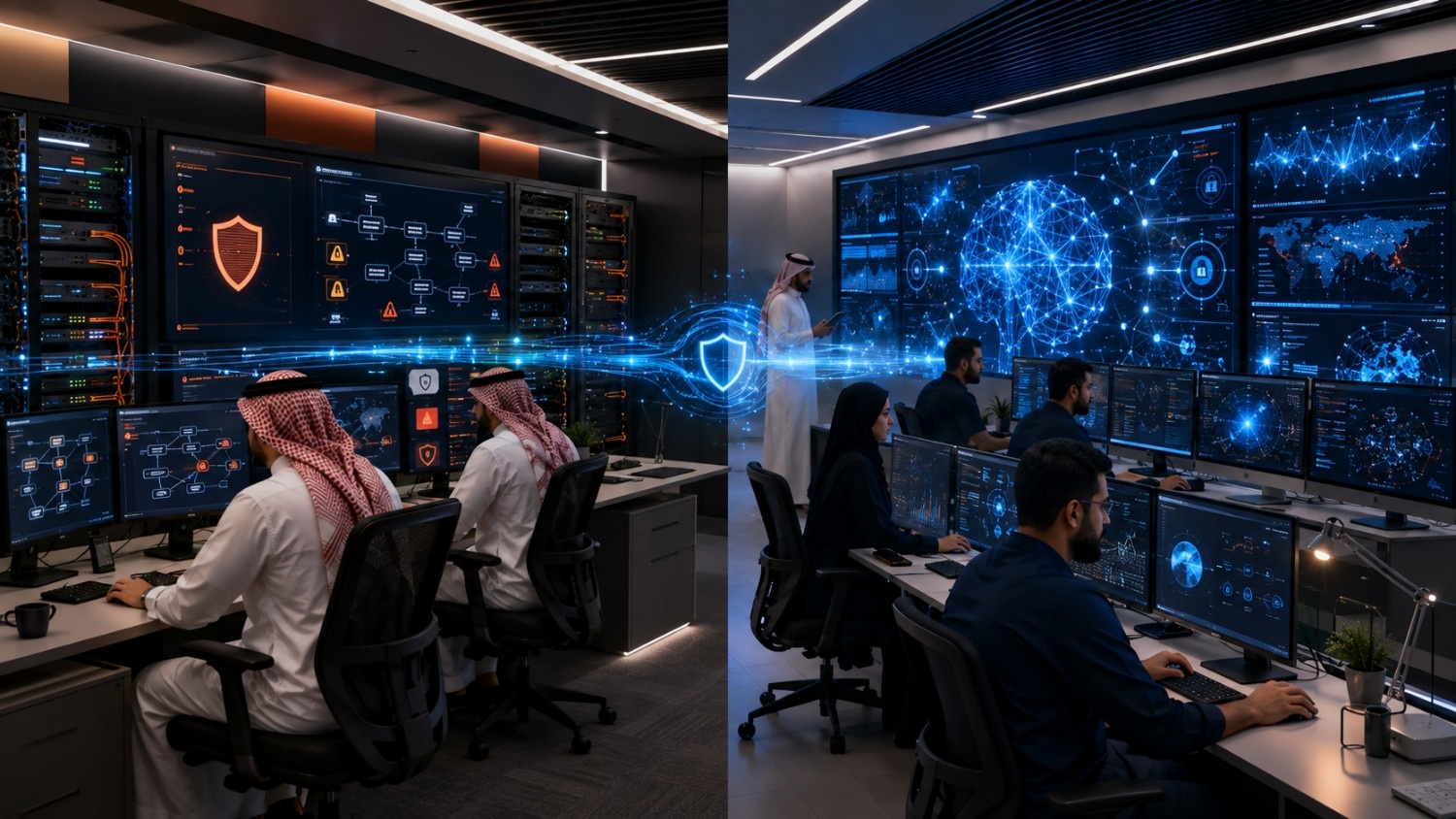
Traditional security systems such as firewalls, antivirus software, intrusion prevention systems, and signature-based detection remain important parts of business cybersecurity. However, modern organizations are increasingly adopting AI-driven security to analyze large volumes of data, detect unusual behavior, and support faster threat response.
This raises an important question: AI vs traditional security systems—which approach is better for modern businesses?
The answer is not necessarily one or the other. AI can strengthen traditional security technologies by adding behavioral analysis, machine learning, automation, and advanced threat detection capabilities.
What Is Traditional Security?
Traditional cybersecurity systems generally rely on predefined rules, signatures, known threat patterns, and manually configured security policies.
For example, traditional antivirus software can compare files against databases of known malware signatures. Similarly, signature-based intrusion prevention systems look for known characteristics associated with specific attacks. These systems need regular updates as new threats and attack patterns emerge.
Common traditional security technologies include:
- Firewalls
- Antivirus software
- Intrusion prevention systems
- Virtual private networks (VPNs)
- Access controls
- Email security
- Endpoint protection
- Network monitoring
- Security policies and rules
These technologies remain essential because they provide foundational protection and predictable security controls.
What Is AI-Driven Security?
AI-driven security uses technologies such as artificial intelligence, machine learning, behavioral analytics, and automation to analyze security information and identify potentially suspicious activity.
Instead of relying only on known threat signatures, AI-based systems can establish patterns of normal activity and identify deviations.
For example, if an employee normally accesses certain applications during business hours but suddenly attempts to access sensitive information from an unusual location or device, behavioral analytics can flag that activity for investigation.
AI can therefore add another layer of intelligence to existing cybersecurity infrastructure.
1. Threat Detection: Rules vs Behavioral Analysis
The biggest difference between traditional and AI-driven security is often the way threats are detected.
Traditional systems are highly effective at identifying known threats. If a malicious file or network activity matches a known signature or rule, the security system can block or alert on it.
The challenge is that new attacks may not match existing signatures.
AI-driven systems can analyze behavior instead. They can look for unusual network traffic, abnormal user activity, unexpected application behavior, or suspicious access patterns.
This does not mean AI can detect every unknown threat. However, behavioral analysis can provide another layer of visibility where signature-based detection may have limitations.
2. Response Speed
Traditional security systems can automatically block certain known threats, but more complex incidents may require security professionals to investigate alerts and decide what action to take.
AI and automation can help accelerate this process by analyzing related security events, identifying potentially important signals, and supporting security teams during investigation and response.
For businesses dealing with large numbers of security events, this can help reduce the time required to identify potentially serious incidents.
However, automated response should be carefully configured. An incorrect automated action can potentially disrupt legitimate business activity.
3. Handling Unknown Threats
Traditional signature-based security is strongest when the threat is already known and has been identified.
AI can approach the problem differently.
By establishing behavioral baselines, AI-based security technologies can flag activity that appears unusual even when the exact threat has not previously been identified.
This is particularly relevant for sophisticated attacks, insider threats, compromised accounts, and certain zero-day scenarios.
AI-based endpoint security, for example, can use behavioral analysis to identify suspicious activity associated with unknown or evolving threats.
4. Scalability and Data Analysis
Modern businesses generate enormous amounts of security data from endpoints, networks, servers, cloud applications, users, and connected devices.
Manually analyzing every event is not practical for most security teams.
AI can process large volumes of security information and identify patterns that may otherwise be difficult to spot.
This makes AI particularly useful for organizations with complex IT environments, multiple locations, large numbers of employees, or extensive cloud and endpoint infrastructure.
5. Automation and Security Operations
Traditional security systems typically perform specific security functions based on configured rules.
AI-driven security can add intelligence and automation to security operations.
For example, AI can help:
- Prioritize security alerts
- Detect abnormal behavior
- Correlate security events
- Analyze network activity
- Identify suspicious user behavior
- Support threat investigations
- Recommend response actions
- Automate selected repetitive security tasks
The objective is not to remove security professionals from the process. Instead, AI can help security teams spend less time on repetitive analysis and more time on complex investigations and strategic security decisions.
Does AI Replace Traditional Security Systems?
No.
This is one of the most important points businesses should understand.
AI-driven security should generally complement, rather than completely replace, foundational cybersecurity controls.
Firewalls, endpoint protection, secure access controls, VPNs, network segmentation, intrusion prevention, backups, patch management, and security policies remain important.
AI can add an intelligence layer that helps analyze the activity taking place across these environments.
In fact, modern cybersecurity architectures commonly combine multiple technologies rather than relying on a single security tool.
How FAMA Technologies Combines Modern Security Capabilities
FAMA Technologies approaches business IT infrastructure through its Office Bridge solution, which includes Network Infrastructure & Security alongside networking, cloud, server and storage, data cabling, and other enterprise infrastructure capabilities.
Within its network infrastructure and security offering, FAMA lists Security Driven Networking, Dynamic Cloud Security, and AI Driven Security Operation. Its network security capabilities also include firewalls, intrusion prevention systems, router security, endpoint protection, email and web security, and switch security with VPN.
This integrated approach is important because businesses rarely need just one security technology. They need infrastructure that connects networking, endpoints, cloud environments, servers, security controls, and monitoring.
Which Security Approach Is Better for Your Business?
Rather than asking whether AI or traditional security is better, businesses should ask:
How can AI improve the security controls we already have?
A modern security strategy may combine:
Traditional controls
→ Firewalls
→ Antivirus/endpoint protection
→ VPN
→ Access controls
→ Network security
with:
AI-driven capabilities
→ Behavioral analysis
→ Anomaly detection
→ Intelligent monitoring
→ Automated alert prioritization
→ AI-assisted threat investigation
The right combination depends on the organization’s size, infrastructure, risk profile, compliance requirements, available security expertise, and technology environment.
AI and Traditional Security: A Combined Approach
The comparison between AI vs traditional security systems is not necessarily about choosing one technology over another.
Traditional security provides the foundational controls businesses need to protect networks, endpoints, applications, and data. AI adds advanced capabilities for analyzing behavior, identifying anomalies, processing large volumes of information, and supporting faster security operations.
AI itself is also not risk-free. AI and machine-learning systems can face specific threats such as data poisoning, model manipulation, and evasion techniques, which means they also need appropriate security controls and governance.
For modern organizations, the strongest approach is therefore a layered cybersecurity strategy where proven security controls are strengthened with intelligent technologies where they provide meaningful value.
With its Office Bridge offering, FAMA Technologies combines network infrastructure, security, cloud, server and storage, and AI-driven security capabilities to support businesses building more connected and secure IT environments.