Introduction
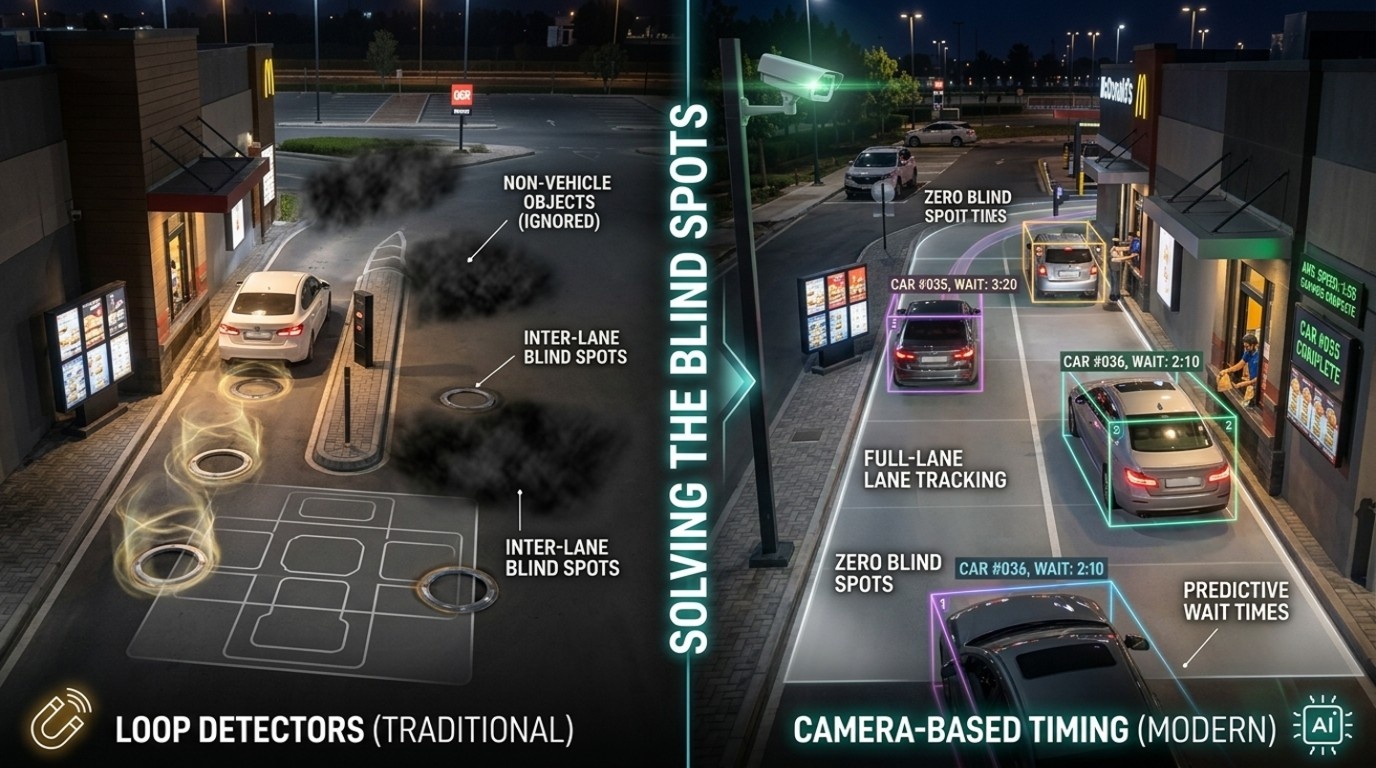
For decades, loop detectors have been a reliable part of drive-thru timing systems. Embedded into pavement, these inductive sensors detect vehicles at specific points and trigger timing events as cars move through the lane.
But the modern Quick Service Restaurant (QSR) has changed.
Customers now use mobile ordering, pickup lanes, multiple drive-thru lanes, and increasingly complex restaurant layouts. Vehicles can queue before the menu board, move into pull-forward areas, abandon the line, or wait in mobile-order pickup zones.
A traditional loop detector may not capture these experiences. For restaurant operators in Saudi Arabia, where QSR brands are expanding rapidly across Riyadh, Jeddah, Dammam, Al-Khobar, and Makkah, understanding these blind spots is becoming increasingly important.
The question isn’t simply whether loop detectors work.
It’s whether they provide enough visibility to understand the complete drive-thru customer journey.
This is where camera-based drive-thru timing systems can provide a significant advantage.
1. What Are Loop Detectors?
Loop detectors use inductive sensing technology to detect vehicles at fixed points in the drive-thru.
A wire loop is installed beneath the pavement. When a vehicle passes over it, the system detects a change in the electromagnetic field and registers the vehicle.
This technology can effectively measure events such as:
- Vehicle arrival at the menu board
- Movement toward payment
- Arrival at pickup
- Departure
- Lane occupancy
For a traditional single-lane drive-thru, this can provide useful operational data.
However, the system only knows what happens at the locations where loops have been installed.
That creates an important limitation.
2. The Problem: Fixed Detection Creates Blind Spots
A loop detector can answer:
“Is a vehicle currently at this location?”
But it cannot necessarily answer:
- When did the vehicle enter the property?
- How long did it wait before reaching the loop?
- Did the customer abandon the queue?
- Was there congestion before the menu board?
- Did a vehicle move into a pull-forward area?
- How long did a mobile-order customer wait?
- Did traffic from another area affect the main drive-thru lane?
These gaps matter because the customer’s experience starts before the vehicle reaches the first detection point.
If your timer starts when the vehicle reaches the menu board, but the customer has already waited two minutes in a queue, your operational dashboard may show a relatively acceptable service time while the customer experiences something very different.
3. Why This Matters for Saudi QSR Operators
Saudi Arabia has a rapidly evolving restaurant and QSR ecosystem.
Drive-thru locations can experience significant traffic fluctuations during:
- Lunch periods
- Dinner periods
- Weekends
- Ramadan
- Iftar
- Suhoor
- Public holidays
- Promotional campaigns
During these peak periods, vehicle queues can form before the traditional detection points.
This creates a critical data gap.
A restaurant may know that its menu-board-to-window time is five minutes, but it may not know that customers spent another two minutes waiting before reaching the menu board.
That difference can influence customer satisfaction, staffing decisions, restaurant layout, and ultimately revenue.
4. What Camera-Based Drive-Thru Detection Changes
Camera-based systems use computer vision to monitor vehicle movement across defined areas of the restaurant property.
Instead of relying exclusively on sensors embedded at fixed points, cameras can provide visibility across multiple zones.
Depending on the solution, these zones can include:
- Drive-thru entrance
- Pre-queue
- Menu board
- Ordering point
- Payment window
- Pickup window
- Pull-forward area
- Mobile pickup area
- Curbside zones
- Exit
This creates a more complete picture of vehicle movement.
5. Camera-Based Timing Can Reveal Queue Behavior
One of the biggest advantages of camera-based timing is improved queue visibility.
Imagine 10 vehicles enter a restaurant property.
Only six reach the traditional menu-board loop.
What happened to the other four?
With conventional fixed-point detection, that information may be difficult to understand.
Camera-based monitoring can potentially identify:
- Vehicles entering the queue
- Vehicles waiting for extended periods
- Vehicles changing lanes
- Vehicles leaving before ordering
- Congestion around specific areas
This can help operators investigate drive-offs and abandonment patterns that conventional timing systems may not capture.
6. The Hybrid Approach: Combining Loops and Cameras
Restaurants don’t necessarily need to completely replace existing infrastructure.
A hybrid approach can combine traditional loop detection with camera-based monitoring.
Loops can continue measuring established drive-thru events, while cameras provide additional visibility across areas that loops cannot easily monitor.
This approach can be particularly useful for established restaurants that already have significant drive-thru infrastructure.
Instead of replacing everything at once, operators can gradually expand their measurement capabilities.
The result can be:
Existing reliability + broader visibility + better operational intelligence.
7. From Lane Timing to Customer Journey Timing
The biggest conceptual change is how restaurants define the drive-thru experience.
Traditional systems often define the experience as:
Menu Board → Payment → Pickup → Exit
But customers experience something broader:
Property Entry → Queue → Ordering → Payment → Food Preparation → Pickup → Exit
That distinction matters.
A customer doesn’t start waiting when the timer starts.
They start waiting when they enter the queue.
Therefore, a measurement system that captures more of the journey can provide operators with a more complete understanding of customer wait times.
8. How Better Timing Data Can Improve Operations
Camera-based timing isn’t valuable simply because it produces more data.
The real value comes from turning that data into operational decisions.
Optimize Staffing: Managers can identify when congestion consistently occurs and determine whether staffing needs to change.
Identify Bottlenecks: If vehicles spend excessive time in one area, operators can investigate that specific stage.
Improve Lane Design: Traffic patterns can reveal whether the physical layout is contributing to congestion.
Reduce Customer Abandonment: Identifying where vehicles leave the queue can help operators investigate potential causes.
Improve Mobile Pickup Flow: As mobile ordering grows, separating mobile pickup traffic from the main drive-thru flow can become increasingly important.
9. Why Real-Time Visibility Matters
Historical reports can tell a restaurant what happened yesterday.
Real-time timing can help managers respond to what is happening right now.
For example, if queue time suddenly increases during a Friday evening rush, managers can investigate immediately.
They may:
- Reallocate staff
- Prioritize kitchen production
- Address communication problems
- Manage pull-forward vehicles
- Adjust operational workflows
This makes timing technology more than a reporting tool.
It becomes an operational decision-support system.
10. How FAMA Technologies Can Help Modernize Drive-Thru Operations
For QSR brands looking to improve their drive-thru technology infrastructure in Saudi Arabia, FAMA Technologies provides solutions designed around modern restaurant operations.
Its broader technology capabilities include:
- Drive-Thru Solutions
- Digital Menu Boards
- Digital Signage
- Kitchen Display Systems
- IT Infrastructure
- Network Solutions
- Restaurant Technology
- Managed IT Services
By combining drive-thru technology with reliable infrastructure and digital customer-facing systems, FAMA Technologies can help restaurants develop a more connected operational environment.
This can be particularly valuable for restaurant groups managing multiple locations across Riyadh, Jeddah, Dammam, Al-Khobar, Makkah, and the wider GCC market.
11. The Future of Drive-Thru Timing
The future of drive-thru measurement is moving toward greater visibility and intelligent analytics.
Emerging capabilities include:
- Computer vision
- AI-powered vehicle detection
- Real-time queue analytics
- Predictive congestion analysis
- Automated performance alerts
- Multi-location dashboards
- Mobile-order traffic analysis
- Vehicle flow analytics
- Intelligent operational recommendations
As these technologies mature, QSR operators will be able to understand not only how long a customer waited, but also why they waited.
That distinction can transform operational improvement.
Conclusion:
Loop detectors remain a proven technology for measuring vehicle activity at specific points, but modern drive-thru operations are becoming more complex.
Customers can queue before the menu board, use mobile ordering, move into pull-forward areas, or leave before reaching a traditional detection point.
Camera-based drive-thru timing addresses many of these blind spots by providing broader visibility across the customer journey.
For Saudi QSR operators, this means a shift from measuring isolated lane events to understanding the complete drive-thru experience.
The goal isn’t simply to replace loops.
It’s to collect better data, understand customer behavior more accurately, and use that information to create faster, more efficient, and more profitable drive-thru operations.
Take the Next Step
Is your current drive-thru timing system measuring the entire customer journey or only the part it can see?
FAMA Technologies can help you explore modern drive-thru technology, camera-based monitoring, digital menu boards, communication systems, and connected QSR solutions designed for the Saudi market.
Whether you’re operating one restaurant or managing a multi-location QSR network, better visibility can help you identify hidden bottlenecks and make smarter operational decisions.
Contact FAMA Technologies today to discuss your drive-thru requirements and discover how camera-based timing can take your restaurant analytics beyond traditional loop detection.