Introduction
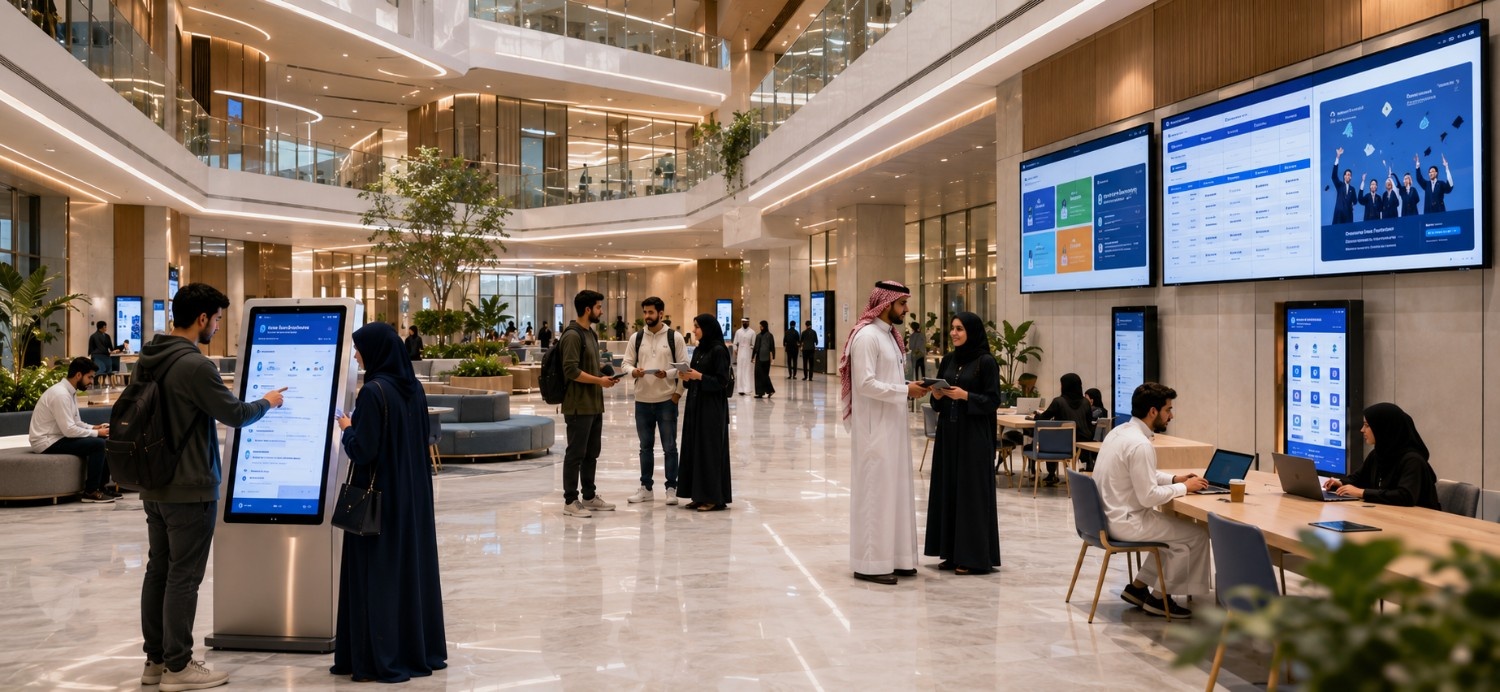
Effective communication is one of the most essential functions of any educational institution. Every day, schools, colleges, and universities across Saudi Arabia, the UAE, Qatar, Egypt, and the wider Middle East need to communicate important information to students, faculty, staff, and visitors, including class schedules, campus events, room changes, examination timetables, emergency alerts, and academic announcements. Traditional notice boards and printed posters are often slow to update, costly to maintain, and increasingly ineffective for today’s digitally connected student population.
Digital signage addresses these challenges by providing a dynamic, centrally managed communication platform that delivers timely, engaging, and real-time information across the campus. As educational institutions continue investing in Smart Campus initiatives and digital transformation, digital signage has evolved beyond simple display screens into an intelligent solution that enhances campus communication, improves wayfinding, strengthens emergency preparedness, increases student engagement, and supports greater operational efficiency across universities throughout Riyadh, Jeddah, Dammam, Makkah, Madinah, Dubai, Abu Dhabi, Doha, Cairo, and the wider Middle East.
1.What is Digital Signage?
Digital signage refers to a network of commercial displays, LED screens, interactive kiosks, and centralized
content management software (CMS) that enables institutions to publish and manage multimedia content
across one or multiple campus locations.
Content can include:
- News and announcements
- Class schedules
- Examination timetables
- Campus maps and wayfinding
- Emergency alerts
- Student achievements
- Event promotions
- Weather updates
- Social media feeds
- Cafeteria menus
- Live dashboards
- Welcome messages
Unlike static notice boards, digital signage allows authorised staff to update content instantly across all
Displays from a single management platform.
2. Why Digital Signage Matters in Education
Educational institutions across Saudi Arabia, the UAE, Qatar, Egypt, and the wider Middle East communicate with thousands of students, faculty members, staff, and visitors every day. Today’s digitally connected students expect information to be available instantly, accurately, and consistently across multiple communication channels. A modern Digital Signage platform enables schools, colleges, and universities to deliver real-time, engaging, and centralized communication while supporting Smart Campus initiatives and improving the overall campus experience.
A modern Digital Signage platform helps educational institutions:
- Deliver real-time campus announcements and updates
- Replace outdated notice boards with dynamic digital displays
- Centralize communication through a single content management platform
- Improve campus navigation with interactive wayfinding kiosks
- Broadcast instant emergency alerts and safety notifications
- Promote university events, seminars, workshops, and student activities
- Display class schedules, examination timetables, and academic announcements
- Share student achievements, news, and important institutional updates
- Manage communication across multiple campuses using cloud-based content distribution
- Reduce printing costs and eliminate manual content updates
- Ensure consistent messaging across all digital screens
- Increase student engagement with multimedia content
- Improve operational efficiency and campus communication
- Support Smart Campus and digital transformation initiatives across the Middle East
Key Applications Across Educational Institutions
1. Reception Areas
Reception displays create a strong first impression by welcoming visitors, showcasing institutional
achievements, highlighting upcoming events, and providing important announcements.
Example :
A university reception screen welcomes prospective students while displaying admissions deadlines,
campus news, research achievements, and upcoming open days.
2. Classroom and Lecture Room Signage
Displays installed outside classrooms can show:
- Class schedules
- Lecturer information
- Room availability
- Timetable updates
- Last-minute room changes
When integrated with timetable management systems, information updates automatically without manual
intervention.
3. Student Information Displays
High-traffic areas such as libraries, cafeterias, and student centres are ideal locations for digital displays
that communicate:
- Examination schedules
- Scholarship opportunities
- Student club activities
- Career fairs
- Sports events
Health awareness campaigns
These displays improve visibility and encourage greater student participation.
4. Interactive Wayfinding
Large campuses can be difficult to navigate, particularly for new students and visitors.
Interactive kiosks help users locate:
- Academic departments
- Lecture theatres
- Faculty offices
- Libraries
- Laboratories
- Parking areas
- Medical centres
- Prayer rooms
QR code integration enables users to continue navigation on their smartphones.
5. Emergency Communication
One of the most valuable applications of digital signage is emergency communication.
In situations such as fire alarms, severe weather, security incidents, or building evacuations, institutions can
Broadcast consistent emergency instructions simultaneously across all connected displays.
This capability supports faster response times and improves campus safety.
Real-World Scenarios
Scenario 1: Exam Week Communication
During examination periods, room allocations frequently change due to scheduling adjustments. Instead of
printing revised timetables, the university updates examination locations instantly through its CMS.
Students receive accurate information on displays positioned across campus, reducing confusion and
preventing delays.
Scenario 2: Open Day Events
A private university hosting an admissions event uses digital signage to welcome visitors, display
programme information, promote scholarship opportunities, and guide attendees to registration areas
through interactive maps. Visitors experience a professional and well-organised campus from the moment
they arrive.
Scenario 3: Emergency Lockdown
Following a security incident, the campus command centre activates an emergency message through the
digital signage platform. Every display immediately replaces scheduled content with evacuation routes and
safety instructions, while alerts are synchronised with the university’s mobile application and public
announcement system.
Scenario 4: Sustainability Initiatives
A school replaces hundreds of printed posters each month with centrally managed digital displays. Besides
reducing paper consumption and printing costs, content can now be updated within minutes, ensuring
students always receive current information.
Integrating Digital Signage with Smart Campus
Solutions
The true value of digital signage is realised when it integrates with other campus systems.
Examples include:
- Learning Management Systems (LMS)
- Student Information Systems (SIS)
- Queue Management Systems
- Visitor Management
- Room Booking Platforms
- Access Control
- Building Management Systems (BMS)
- Emergency Notification Systems
- Social Media Platforms
This integration transforms displays from passive communication tools into active components of the Smart
Campus ecosystem.
Benefits for Educational Institutions
Improved Communication: Deliver accurate information in real time across multiple campuses.
Better Student Engagement: Promote campus activities, achievements, and student initiatives through visually engaging content.
Enhanced Safety: Broadcast emergency instructions instantly and consistently.
Operational Efficiency: Reduce manual updates and administrative workload through centralised content management.
Sustainability: Lower printing costs and reduce paper waste, supporting environmental goals.
Stronger Institutional Image: Professional digital communication enhances the campus experience for students, parents, staff, and visitors.
Why FAMA Technologies?
FAMA Technologies delivers end-to-end digital signage solutions tailored to educational institutions,
including:
- Samsung, LG, Philips, and commercial-grade displays
- Indoor and outdoor LED screens
Interactive touch displays - Wayfinding kiosks
- Centralised cloud-based CMS
- Video walls
- Emergency messaging integration
- Multi-campus content management
- Installation, commissioning, training, and managed services
Our solutions are designed to integrate seamlessly with Smart Campus technologies, enabling institutions
To communicate more effectively while supporting operational excellence.
Final Thoughts
Digital signage has become an essential component of modern educational environments. Beyond
replacing traditional notice boards, it enables institutions to communicate more effectively, strengthen
campus safety, improve student engagement, and support digital transformation initiatives.
As schools and universities continue to modernise under Saudi Vision 2030, digital signage provides a
scalable foundation for smarter communication and a better campus experience. When integrated with
other Smart Campus technologies, it becomes a strategic asset
Call to Action
Looking to modernise communication across your campus?
FAMA Technologies provides integrated digital signage solutions that help schools, colleges, and
Universities deliver engaging, real-time communication while supporting Smart Campus transformation.
Contact our Education Solutions team to explore a solution tailored to your institution.