Introduction
In today’s rapidly evolving education landscape across Saudi Arabia, the UAE, Egypt, Qatar, and the wider Middle East, delivering an exceptional student experience goes far beyond academic excellence. Every interaction a student has with an institution—from admissions and registration to financial services, academic advising, student affairs, and library support—plays a critical role in shaping their overall campus experience.
As universities and educational institutions across Riyadh, Jeddah, Dammam, Makkah, Madinah, Dubai, Abu Dhabi, Doha, and Cairo continue investing in Smart Campus initiatives aligned with digital transformation goals, managing student services efficiently has become more important than ever.
Long waiting times, overcrowded service centres, and inefficient service processes can negatively impact student satisfaction, staff productivity, and institutional reputation. To address these challenges, leading educational institutions are adopting intelligent Queue Management Systems (QMS) to modernize student services and improve operational efficiency.
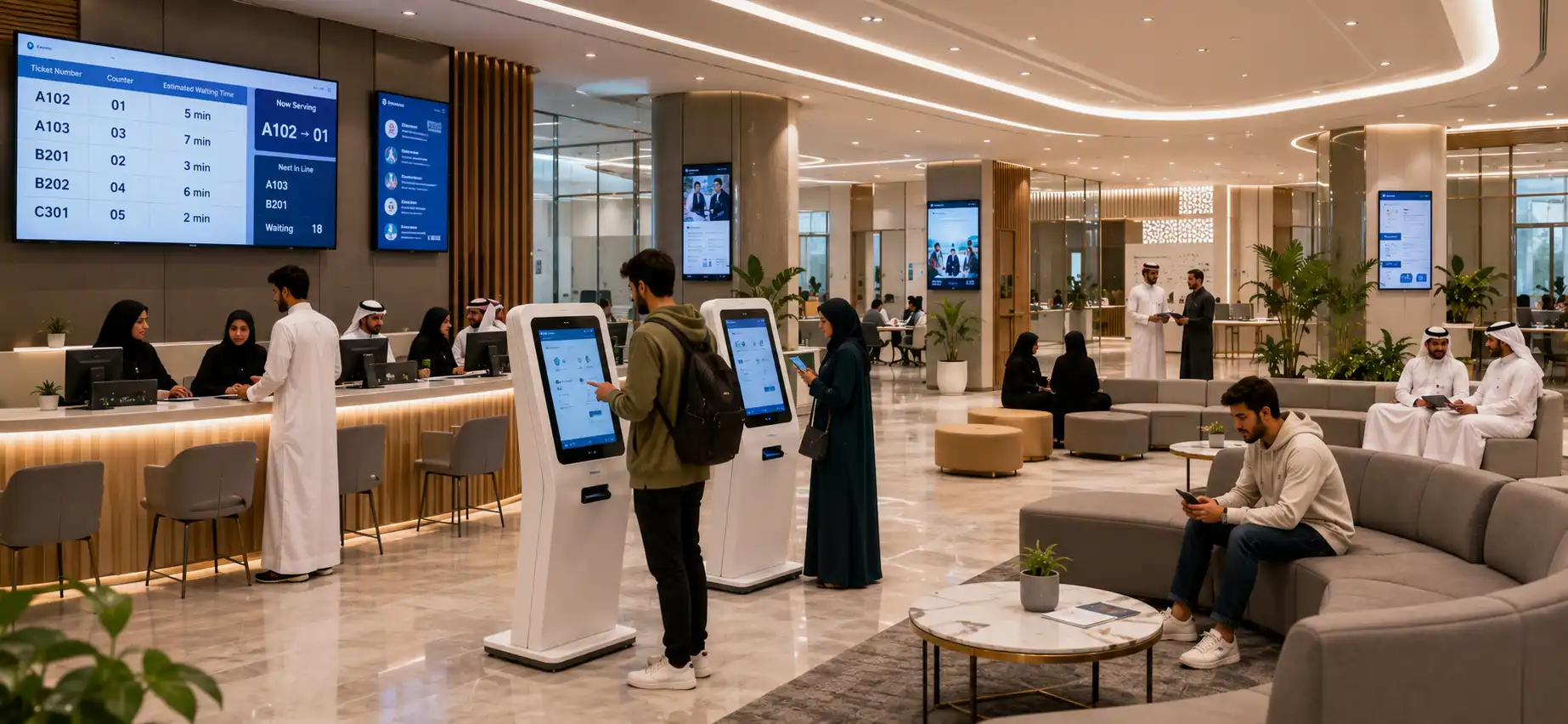
By combining self-service kiosks, online appointment scheduling, mobile ticketing, real-time notifications, digital signage, and advanced performance analytics, queue management solutions enable schools, colleges, and universities to deliver faster, more transparent, and student-centric services while supporting the broader Smart Campus vision across the Middle East.
1. Why Student Experience Matters
Student expectations across Saudi Arabia, the UAE, Egypt, and the wider Middle East have evolved significantly. Today’s learners are accustomed to digital services that are convenient, accessible, and available on demand. They expect the same level of efficiency from educational institutions that they experience in banking, retail, healthcare, and government services. As universities across the region embrace Smart Campus initiatives and digital transformation, delivering fast, seamless, and student-centric services has become increasingly important.
Research consistently shows that positive service experiences contribute to higher student satisfaction, improved retention, and a stronger institutional reputation. Reducing administrative friction allows students to spend more time focusing on learning, research, and campus life.
Common service areas where delays occur include:
- Admissions
- Registration
- Finance and fee payments
- Student affairs
- Academic advising
- IT help desks
- Libraries
- Career services
- International student offices
- Health and counselling centres
Without an intelligent queue management system, these departments often experience congestion during peak periods such as student enrolment, semester registration, examination seasons, scholarship processing, and the beginning of academic terms, impacting both operational efficiency and the overall student experience across universities in the Middle East.
2. What is an Intelligent Queue Management
System?
A Queue Management System (QMS) is a smart digital solution that helps educational institutions across Saudi Arabia, the UAE, Egypt, and the wider Middle East organize and manage student flow by replacing traditional waiting lines with efficient, technology-driven service processes.
Modern education-focused Queue Management Systems typically include:
- Self-service student kiosks
- Online appointment scheduling
- Mobile queue registration
- QR code ticketing
- SMS and email notifications
- Digital queue display screens
- Staff management dashboards
- Real-time performance analytics
- Student feedback terminals
- Multi-campus management
These intelligent features help universities and colleges deliver faster, more transparent, and student-centric services while improving administrative efficiency and supporting Smart Campus initiatives throughout the Middle East.
How Queue Management Works
A typical student journey may follow these steps:
- The student books an appointment online or scans a QR code to join the queue.
- Upon arrival, they confirm their visit using a self-service kiosk or mobile device.
- The system assigns a digital ticket and estimated waiting time.
- Students monitor their position through display screens or mobile notifications.
- When called, they proceed directly to the designated service counter.
Staff access relevant student information through integrated systems, enabling faster service. - Upon completion, students can submit feedback digitally.
- This process minimises uncertainty, reduces crowding, and improves service flow.
Key Benefits for Educational Institutions
1. Reduced Waiting Times
Virtual queues and appointment scheduling distribute demand more evenly, reducing congestion during
peak periods.
2. Improved Student Satisfaction
Transparent waiting times and timely notifications reduce frustration and enhance the overall campus
experience.
3. Increased Staff Productivity
Automated ticket allocation and workflow management allow staff to focus on service delivery rather than
queue administration.
4. Better Resource Planning
Analytics provide insights into service demand, helping managers optimise staffing and operating hours.
5. Data-Driven Decision Making
Dashboards track key performance indicators such as average waiting time, service duration, and customer
satisfaction.
Real-World Scenarios
Scenario 1: Semester Registration
At the beginning of a new semester, thousands of students require registration support. Instead of forming
long physical queues, students book appointments online or join a virtual queue. They receive SMS
notifications when their turn approaches, allowing them to attend lectures or use campus facilities while
waiting. The registration office experiences smoother workflows and reduced crowding.
Scenario 2: Financial Aid Services
During scholarship application periods, demand for financial aid offices increases significantly. A queue
management system categorises students by service type, directing them to specialised advisors. Waiting
times decrease, and staff handle enquiries more efficiently.
Scenario 3: University Library Support
Students seeking research assistance book appointments with librarians through the queue management
platform. Digital displays guide them to the correct consultation area, improving both service quality and
resource utilisation.
Scenario 4: Student Health Centre
A campus health clinic integrates its appointment system with queue management software. Students
receive reminders before appointments and real-time updates regarding delays, reducing missed
appointments and improving clinic efficiency.
Integration with Smart Campus Technologies
The greatest value of a queue management system is achieved when integrated with other Smart Campus systems
platforms.
Examples include:
- Student Information Systems (SIS)
- Learning Management Systems (LMS)
- Enterprise Resource Planning (ERP)
- Identity Management Systems
- Digital Signage
- Self-Service Kiosks
- Visitor Management
- Mobile Campus Applications
- Business Intelligence Dashboards
Integrated systems eliminate duplicate data entry and provide staff with a complete view of each student’s
interaction history.
Best Practices for Implementation
Successful queue management projects should:
- Map existing service processes before implementation.
- Offer both appointment-based and walk-in services.
- Ensure accessibility for students with disabilities.
- Integrate with existing campus systems.
- Provide multilingual interfaces where appropriate.
- Train staff on workflow management.
- Use analytics to refine service delivery over time.
A phased rollout—starting with high-demand departments—can help institutions realise early benefits
While minimising disruption.
Why FAMA Technologies?
FAMA Technologies provides intelligent queue management solutions designed for educational environments.
Our capabilities include:
- Self-service ticketing kiosks
- Online appointment scheduling
- Mobile queue registration
- Digital queue displays
- SMS and email notifications
- Integration with ERP and SIS platforms
- Real-time analytics dashboards
- Customer feedback terminals
- Multi-campus deployment
- Ongoing support and managed services
These solutions integrate seamlessly with broader Smart Campus initiatives, creating efficient, student-
centred service environments.
Looking Ahead
Student engagement will continue to evolve alongside advances in Artificial Intelligence and Extended Reality
(XR), mobile technologies, and predictive analytics. Future campuses are expected to provide increasingly
personalised, data-informed experiences that anticipate student needs while maintaining strong
governance and privacy protections.
Institutions investing in integrated digital platforms today will be well positioned to adopt emerging
technologies as they mature.
Final Thoughts
Efficient student services are a cornerstone of the modern educational experience. Intelligent queue
management systems reduce waiting times, improve operational efficiency, and enable institutions to
Deliver transparent, data-driven services that meet the expectations of today’s learners.
As schools and universities continue their digital transformation journey, queue management should be
viewed not merely as an operational tool but as a strategic investment in student satisfaction, institutional
performance, and Smart Campus development.
Call to Action
Ready to transform your student service experience?
FAMA Technologies helps schools, colleges, and universities implement intelligent queue management
solutions that improve efficiency, enhance satisfaction, and integrate seamlessly with Smart Campus
technologies.
Contact our Education Solutions team to schedule a consultation and discover how our solutions can
Streamline your campus services.