Introduction:
Walk into any busy quick-service restaurant (QSR) during lunch or dinner hours, and you’ll likely see the same challenge: long queues, overwhelmed staff, impatient customers, and missed sales opportunities.
Whether it’s a burger restaurant in Riyadh, a café in Jeddah, a chicken chain in Dubai, or a growing franchise in Cairo, customer expectations have changed dramatically. Today’s customers want fast, convenient, and personalized ordering experiences without waiting in line.
This is why self-ordering kiosks have become one of the fastest-growing technologies in the restaurant industry. More than just a digital ordering screen, these kiosks help restaurants improve operational efficiency, increase average order value, reduce human error, and deliver a better customer experience.
Across Saudi Arabia, the UAE, Egypt, and the wider Middle East, restaurants are increasingly investing in self-service technology as part of their digital transformation journey.
1. What Is a Self-Ordering Kiosk?
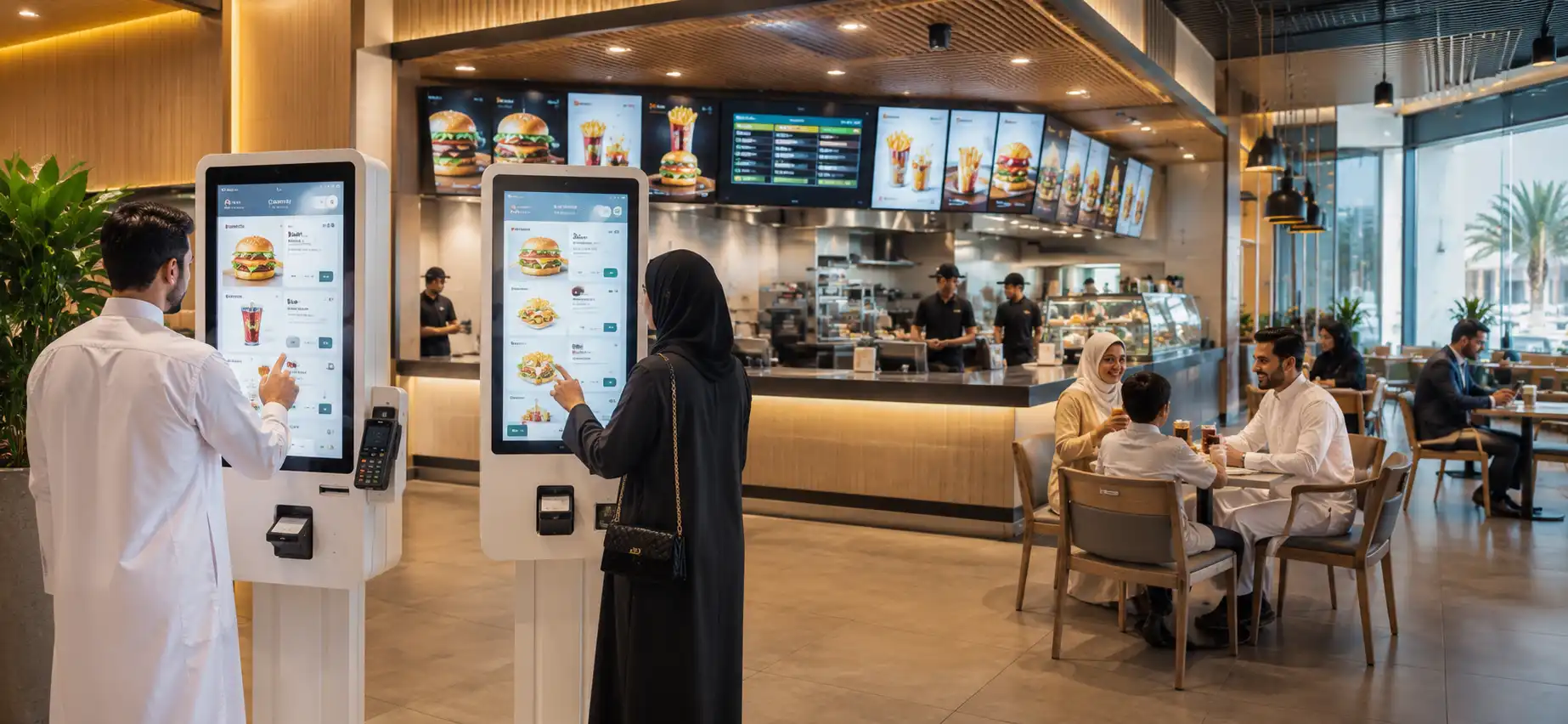
A self-ordering kiosk is an interactive touchscreen installed inside a restaurant that allows customers to browse the menu, customize meals, place orders, and complete payments without waiting at the counter.
Modern kiosks integrate with:
- POS systems
- Kitchen Display Systems (KDS)
- Digital menu boards
- Payment gateways
- Loyalty programs
- Mobile ordering platforms
- Inventory management systems
Once an order is placed, it is instantly sent to the kitchen, reducing delays and minimizing manual intervention.
2. Why Restaurants Are Adopting Self-Service Ordering
Restaurant operations have become more demanding than ever.
Customers expect speed, personalization, and convenience, while restaurant owners must manage labor costs, improve efficiency, and maintain consistent service quality.
Self-ordering kiosks address all these challenges through automation.
Instead of waiting for a cashier, customers can place orders at their own pace, review menu items, add extras, and pay securely all within minutes.
This creates a smoother dining experience while allowing restaurant staff to focus on food preparation and customer service.
3. Reduce Waiting Times During Peak Hours
One of the biggest benefits of self-ordering kiosks is their ability to reduce queues.
During busy periods, traditional counters often become bottlenecks.
By allowing multiple customers to order simultaneously, kiosks significantly reduce waiting times.
For high-traffic restaurants in Riyadh, Jeddah, Dammam, Dubai, Abu Dhabi, and Cairo, this translates into faster customer turnover and improved operational efficiency.
The result?
More completed orders, happier customers, and higher revenue.
4. Improve Order Accuracy
Miscommunication between customers and cashiers is one of the most common causes of incorrect orders.
A self-ordering kiosk eliminates this issue by allowing customers to select exactly what they want.
Whether it’s removing ingredients, adding extra toppings, choosing combo upgrades, or selecting preferred beverages, customers control every detail of their order.
The order is then sent directly to the Kitchen Display System (KDS), reducing human error and improving accuracy.
5. Increase Average Order Value
Self-ordering kiosks are also excellent sales tools.
Unlike busy cashiers who may forget to suggest additional items, kiosks automatically recommend:
- Meal upgrades
- Desserts
- Beverages
- Side dishes
- Combo meals
- Limited-time offers
These intelligent upselling features encourage customers to spend more, increasing the average order value without creating additional pressure on restaurant staff.
6. Enhance the Customer Experience
Modern customers appreciate convenience.
A self-service kiosk gives them complete control over the ordering process.
Customers can:
- Browse the menu comfortably
- View high-quality food images
- Compare meal options
- Customize orders
- Review pricing before checkout
- Select preferred payment methods
For international restaurants operating across the Middle East, multilingual interfaces including Arabic and English make the experience even more accessible.
7. Support Staff During Labor Shortages
Finding and retaining restaurant staff has become increasingly challenging.
Rather than replacing employees, self-ordering kiosks help existing teams work more efficiently.
With fewer customers waiting at the counter, staff can focus on:
- Food preparation
- Customer assistance
- Order fulfillment
- Dining area cleanliness
- Guest satisfaction
This improves service quality while reducing operational pressure during peak hours.
8. Seamless Integration with Restaurant Technology
Modern self-ordering kiosks don’t operate independently.
They integrate with your entire restaurant ecosystem, including:
- POS systems
- Kitchen Display Systems (KDS)
- Digital Signage
- Drive-Thru Ordering Systems
- Loyalty Programs
- Online Ordering Platforms
- Inventory Management
This creates a connected restaurant environment where information flows automatically between every department.
9. Why Self-Ordering Kiosks Are Growing Across the Middle East
Governments and businesses across Saudi Arabia, the UAE, Qatar, Bahrain, Oman, Kuwait, and Egypt are investing heavily in digital transformation initiatives.
Restaurants are embracing automation to:
- Improve customer experiences
- Reduce operational costs
- Increase efficiency
- Minimize order errors
- Support contactless ordering
- Handle higher customer volumes
As competition continues to grow, adopting self-service technology is becoming less of a luxury and more of a necessity.
10. How FAMA Technologies Helps Restaurants Modernize
At FAMA Technologies, we provide advanced Self-Ordering Kiosk Solutions designed specifically for restaurants, cafés, QSRs, food courts, and hospitality businesses across Riyadh, Jeddah, Dammam, Makkah, Madinah, Dubai, Abu Dhabi, Doha, Cairo, and the wider Middle East.
Our solutions integrate seamlessly with:
- POS Systems
- Kitchen Display Systems (KDS)
- Digital Menu Boards
- Queue Management
- Drive-Thru Solutions
- Payment Gateways
- Restaurant Analytics
By combining intuitive hardware with powerful software, we help restaurants streamline operations, improve customer satisfaction, and increase profitability.
Conclusion
The restaurant industry is evolving rapidly, and customer expectations continue to rise.
Self-ordering kiosks are no longer just a modern convenience; they have become an essential part of delivering faster service, improving order accuracy, reducing queues, and increasing restaurant revenue.
Whether you’re opening a new QSR in Riyadh, upgrading a café in Dubai, or expanding a restaurant chain across Saudi Arabia and the Middle East, investing in self-service technology can provide a measurable competitive advantage.
With FAMA Technologies as your technology partner, you can implement a scalable, fully integrated self-ordering kiosk solution that enhances every stage of the customer journey from ordering to payment and food collection.
Take the Next Step
Ready to eliminate long queues and modernize your patient check-in process?
Partner with FAMA Technologies today to implement self-service kiosks that enhance efficiency and patient satisfaction.
Contact our experts now to explore a customized solution for your facility.