Introduction
The Quick Service Restaurant (QSR) industry in the MENA region has long been one of the fastest-growing sectors, driven by urbanization, tourism, and a strong culture of dining convenience. However, in recent times, the industry has been navigating a phase of heightened uncertainty.
Shifting economic conditions, regional instability, supply chain constraints, and evolving customer expectations have collectively reshaped how restaurants operate. In such an environment, delivering a consistent and high-quality customer experience has become more challenging than ever.
To stay competitive, QSR brands are increasingly embracing digital transformation—and at the center of this shift is the smart drive-thru solution.
1. The Changing Dynamics of the MENA QSR Industry
Across countries like Saudi Arabia, the UAE, and other Gulf markets, QSR businesses are experiencing significant operational changes:
Fluctuations in consumer demand
Delays in sourcing ingredients and supplies
Increased operational costs
Workforce management challenges
Growing demand for speed and convenience
These challenges are not always visible to customers, but they directly impact service quality, wait times, and overall experience.
As a result, businesses must adopt systems that allow them to operate efficiently even in unpredictable conditions.
2. Evolving Customer Expectations in Uncertain Times
Customer behavior has undergone a major shift. Today’s QSR customers in MENA expect:
Faster Service : Time is critical. Customers prefer brands that deliver quickly without compromising quality.
Convenience First :Drive-thru, takeaway, and off-premise dining are becoming dominant.
Contactless Experiences : Customers prefer minimal interaction and seamless ordering.
Accuracy & Consistency : Even during peak hours or disruptions, customers expect error-free orders.
These expectations are putting pressure on traditional restaurant operations that rely heavily on manual processes.
3. Key Challenges Facing QSRs in MENA Today
Supply Chain Disruptions:
External factors have caused delays in logistics and product availability, affecting menu consistency.
Increased Waiting Times
Limited staff and operational bottlenecks often lead to longer queues.
Staffing Constraints
Recruiting and retaining skilled staff remains a challenge.
Order Inaccuracy
Manual order-taking increases the risk of mistakes, especially during rush hours.
Pressure to Digitize Quickly
QSRs are expected to adopt modern technology rapidly to meet customer demands.
4. Why Traditional Service Models Are No Longer Enough
The traditional dine-in-heavy model is no longer sufficient in today’s environment. Restaurants need:
Faster service channels
Reduced dependency on staff
Better traffic flow management
Enhanced operational visibility
This is where smart drive-thru solutions come into play.
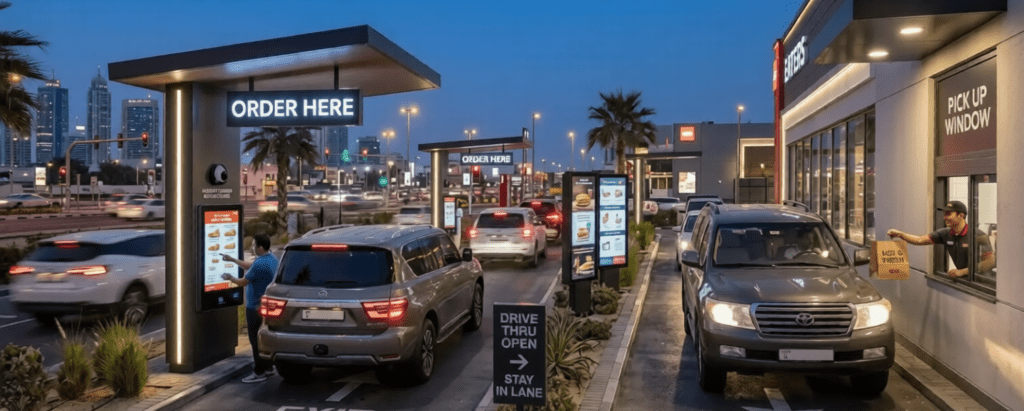
5. The Rise of Smart Drive-Thru Systems in MENA
Drive-thru systems have evolved significantly. Modern solutions are powered by:
These systems enable restaurants to handle high volumes of orders efficiently while maintaining service quality.
6. How Drive-Thru Solutions Improve Customer Experience
Speed & Efficiency : Orders are processed faster, reducing waiting time significantly.
Seamless Ordering : Digital menus and automated systems simplify the ordering process.
Higher Accuracy : Eliminates manual errors, ensuring correct orders every time.
Comfort & Safety : Customers can order from their vehicles without entering crowded spaces.
7. Introducing FAMA Technologies Drive-Thru Solutions
FAMA Technologies has emerged as a leading provider of advanced drive-thru solutions tailored specifically for the MENA market.
Their solutions are designed to address real-world challenges faced by QSR businesses.
8. How FAMA Drive-Thru Solutions Solve QSR Challenges
Smart Automation
FAMA systems automate the entire ordering process, reducing dependency on manual staff.
Seamless Integration
Integrated with POS, kitchen systems, and digital displays for smooth operations.
High-Speed Performance
Built to handle peak-hour traffic without delays.
Contactless Experience
Supports modern customer expectations for safety and convenience.
Real-Time Data Insights
Provides analytics to optimize performance and decision-making.
9. Why FAMA Stands Out in the MENA Market
Region-Specific Expertise
FAMA understands the unique challenges of the Gulf market.
Scalable Solutions
Suitable for single outlets and large QSR chains.
Reliability & Performance
Ensures consistent service even during high demand.
End-to-End Support
From installation to maintenance and upgrades.
Future-Ready Technology
Designed to evolve with changing industry trends.
10. Real-World Impact on QSR Operations
With FAMA Drive-Thru Solutions, QSRs can:
Reduce waiting time by up to 40%
Increase order accuracy
Handle higher order volumes
Improve customer satisfaction
Boost revenue growth
11. Use Case Scenario
During peak evening hours, a QSR outlet equipped with FAMA Drive-Thru experiences:
Without such systems, the same outlet may struggle with delays and customer dissatisfaction.
12. The Future of QSR in MENA
The future will be defined by:
Drive-thru solutions will play a central role in shaping this future.
Conclusion
In uncertain times, adaptability is the key to survival and growth. The QSR industry in MENA must embrace technology to overcome operational challenges and meet evolving customer expectations.
FAMA Drive-Thru Solutions offer a powerful, reliable, and scalable way to enhance customer experience while improving operational efficiency.
For QSR businesses looking to stay ahead, investing in smart drive-thru technology is no longer optional—it is essential.
Take the Next Step
Upgrade your restaurant operations with FAMA Drive-Thru Solutions and deliver the speed, convenience, and experience your customers expect—no matter the circumstances.