Introduction
Healthcare facilities across Saudi Arabia, the United Arab Emirates, Kuwait, Qatar, and Egypt are undergoing rapid transformation to address rising demands for patient safety, regulatory compliance, and operational efficiency.
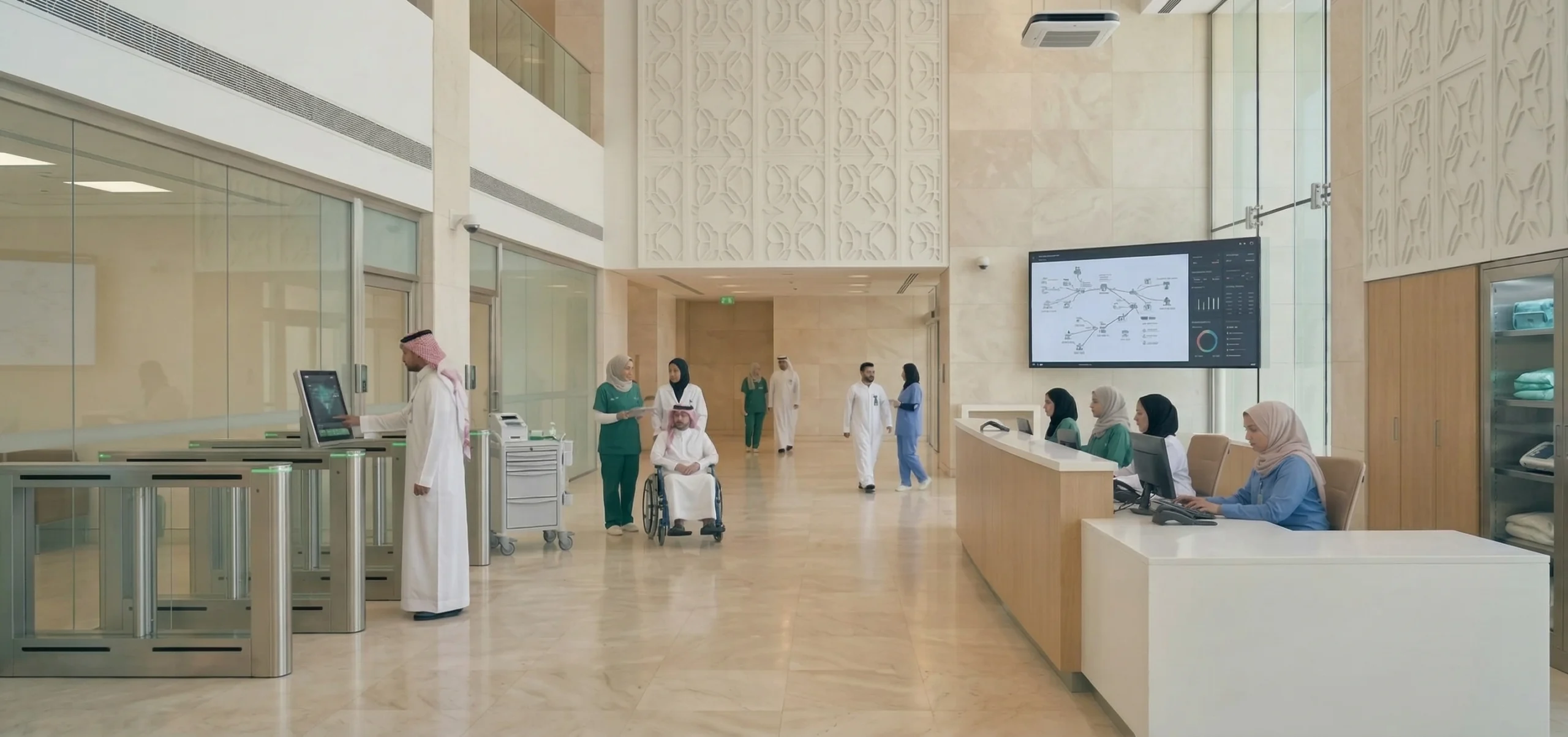
A key component of this evolution is the implementation of advanced hospital access control systems. These systems are essential not only for safeguarding patients and staff but also for securing sensitive medical equipment, pharmaceutical inventories, and critical clinical areas, ensuring that healthcare delivery remains safe, efficient, and compliant with international standards.
1. The Growing Challenge in Healthcare Security
Hospitals are complex, high-stakes environments with multiple restricted zones such as ICUs, laboratories, pharmacies, data centers, and administrative areas. Effectively managing access in these zones has become increasingly challenging.
Common security and operational issues include:
Unauthorized access to sensitive and restricted areas.
Risk of theft or misuse of medicines and high-value medical supplies.
Difficulty maintaining compliance with evolving healthcare regulations.
Inefficiencies caused by manual or outdated security systems.
In the MENA region, where regulatory requirements are becoming stricter, healthcare providers must align with key standards, including:
SIRA (Security Industry Regulatory Agency) – UAE: Mandatory for healthcare facilities in Dubai. Requires approved access control systems for staff entrances, ICUs, pharmacies, medicine storage rooms, server rooms, and other critical areas.
MOHAP Good Storage Practices – UAE: Focuses on secure, controlled access and monitoring for pharmacies and laboratories to ensure the safety and integrity of medicines and controlled substances.
HCIS (High Commission for Industrial Security) Standards – KSA: Essential for large-scale and critical healthcare projects in Saudi Arabia. Emphasizes robust physical security and access control in line with Vision 2030 smart hospital initiatives.
HIPAA-compliant Physical Security (or equivalent data protection standards): Commonly adopted by international, private, and American-affiliated hospitals in Qatar, Kuwait, and across the region to protect patient health information through strong physical safeguards.
Without modern access control systems in place, these challenges can compromise patient safety, increase operational risks, and lead to regulatory penalties.
2. The Solution: Modern Access Control Systems for Hospitals
To overcome these challenges, healthcare facilities are implementing intelligent hospital access control systems that combine automation, security, and compliance.
These systems leverage advanced technologies such as:
Biometric access control for accurate identity verification.
Touchless face recognition security to enhance hygiene and accelerate staff and patient movement.
Smart electronic locks to manage controlled entry to sensitive hospital areas.
Unlike traditional systems, modern access control solutions enable real-time monitoring, automated access permissions, and comprehensive, detailed reporting, ensuring both robust security and optimized operational efficiency and patient safety.
3. Securing Critical Areas in Healthcare Facilities
Different hospital zones require different levels of security. Advanced access control systems are designed to protect each area effectively:
ICU-Controlled Access Systems: Restrict entry to critical care units to authorized medical personnel only, ensuring patient safety and operational security.
Laboratory Access Control Solutions: Protect sensitive research and diagnostic areas, maintaining compliance and preventing unauthorized access.
Pharmacy Storage Security Systems: Safeguard controlled drugs, prevent misuse, and ensure secure inventory management.
This targeted approach minimizes security and compliance risks while maintaining smooth clinical workflows and uninterrupted patient care.
4. What FAMA Technologies Brings to Healthcare Security
FAMA Technologies delivers end-to-end healthcare security solutions across KSA and the MENA region, designed specifically for the unique needs of hospitals and medical facilities. Their approach integrates advanced technology with operational usability, ensuring security measures support, rather than disrupt, clinical workflows.
Integrated Security Solutions
Biometric and touchless facial recognition systems for staff and patient areas.
Smart electronic locks for sensitive hospital zones.
Centralized dashboards for real-time monitoring, reporting, and analytics.
Specialized Healthcare Applications
Controlled access systems for ICUs and high-dependency units.
Secure access management for laboratories and research facilities.
Robust pharmacy storage security systems to protect medications and medical supplies.
Compliance-Ready Systems
FAMA Technologies ensures all solutions meet local and international healthcare standards, including HCIS, HIPAA, MOHAP, and SIRA. This guarantees that hospitals remain secure, efficient, and audit-ready while maintaining regulatory compliance.
5. The Impact: Safer and More Efficient Healthcare Environments
Why Now? The MENA Smart Hospital Boom :
With Saudi Arabia’s smart hospital market projected to triple by 2033 and massive digital transformation underway across the GCC, advanced access control is no longer optional — it is a core component of next-generation healthcare infrastructure.
Implementing advanced access control systems delivers real, measurable benefits:
Reduced unauthorized access and security incidents.
Enhanced infection control through touchless biometric access.
Stronger regulatory compliance (HCIS, SIRA, MOHAP & HIPAA).
Faster, smoother movement for authorized staff.
Detailed audit trails for better accountability and investigations.
Significant cost savings by reducing theft and operational inefficiencies.
Improved staff productivity and visitor management.
Quick emergency lockdown and response capabilities.
Better protection of medicines, equipment, and sensitive data.
Increased patient confidence and trust.
Healthcare facilities across the MENA region can now achieve higher levels of safety, efficiency, and operational excellence while staying fully compliant.
Conclusion
As healthcare systems continue to evolve across the MENA region, the need for smarter and more secure infrastructure is becoming essential.
Hospital access control systems are no longer just an option, they are a necessity for ensuring safety, compliance, and operational excellence in modern healthcare environments.
Take the Next Step
If your goal is to enhance security, maintain compliance, and optimize operational efficiency in your healthcare facility.
Get in touch with FAMA Technologies today to explore advanced access control solutions tailored for hospitals in MENA.