Introduction
Digital Signage / Electronic Signage Display Solutions have revolutionized the way a business presents itself to its audience and has been a leading force in Digital Transformation. The invention has been a great leap towards providing a brand with a platform to get maximum exposure and visibility.
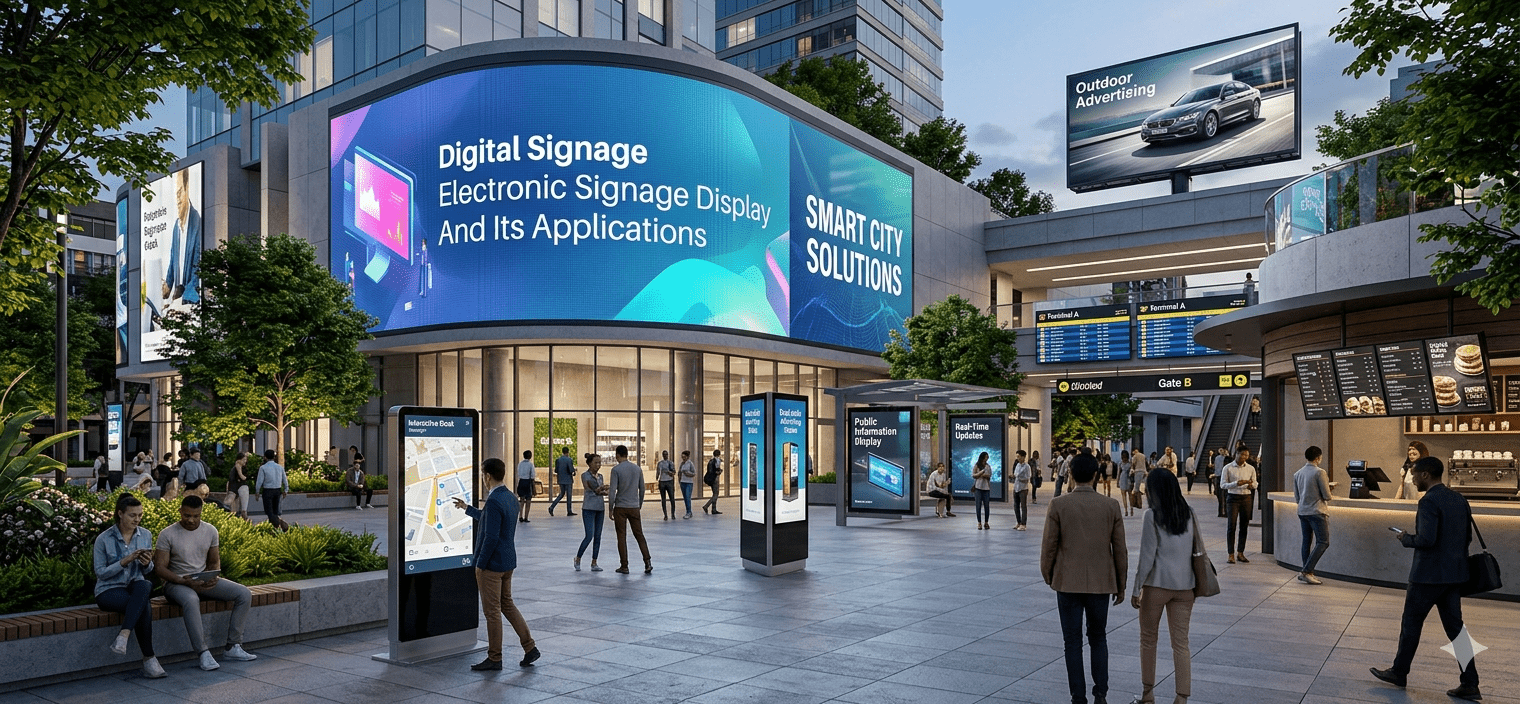
There is a spectrum of products that fall under the umbrella of Digital Signage, commonly known as Digital Menu Boards, Video Wall, Indoor Digital Signage, Outdoor Digital Signage, and so on.
Digital Signage / Electronic Signage Solutions are mostly used in Restaurants, Shopping Malls, Hospitality, Retail, Cinemas, Transport, and Education.
1. RESTAURANTS
The Digital Signage / Electronic Signage Display works in the form of a Digital Menu Board showcasing mainly the menu with different formats of promotions on a rotation basis.
2. SHOPPING MALLS
The Digital Signage/Electronic Signage as a wayfinding Kiosk with an interactive screen is replacing the traditional models at a fast pace and is being used for running various promotional activities as well.
3. RETAIL
Retail say a supermarket, digital signage/Electronic Signage as an interactive kiosk can help customers find information on various selling items, including the location within the premises.
4. CINEMAS
In cinemas, the digital signage/Electronic Signage display takes the shape of a ticketing kiosk and has proved to be a great comforter to moviegoers who can avoid long queues and collect their tickets in a very short span of time.
Similarly, the Transport sector is increasingly using Digital Signage as a wayfinding and promotional tool.
Finally, In Education, Digital Signage can be used as a Digital Menu Board in cafeterias and as an informational & promotional tool inside schools or university campuses and so on.
Every Digital Signage solution consists of 2 basic architect elements – Hardware and software. The Hardware mainly comprises an HD screen which might be encased in a temperature & weatherproof casing as in Outdoor Digital Signage.
Software must be scalable enough to adapt as per the need. The choice of both Hardware and Software determines the productivity of the solution. Hence, thorough research is absolutely crucial before zeroing in on one.
5. Cost-effective
In the long run, digital signage is more cost-effective than traditional methods of advertising. While the initial cost of purchasing and installing digital signs may be higher, the cost of maintaining and updating them is significantly lower. Additionally, digital signs have a longer lifespan and can be used for several years without needing to be replaced.
6. Self-check-ins and check-outs
Self-check-in and check-out systems can also be integrated with digital signage to create an even more efficient and convenient experience for guests. By using digital signs, guests can be guided through the check-in and check-out process and provided with real-time information about available rooms and amenities.
One of the main benefits of using digital signage for self-check-in and check-out is the ability to provide guests with a seamless and intuitive experience. For example, digital signs can be used to display step-by-step instructions for using the self-check-in kiosk or mobile app, making it easy for guests to complete the process quickly and efficiently.
Additionally, digital signs can be used to display real-time information about available rooms, such as room number, occupancy status, and amenities, allowing guests to make an informed decision when choosing a room.
Digital signage can also be used to enhance the security of self-check-in and check-out systems. For example, by displaying the guest’s names and room numbers on a digital sign, front desk staff can easily confirm the identity of guests who are checking in or out. Additionally, digital signs can be used to display security alerts and notifications, such as suspicious activity or potential security breaches, which can help to ensure the safety and security of guests and staff.
Furthermore, digital signage can also be used to improve the efficiency of the check-in and check-out process. For example, by using digital signs to display real-time information about the occupancy status of rooms, front desk staff can quickly and easily assign rooms to guests, reducing wait times and improving overall efficiency.
In conclusion, by integrating digital signage with self-check-in and check-out systems, hotels, resorts, and other types of lodging can provide guests with a more efficient and convenient experience. Digital signs can be used to guide guests through the check-in and check-out process, provide real-time information about available rooms and amenities, enhance security and improve the overall efficiency of the process.
7. Scheduled Content
One of the key benefits of digital signage is the ability to schedule content. This feature allows businesses to plan and schedule their content in advance, ensuring that the right message is displayed at the right time and in the right place.
Scheduling content in digital signage can be done through a content management system (CMS), which is usually provided by the digital signage software. This system allows businesses to create and schedule content, such as images, videos, and text, to be displayed on one or multiple digital signs. The CMS typically has a user-friendly interface that allows for easy scheduling and management of content.
For example, a retail store can schedule different content to be displayed on their digital signs during different times of the day. During the morning, the store can display content promoting its breakfast menu, and in the evening, it can schedule content promoting its dinner specials. Additionally, the store can schedule different content to be displayed on different digital signs located in different parts of the store, such as promoting specific products or services in the relevant department.
Scheduling content in digital signage can also be used to target specific audiences. For example, a sporting goods store can schedule different content to be displayed on their digital signs during different times of the day, targeting different demographics such as kids during the morning and adults in the evening.
Another benefit of scheduling content in digital signage is that it allows businesses to plan and organize their content in advance. This can be useful for businesses that have a lot of content to display, and it allows them to ensure that the right message is being delivered at the right time. It can also help to save time and resources, as the content can be scheduled in advance, reducing the need for manual updates.
In conclusion, scheduling content in digital signage is a powerful feature that allows businesses to plan and organize their content in advance, ensuring that the right message is displayed at the right time and in the right place. This feature can be used to target specific audiences, and it can help to save time and resources by allowing businesses to schedule content in advance.
8. Real-time Updates
Digital signs can be updated in real-time, allowing you to quickly respond to changing market conditions or customer demands. For example, if a sale is about to end or a new product is about to launch, a digital sign can be updated in real-time to reflect this, ensuring customers are always aware of the latest offers and promotions.
9. Targeted Messaging
Digital signs can be used to deliver targeted messaging to specific audiences, such as promoting specific products to specific demographics. For example, a digital sign in a mall could display different content for different times of the day, such as targeting families with children during the day and young adults in the evening.
10. Increased ROI
Digital signs can increase your return on investment by reaching more customers and generating more sales. By displaying targeted messaging and interactive content, digital signs can help to attract more customers and encourage them to make a purchase. Additionally, digital signs can help to improve the customer experience, which can lead to increased customer loyalty and repeat business.
Conclusion
Digital signage refers to the use of electronic displays to communicate information, promote products or services, or provide direction in public spaces. It is a form of out-of-home advertising that allows businesses and organizations to reach their target audience dynamically and interactively.
Digital signs can be found in various settings such as retail stores, transportation hubs, and corporate buildings. The signs can display a variety of content, such as videos, images, text, and web pages, and can be updated and controlled remotely. Digital signage solutions often include hardware such as LCD and LED displays, interactive kiosks, and digital menu boards, as well as software for creating and managing content.